I love slow travel and I wouldn’t recommend trying to see any city in 15 minutes, let alone one like Samarkand, that not only is one of the oldest cities in Central Asia, it’s famous the world over for its Silk Road history.
But sometimes life doesn’t work out the way you want it to, so on my first visit to Samarkand in 18 years — I was unable to get a visa for many years — I ended up whizzing round the fabulous Registan square and its three iconic medressas in just a quarter of an hour.
I came back to Samarkand as part of a press tour (nothing to do with tourism), but a visit to the fabled Silk Road city was scheduled on the final afternoon, before I had to travel back to Tashkent for a flight in the early hours of the morning.
What got in the way of those plans was some of Central Asia’s famously generous hospitality. The day started with tours of two power stations close to the city of Navoi. Instead of leaving promptly, we were treated to a lavish banquet, at a table almost groaning under the weight of the seasonal produce, and complete with local wines and imported whisky.
Well fed and lubricated, we made the three-hour bus journey upstream along the Zerafshan river to Samakand, arriving in the early afternoon — just in time for our equally lavish second lunch.
Lunch completed, we staggered into an air conditioned bus for a tour of the city. At that time I was expecting to stay in Samarkand until nine, when I would be driven back to Tashkent.
A whirlwind visit to the Silk Road city
A single afternoon already seemed too short a time to revisit Samarkand, a city whose tall minarets once guided travellers across the desert on their journeys between China and Europe.
Captured through the centuries by Persians, Greeks, Turks, Mongols and others, it is now the second-largest city in 21st century Uzbekistan. It was added to UNESCO’s World Heritage List in 2001.
When we arrived, I saw the roads surrounding the historic centre, while just as fast and busy as I remembered are now lined with two- and three-storey buildings (many of them still under construction).
An official from the local government told me that UNESCO has helped with the renovation of the historic heart of the city. The low-rise buildings are an attempt to stay in keeping with the historic look of the city, rather than dwarfing the medressas and other monuments with high-rises.
I was eager to start sightseeing, but instead, an equally lavish second lunch was next on the agenda. Uzbek food is delicious, so I could hardly complain, and an hour or so later the tour started at the Amir Temur Mausoleum Gur-i Amir Сomplex, where the legendary warrior and ruler Amir Temur (also known as Tamerlane) is buried, along with his sons and grandsons. Gur-i Amir means ‘Tomb of the King’ in Persian.
A glimpse into history
The earliest part of the complex, of which only the foundations, entrance and part of one minaret remain, is the first thing you see when entering the complex. Construction of that part began back in the 14th century.
Ahead is the main building of the mausoleum, with its single azure dome and terracotta brick walls decorated with blue and white tiles.
Inside, the high ceilinged chamber is stunningly decorated with tiles that glitter and gleam in the light. Other parts of the walls are decorated with painted plaster.
Temur’s remains lie in a tomb in the chamber. Legend has it that anyone who opens the tomb will be cursed. Soviet scientists ignored this in the early 1940s, and Mikhail Mikhaylovich Gerasimov opened the tomb on 20 June 1941; two days later the Nazis invaded the Soviet Union in Operation Barbarossa.
After the war, an extensive restoration started, both inside and out. By that time, many of the majolica tiles had fallen off. After Uzbekistan became independent in 1991, and the government looked to historic heroes like Tamerlane to help instil national pride in the newly independent country, efforts to preserve the mausoleum were stepped up.
Nearby is the smaller 14th century Ruhabad mausoleum, best known because it is believed to hold a hair of the Islamic prophet Muhammed.
A mosque stands next to the one-story madrasah, which sells traditional Uzbek crafts.
Speedy exit
After the visit to the Amir Temur Mausoleum Gur-i Amir Сomplex, we moved on to the central market. There, one of the organisers surprised me by handing over a ticket … for a train due to leave Samarkand station for Tashkent in just over an hour’s time.
This was unexpected, not least because I’d been expecting to return to Tashkent by road. Coming all the way to Samarkand and not revisiting Registan Square was unthinkable. I begged the organisers to call a taxi immediately, and take a detour via the Registan, and they kindly agreed.
It turned out that the market was not far from the Registan, so I set off with one of the organisers deputed to take me to the station.
Nearby were some small tourist trains, which took us through the central part of the old city to the top of the hill overlooking the Registan.
Peace in the city
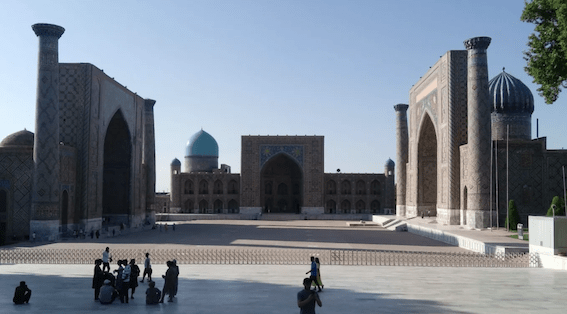
A feeling of great peace came over me as we looked across to the three medressas with their intricately decorated arches, azure domes and towering minarets.
I remembered Samarkand being noisy and full of zooming cars, in contrast to the peaceful old town of Bukhara, but only pedestrians were walking in front of Registan Square, and there was no road between us and the medressas, just a grassy bank and the paved expanse of the square.
(I’d love to have compared Samarkand in 2004 to Samarkand in 2022, but unfortunately my laptop was stolen shortly after I returned to London in 2004, and I lost most of my photos.)
Just looking down on the Registan as the shadows cast by the medressas started to lengthen in the evening sun would have been enough, but the organiser decided we had just enough time to whiz around it.
Tickets purchased, we shot in and out of the museum area in the Ulugh Bek Medressa to the left
The square, I believe, had been repaved in the 18 years since my last visit, and it was clear there had been a lot of restoration works on the decorative tiles of the medressas.
The square dates back to the 14th century and used to house markets for local merchants and silk road travellers.
The Ulugh Bek Medressa is by far the oldest of the three, having been built 1417–1420.
It was named after Ulugh Beg, Temur’s mathematician grandson, who delivered lectures there when it was a centre for learning for around 200 students.
Directly ahead, looking across at the square, is the Tilla-Kari
Medressa, built more than two centuries later, in 1646-1660. The name means ‘gilded’ in Persian. As well as a mosque it was also a residential college for students.
The large inner is surrounded by the students’ dormitories. Stalls selling silks, ceramics and other handicrafts are set up in the courtyards.
When we visited in 2004, loudspeakers were blaring out the hits of the time; 18 years later it was so quiet we could hear the birds signing.
The third madrasah, the Sherdor Madrassah is on the right of the square, opposite the Ulug bek Medressea. Commissioned, like the Tillya-Kori Madrasah by the then ruler of Samarkand, Yalangtush Bakhodur, in the 17th century, it was completed in 1636.
We continued our high-speed dash around, while I tried to soak up the atmosphere, even if i didn’t have time to linger over the details.
On the way home
A few minutes later I was in a taxi, on the first part of my long journey home. The entire visit to the Registan and its three medressas had taken just under 15 minutes.
I haven’t attempted to write any time of guide to Samarkand and its iconic monuments in this post, as my visit was so ridiculously quick. However, I did think it was worth writing up because it brought up some thoughts for me about fast and slow travel.
Pre-motherhood I embraced slow travel. I used to take epic meandering journeys across Central Asia or Eastern Europe, getting about by trains, buses or shared taxis. I often had the luxury of lingering when I wanted to or taking spontaneous side trips. (That would be even easier these days when wifi is everywhere; it wasn’t back then so I couldn’t always do my job on the road.)
I even used to travel slow as a child because both my parents were teachers, which meant long summer holidays when we could take leisurely drives down through France and Spain, pitching our tent or staying the night at hotels wherever we chose.
These days, however, I have a full time job, a child at primary school, a mortgage, two guinea pigs… a whole set of responsibilities that mean I no longer have the luxury of truly slow travel. Everything is planned, and crammed into the few weeks of holiday I have each year.
Is it still worth travelling? Absolutely. But it’s required a big change in mindset, and some scaling back of my travel dreams.
I’d love to hear readers’ thoughts on fast and slow travel. And, if you’re a slow traveller at heart, how have you made fast travel work for you?
More posts about Uzbekistan
Why Navoi, Uzbekistan is worth a visit
 Steppe in Style
Leave a comment