I put together this handy guide to historical sites in and around Saranda.
For a city with a long history — settlement in the Saranda area dates back centuries — Saranda is by and large a modern city, where concrete hotels, villas and apartment blocks have mushroomed densely around the bay.
There are a few exceptions of course, like the ruins of the ancient synagogue and basilica right in the centre, the old Customs House that is now home to the Museum of Traditions and — for those interested in the more recent communist-era history — several Cold War bunkers on patches of waste land around town.
Yet there are many historical sites in and around Saranda; the hills that tower steeply above the town are dotted with castles, monasteries and other historic sites, not to mention the Unesco World Heritage site at nearby Butrint.
A guide to historical sites in and around Saranda
Downtown Saranda
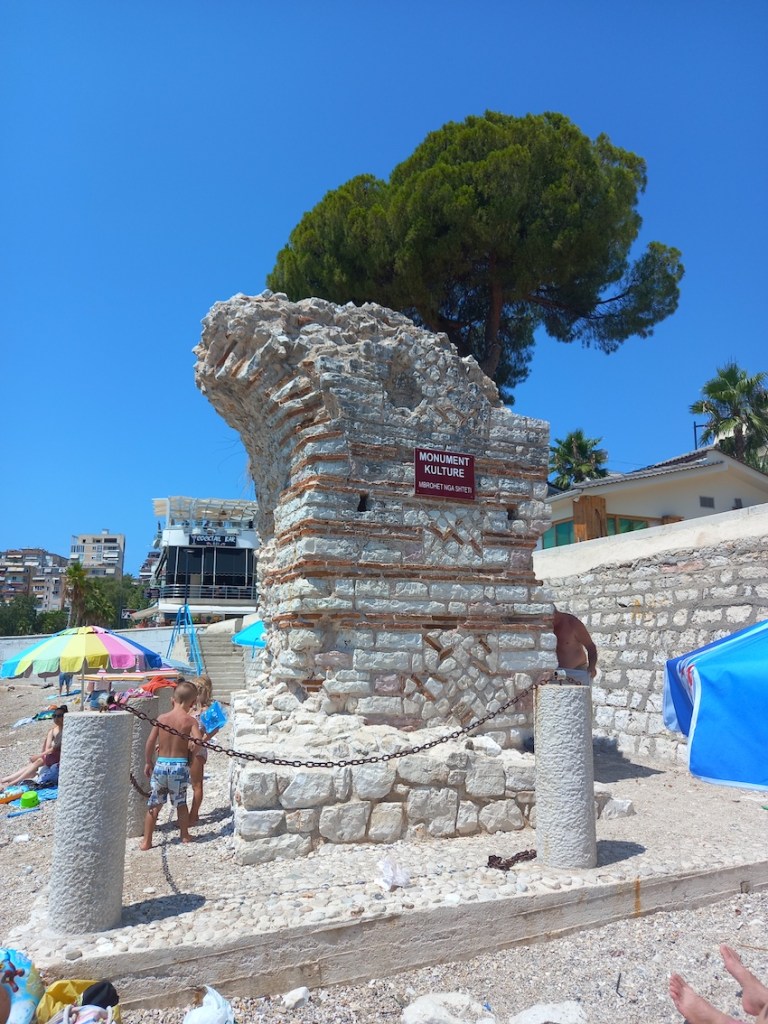
1. Onhezmus city walls
Very little of the fortified walls of ancient Onhezmus (now Saranda) have survived but there’s one fragment on City Beach and another inside the restaurant of Hotel Republika along with a small exhibition of archaeological finds.
The old city, Onchesmus, was a port town in the region of Chaonia in ancient Epirus. The city was home to the Greek-speaking tribe of the Chaonians.
Onchesmus served as the port for the nearby Chaonian capital of Phoenice, now Finiq. The city was important during the time of Cicero and was a common departure point for travel from Epirus to Italy.
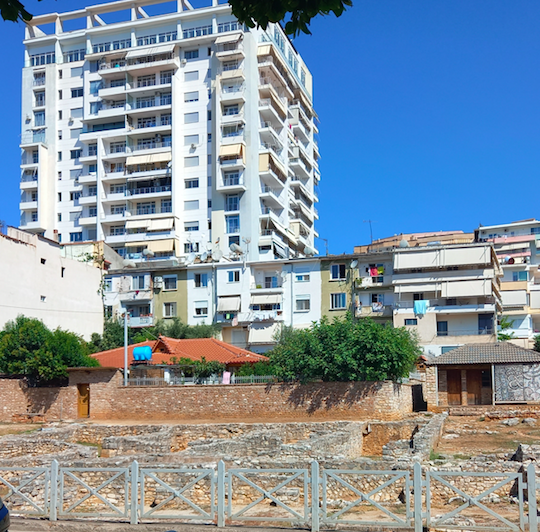
2. Synagogue and basilica
The excavated ruins of what was once a Christian basilica and later turned into a synagogue lie in the heart of Saranda. Excavations started in the communist era and have since continued.
The remains of a 5th or 6th century AD synagogue have been uncovered, at what used to be the centre of a wealthy Jewish community.
Archaeologists have been digging for decades. They first started back in the 80s when Albania was under communist rule. But it wasn’t until more recent excavations by the Albanian Academy of Sciences and the Hebrew University Institute of Archaeology that major discoveries were made.
The synagogue is believed to have been a community meeting place and school as well as religious centre. Later it was converted into a Christian church.
No one knows for sure what caused the destruction of the buildings, but some say it was an earthquake and others say it was destroyed by a Slavic invasion.
The most interesting thing to see is the mosaic floor, decorated with Jewish symbols on it such as a ram’s horn, a menorah, and an etrog. Other mosaic pavements show animals, trees, and biblical symbols. The excavators also found some other mosaic pavements that pre-date the building of the synagogue.
The archaeologists are planning to keep digging in the coming years to uncover more of the synagogue that’s still buried under modern buildings and streets.
3. Saranda Museum of Archaeology
The Museum of Archaeology, located in the heart of Saranda, is a small, single-room facility dedicated to showcasing the rich history of the area.
The main feature of the museum is a 6th century mosaic floor, which was discovered during the construction of a post office and is believed to have once been the floor of a basilica. The museum was specifically built to protect and display this unique artefact.
In addition to the mosaic floor, the museum has information about nearby Butrint, Phoenice and the Islamic buildings in Delvina. It houses other archaeological objects that have been discovered in and around Saranda, such as columns, vases and pottery.
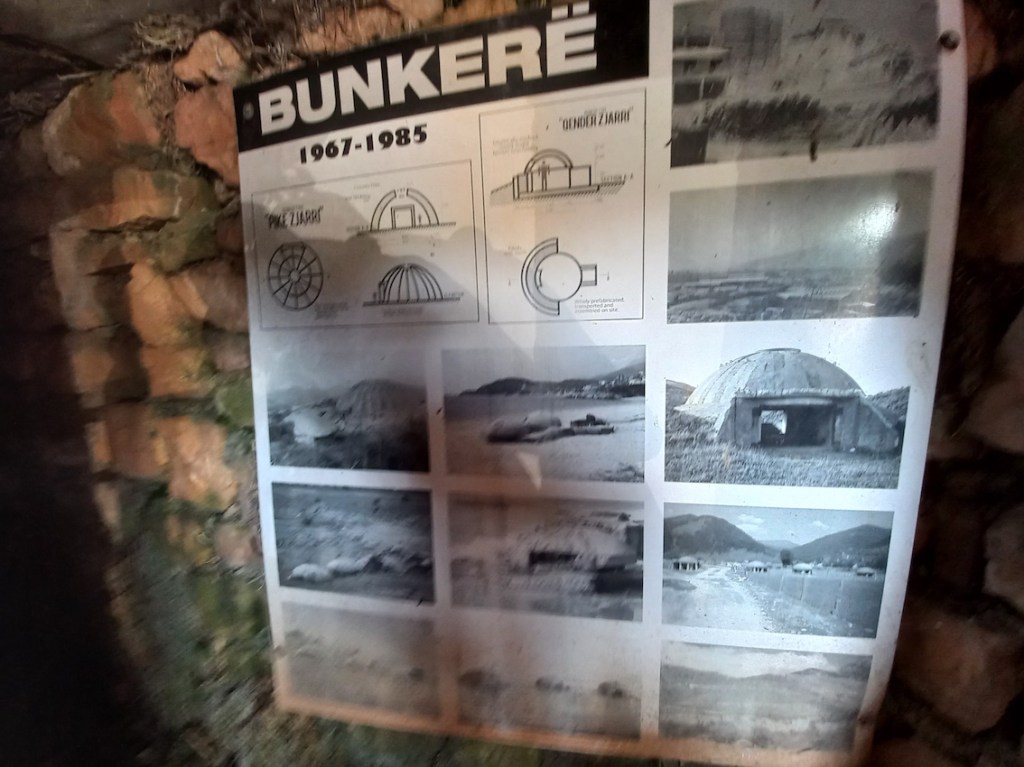
4. Memorje 78
One of the thousands of concrete bunkers built during the Cold War, Memorje 78 is open to visitors (though strewn with litter) and has a small display of pictures.
In Albania, it’s common to see concrete military bunkers. On average, there are about 5.7 bunkers for every square kilometre.
These bunkers were built during the communist government of Enver Hoxha from the 1960s to the 1980s. The government wanted to fortify the country and built over 750,000 bunkers. However, the bunkers were never used for their intended purpose.
The bunkers were made of concrete, steel, and iron. They came in different sizes, from small one or two-person bunkers to large underground shelters. The most common type is a small concrete dome that is just big enough for one or two people to stand in.
After the communist regime ended in 1992, the bunkers were abandoned. Most are now empty and not in use, though some have been repurposed for different things, like homes, cafes and animal shelters.
5. Museum of Traditions
Saranda’s old Customs House houses the Museum of Traditions, with displays of artefacts and old photographs illustrating the history of Saranda.
Located in the historic Customs House, the museum features a collection of photographs, ethnographic relics, and everyday objects.
The exhibition begins with a sketch from the 19th century British poet and artist Edward Lear and a 1930 photograph that illustrates the changes that have occurred in the city in a relatively short period.
Visitors can also see photographs of the Monastery of 40 Saints from before its destruction during World War II, and a collection of ethnographic objects illustrating everyday life through the ages, such as musical instruments, traditional clothing, and household objects.
The second floor has a small exhibition of old photographs, sketches, and photos of cultural events.
3-5km away
6. Monastery Of 40 Saints
Built in the 6th century, the Monastery Of 40 Saints was named after the Forty Martyrs of Sebaste — 40 Roman soldiers who were executed after refusing to renounce their Christian faith.
The saints gave the modern city of Saranda its name; it was named Agi Saranda, 40 saints in Greek, which was then shortened to Saranda.
Built during the 6th century AD, it was an important pilgrimage site for over a millennium. The complex featured a basilica church, hostels, underground chambers, holy water springs, and crypts. The underground rooms had forty small chapels, each dedicated to one of the Forty Martyrs of Sebaste.
The monastery was destroyed during the Ottoman conquest and again during the Second World War. In the 1950s, the communist government demolished the remaining structures and turned it into a military base.
Today, only parts of the side walls of the church remain, but it still holds religious significance for the local Greek Orthodox population and is visited by pilgrims.
7. Lekuresi Castle
Poised atop Lekursi Hill and overlooking Saranda, Lekuresi Castle offers another fantastic view of the city. It was built in 1537 by the Ottoman emperor Sultan Suleiman the Magnificent to enable his attack on Corfu.
The castle was built for strategic reasons, as it offered protection against the Venetians and controlled the harbour and Saranda-Butrint road. It was home to a garrison of around 200 soldiers. The castle was abandoned after it was raided in the 18th century by Ali Pasha of Tepelena and has been abandoned since 1878.
The castle is square in shape with two round towers located in diagonal corners. The southeast tower, located next to the entrance, is the best preserved and stands at 7 metres tall. The walls of the castle are made of limestone and are 2 metres thick and also reach up to 7 metres high in places.
Visitors can still find the remains of the old village of Lëkurës, close to the back entrance to the castle. At the entrance gate, there are also 20th century artillery on display. Additionally, there are many cold war bunkers on the nearby hillsides.
The castle now houses a restaurant with outdoor terrace.
6-10 km away
8. Phoenice Archaeological Park
Phoenice Archaeological Park is the remains of an ancient Greek city, parts of which date back to the 5th century BC, near the village of Finiq.
The excavation site was once the capital of the Greek tribe of the Chaonians and was the wealthiest city in the region of Epirus.
Phoenice was strategically located and economically developed, making it an important political and administrative centre. The first structures at the site date back to the 5th century BC when an acropolis was built to house public buildings. In the following century, fortifications were extended and defensive walls up to 3.6 metres thick.
The city was also where the the Treaty of Phoenice, which ended the First Macedonian War in 205 BC, was signed.
During the early Byzantine period, Phoenice was the seat of a bishopric and more religious buildings were constructed, including a baptistery and basilica.
However, after the 6th century, the city declined and the urban centre was moved to nearby Mesopotam.
9. St George’s Monastery
St George’s Monastery comprises a walled complex with a 14th century church (later reconstructed), overlooking the Ionian sea.
The monastery is perched on the hill of Dema, providing breathtaking views of the Ionian Sea on one side and the Butrint Lake on the other.
The nearby Monastery Beach, one of the most beautiful beaches in Saranda, is located just down the hill from the monastery.
10. Monastery of St Mary, Kakome
The Monastery of Saint Mary’s was built in the 16th-17th century and was since abandoned. The ruins are located on a hill above Kakome Bay.
The complex comprises a tower, a two-story building, and a central church dedicated to Saint Mary. The dome-shaped church was constructed during the 16th-17th century and later expanded and reinforced in the 18th century.
10-15 km away
11. Gjin Aleksi Mosque
The 15 century Gjin Aleksi Mosque is notable for the casks placed in holes in its walls that give it an exceptionally high quality of acoustics.
It was built by the Grand vizier of the Ottoman Empire in 1592, on the ruins of a byzantine church.
12. Ali Pasha’s Castle
The ruins of Ali Pasha’s Castle stand at the entrance to the Vivari Channel at the Butrint National Park. It was built by the Venetians but changed hands many times, and is now named after Ottoman ruler Ali Pasha of Tepelene, who rebuilt it in the early 19th century.
The castle has a long history. When it was originally built by the Venetians in the late 15th or early 16th century, it served as a stronghold to control the fishing, grazing, olives and timber industries in the area around Butrint.
The castle was the centre of many conflicts with the Ottoman Empire and changed hands several times. In 1798, French soldiers destroyed the castle to prevent it from falling into Ottoman hands.
Despite this, Ali Pasha took control of the structure around 1804 and made several defensive improvements, including the installation of gun batteries. Its main role is believed to be have been to control access to Butrint from the sea.
16-20 km away
13. Martyrs’ Cemetery of Delvina
The town of Delvina, with a population of just over 7,500, lies in mountainous countryside 16 km northeast of Saranda. In the town itself, next to the orthodox church, is the Martyrs’ Cemetery of Delvina, where those killed in the Second World War are remembered.
Delvina is located on a mountain slope, and has a variety of religious buildings illustrating its diverse population over the centuries, including a mosque, Catholic church, Protestant church and Orthodox church.
The town has a history of changing hands between different groups and a mix of different cultures and languages. Today, the majority of the population is Albanian, with a significant Greek minority.
14. Delvina Castle
Attractions around the town include the ruins of Delvina Castle on a nearby hilltop, flanked by Cold War bunkers.
Delvina Castle is believed to have been built in late antiquity, but it is unclear when exactly it was constructed. The castle was rebuilt and restored in the 11th and 12th centuries, and it reached its full extent in the 13th and 14th centuries.
Today, there is not much left of the castle, except for some fortification walls and the walls of a mosque dating back to the Ottoman period.
According to the memoirs of the Ottoman traveler Evliya Çelebi, who visited Delvina in 1670, the castle had both an ammunition depot and a mosque.
The castle is located on a rocky ridge and is elongated in shape, with an area of 0.17 hectares. The east side of the castle is protected by two rows of walls. It has three turret towers and an entrance on the north side.
The castle currently needs restoration and clearing from vegetation. The south wall of the west and part of the north wall are built on steep cliffs, using the natural protection provided by the terrain.
14. King Mosque
The Xhemahalle Complex, including the King Mosque, dates back to 1682 and is now in ruins but it was built with a complex hydraulic system feeding the hammam as well as the madrasa and mosque.
The complex is located among cypress trees and is currently undergoing restoration.
The mosque is believed to be the first mosque built in Albania. The hammam is also the only one of its kind in Albania.
16. Monastery of Kamena
The Monastery of Kamena, 2km from Delvina, comprises a monastery and church partway up Mount Sopot that is believed to date from 630, though it was later reconstructed.
The beautiful 10th century monastery was built by the Albanian Orthodox Church in the 16th century.
17. Monastery of St Mary, Kostar
The Monastery of Saint Mary, located in the small village of Kostar, is perched on the edge of a steep cliff.
The structure, which was crafted out of the rock it stands upon, offers breathtaking views of the surrounding valley and nearby towns.
Its history dates back to 1332, with expansions carried out between 1690-1770. Despite its age, the interior still is adorned with intricate wall paintings and elegant wooden furnishings.
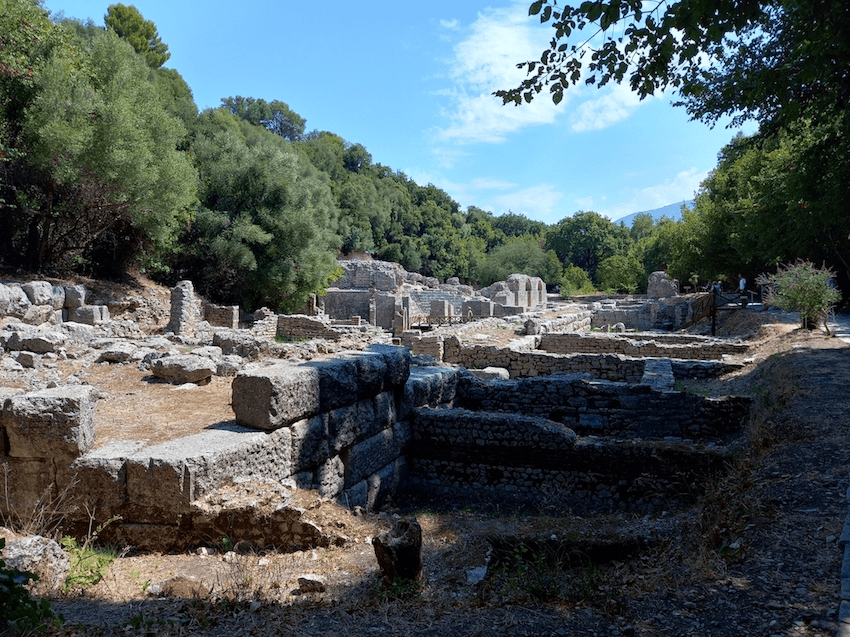
18. Butrint National Park and Unesco World Heritage site
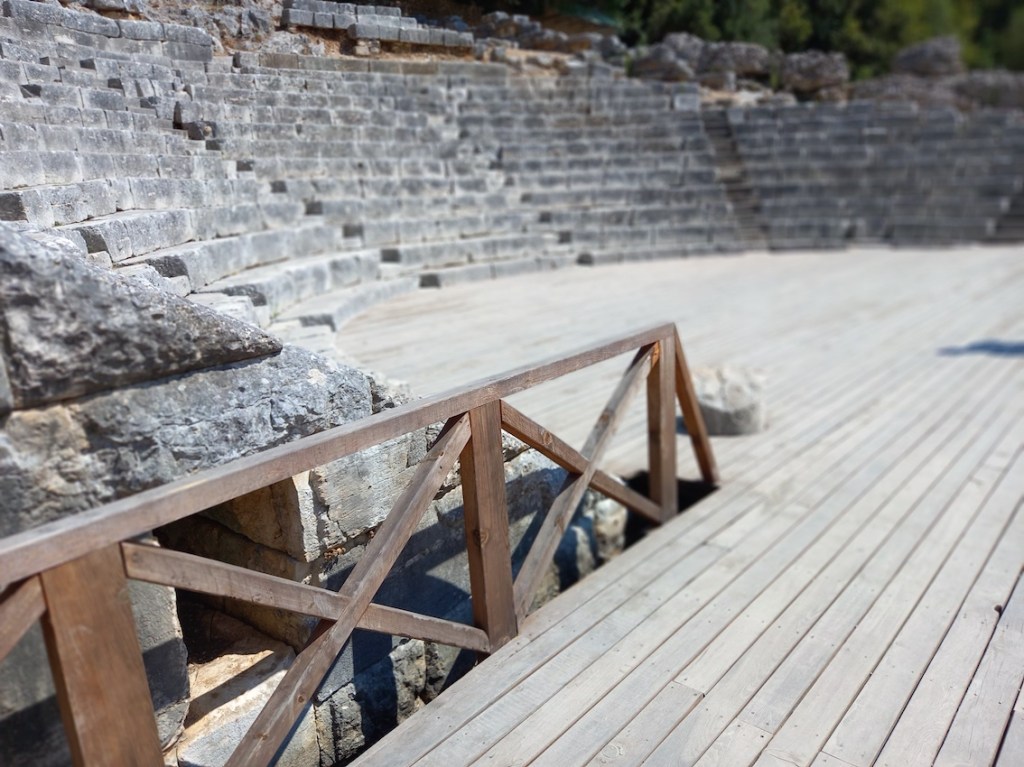
Butrint is an ancient city located in southern Albania, about 20km from Saranda. It has a rich history dating back to prehistoric times, and has been inhabited by Greeks, Romans, and Christians throughout the centuries.
The city was once prosperous under Byzantine rule, but was later abandoned due to marshland formation. Today, the archaeological site is a collection of ruins from each period of the city’s development.
What makes Butrint unique is the combination of archaeology, monuments and nature, as well as the lack of aggressive development seen around many other historic sites in the region.
Butrint has a variety of historical sites, ranging from prehistoric evidence to the 19th century. The city was heavily influenced by Greek culture and was settled by Chaonian tribes before becoming a Roman colony in 44 BC. In the 5th century, Butrint became an Episcopal centre and was fortified with early Christian structures.
After being abandoned for a time, the city was reconstructed under Byzantine control in the 9th century. It was later controlled by the Angevins and Venetians before being conquered by the Ottomans. The fortifications at Butrint are a testament to the different stages of construction throughout its history.
Some of the notable ancient monuments include the well-preserved theatre, and from the paleo-Christian era, the baptistery with its mosaic floor decoration. The paleo-Christian basilica, rebuilt in the 9th century, also offers a glimpse into the city’s past.
Let me know which are your favourite historical sites in and around Saranda – and if there are any good ones I missed out!
More about Saranda
Corfu and Saranda: close but long divided
8 fun city beaches along the Adriatic and Ionian coasts
My 12 item capsule wardrobe for Corfu and Saranda
 Steppe in Style
Leave a comment