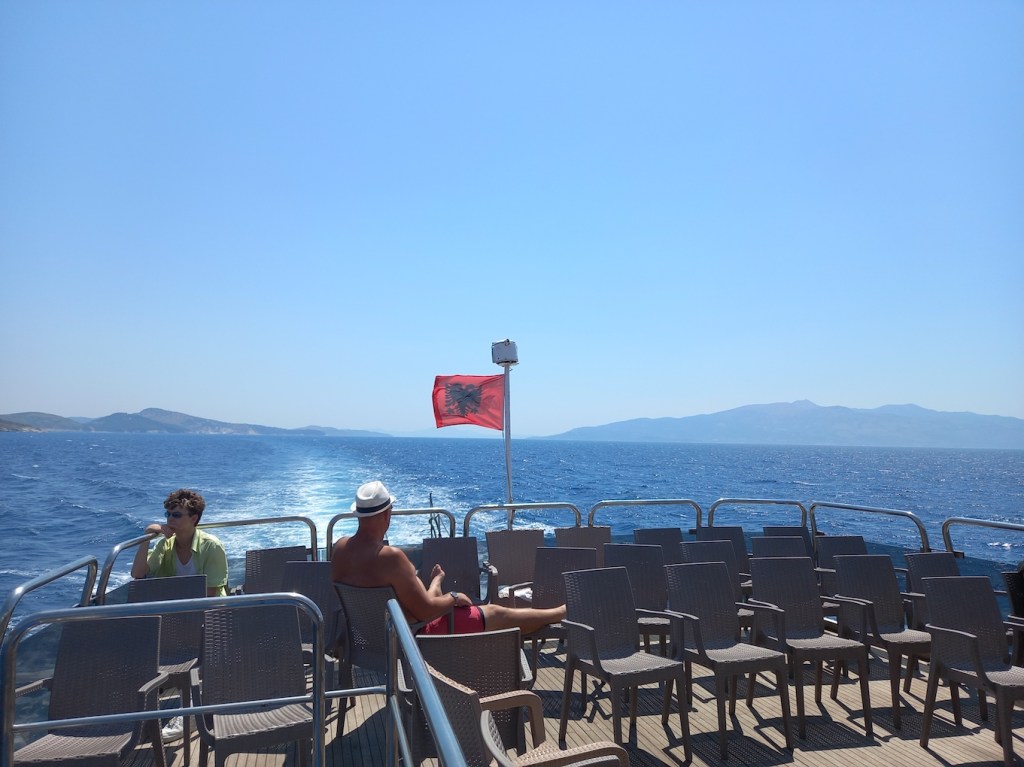
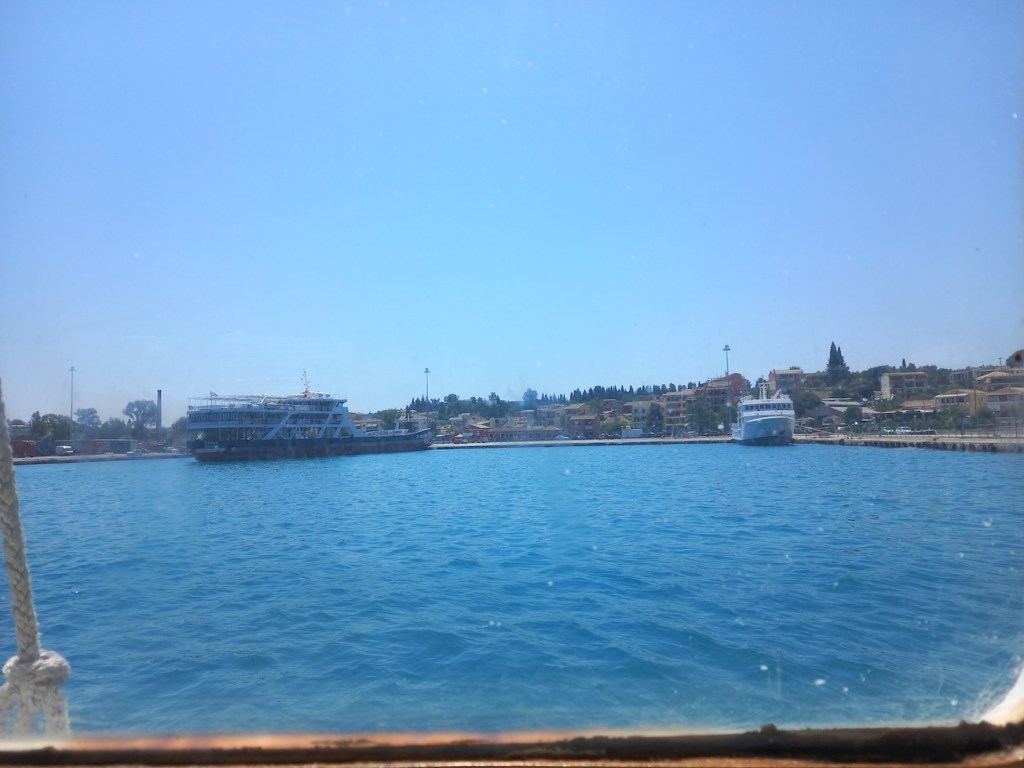
Just 35 years ago, the journey we are about to take would have been impossible. We’re sitting in a ferry at Corfu Port, waiting for it to take us the hour-long ride — only 30 minutes by hydrofoil — across the Straits of Corfu to Saranda, Albania.
Well beyond the scheduled departure time, the cream leather armchairs and banquettes on our deck are still filling up with people. There are Albanians heading home with bags of shopping, several young European couples and right next to us an English family with three teenage children.
They, like us, would have been unable to make this short journey between Corfu and Saranda before the end of the Cold War, when Albania was almost completely closed off to the West and the small stretch of water we’e about to cross was one of the earliest flashpoints in the 45-year standoff between East and West.
Barely a year after the end of the Second World War, when the world was redividing into the East and West camps, Albania opened fire on two British warships, HMS Orion and HMS Superb, on 15 May 1946. The ships were crossing the channel after clearing it of German mines, but hadn’t asked permission from Tirana to enter Albanian waters.
While there were no damage or casualties, it angered the British side. London demanded an immediate apology from the Albanian government, but the Albanian side refused, arguing that the British ships were in Albanian territorial waters without prior notification. The verdict went against Albania, and a large amount of Albanian government treasury gold was confiscated by the British.
Recollections of the straits
It’s my first time in Corfu and I only visited Albania for the first time as an adult, in 2007 — my parents having an unaccountable preference for holidaying in the south of France rather than the former Eastern Bloc countries when I was a child.
But I’ve read plenty of accounts of people visiting Corfu and being intrigued (and perhaps intimidated) by the looming mountains of Albania less than 2km away.
One BBC correspondent took the same journey as we’re about to take in 2013, and recalled visiting the northeast coast of Corfu over a period of 30 years, when he looked across at Albania’s “bare coastline and forbidding mountains” which “seemed to represent the isolation of the country”. He recalled the Straits of Corfu being “raked by Albanian searchlights trying to catch those desperate enough to risk a night-time swim, or a paddle in the inner tube of a car tyre to escape its hunger and brutality.”
Long before that, the author and naturalist Gerald Durrell wrote in “My Family and Other Animals” of seeing the “distant coastline of Albania … dimly outlined by a faint reddish glow in the sky”. In one episode of The Durrells, that dramatised the family’s years in Corfu from 1936-39, the eldest son Larry (the writer Lawrence Durrell) dozes off in a boat and drifts towards the Albanian coast — despite warnings of the dangers from his mother.
But the first many westerners saw of Albanians was the distressing images of hundreds of thousands of desperate people trying to force their way onto ships bound for Italy immediately after the collapse of communism. After decades of isolation, even from most fellow communist countries, Albania was one of the poorest countries in Europe.
Cities with long histories
Like the rest of the Mediterranean region, cities of Corfu Town and Saranda have long histories, and have seen Greek, Roman and other invaders.
We saw the Old Fortress when we walked to the seafront Esplanade the night we arrived in Corfu (though my daughter was more interested in an open air showing of Encanto). It’s built on a small island on the eastern end of Corfu Town, accessed via a bridge.
Inside, the fortress tells the story of Corfu’s occupiers: construction started when it was under Byzantine control, and continued under the Venetians. Just after the bridge, there’s a statue of Commander Schulenburg, put up by the Venetians to remember the battle against the Ottomans. But there’s also the English-built St. George Church.
The much bigger New Fortress looms above the port. It’s not really new; it was built 1576 and 1645, though it was partly destroyed in the Second World War.
Saranda is partly famous for the nearby Roman and Venetian ruins at Butrint, but settlements in Saranda itself date back several millennia. There is a legend that the inhabitants of Saranda in ancient times were descended from the Greek hero, Achilles.
The old name of the Albanian city is Agii Saranda, after the 40 Christian monks and soldiers who were killed by the Ottomans for refusing to change their religion, and were made saints. Agii Saranda is derived from two Greek words, Agii meaning Saints and Saranda meaning 40.
Albania’s concrete coast
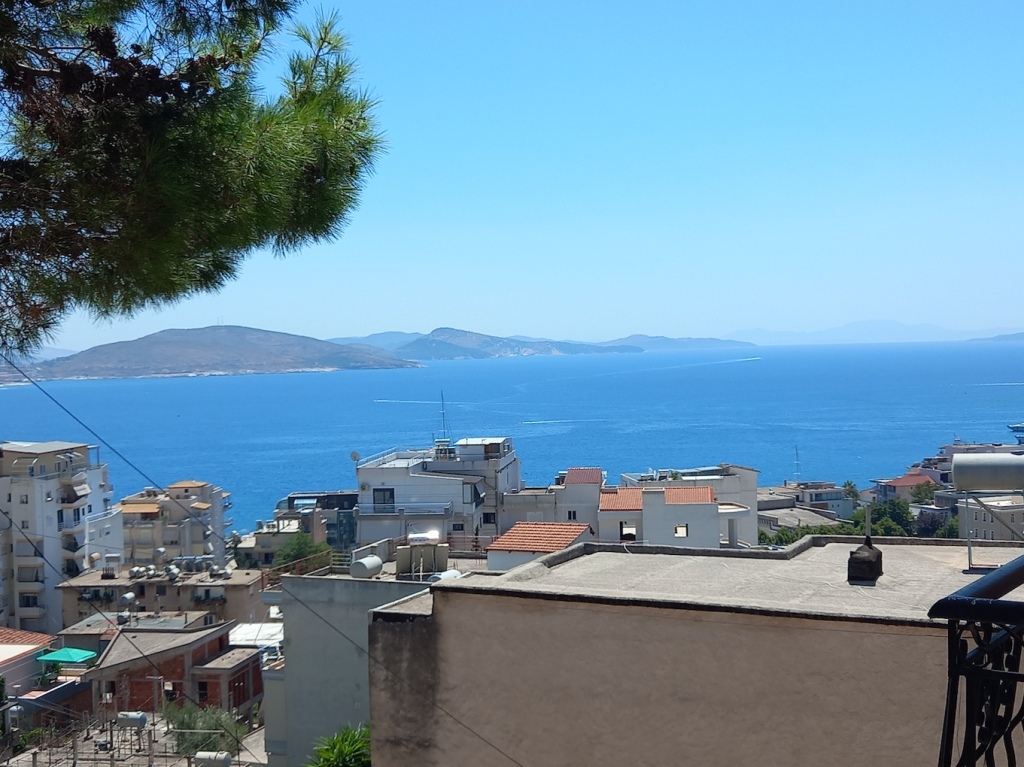
The ferry route is about 14km as we travel north through the straits to the port of Saranda. As we approach Saranda, the Albanian coast becomes increasingly built up, with big concrete hotels in sharp contrast to the pretty villas surrounding Corfu Town.
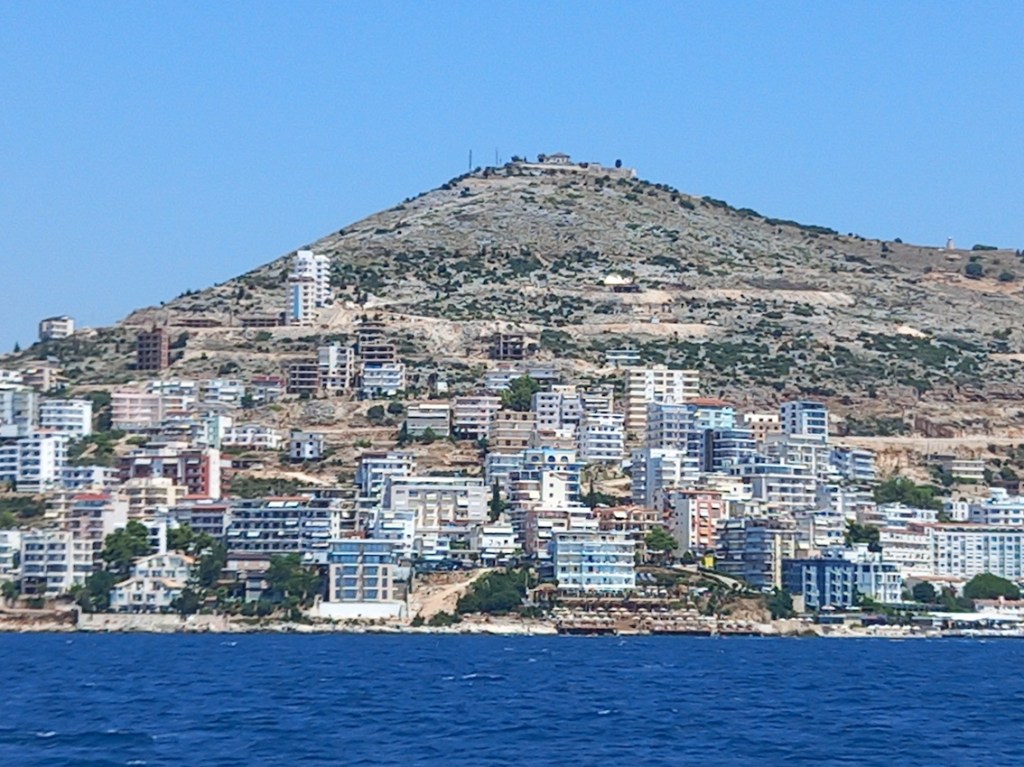
Corfu Town is a Unesco World Heritage site, with a mix of styles from the old Venetian building mixed in with Greek and even Parisian styles, and the occasional painted houses among the golden stone.
Saranda could hardly be more of a contrast, a mix of towering apartment blocks, big modern villas (most of them hotels and guesthouses) and the odd uncompleted concrete shell.
What the two towns have in common, though, is their warm welcome for visitors and the local life that spills out of homes and apartments onto the streets and especially their respective seaside boulevards.
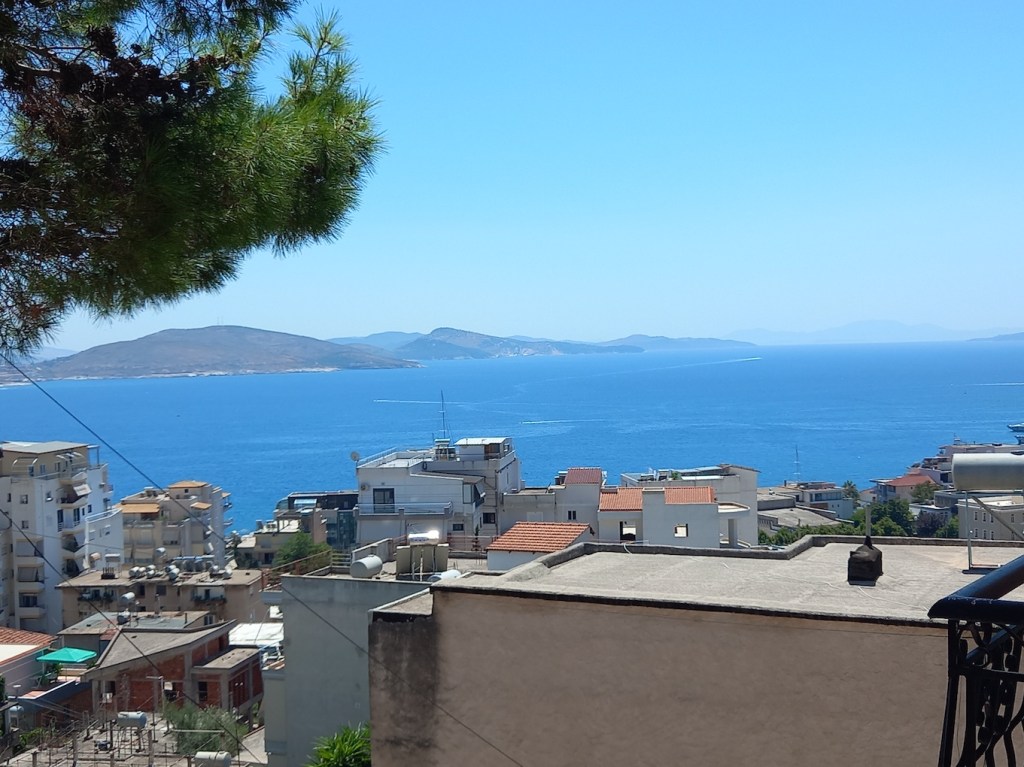
The view of Corfu from this part of Albania is less vivid that vice versa because Saranda is further away from Corfu — about 14 km east of the northern end of the island — than the Albanian coast is from Corfu Town. But it’s still clearly visible, just as it would have been visible (but out of bounds) in the Cold War era.
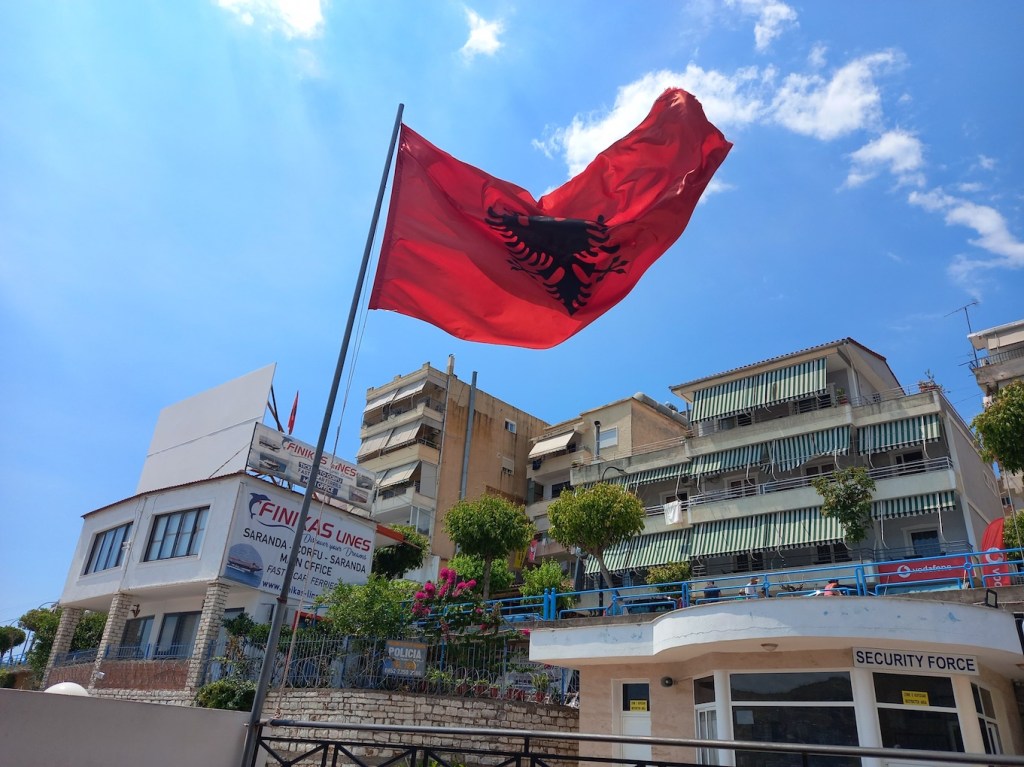
And as we discover two concrete bunkers down by the coast in Saranda, relicts of the city’s isolated communist past, I cant help reflecting on these two cities’ significance on the dividing line between East and West in the old Cold War, just as we appear to be entering a new Cold War. The difference being of course, that this time around we and Greece and Albania are all ranged on the same side.
How to travel between Corfu and Saranda
The ferry offices are clustered around the ports in both Corfu Town and Saranda. Both directions, we bought tickets in person on the day of travel. All the ticket agents seem to speak English so we had no trouble getting understood, and payment was in euros at both ends.
You need to leave time to get from the ticket offices to the port at the Corfu Town end, and in both you need time to go through passport control and customs.
The main companies operating on this route are Finikas Lines and Ionian Seaways.
There’s a mix of traditional ferries that take a bit over an hour, and much faster hydrofoils.
A warning that the ferries in particular don’t always depart according to the timetable! Bring water, snacks, a book and sun protection.
Where to stay in Corfu
Hotel Bretagne
Picked for our first night because it was within walking distance of the airport, the Hotel Bretagne was a really nice choice, with simple air conditioned rooms and a good breakfast.
Arcadion Hotel2
Very central location to explore Corfu Town, stylish rooms and not super expensive.
Archontiko Petrettini Boutique Hotel
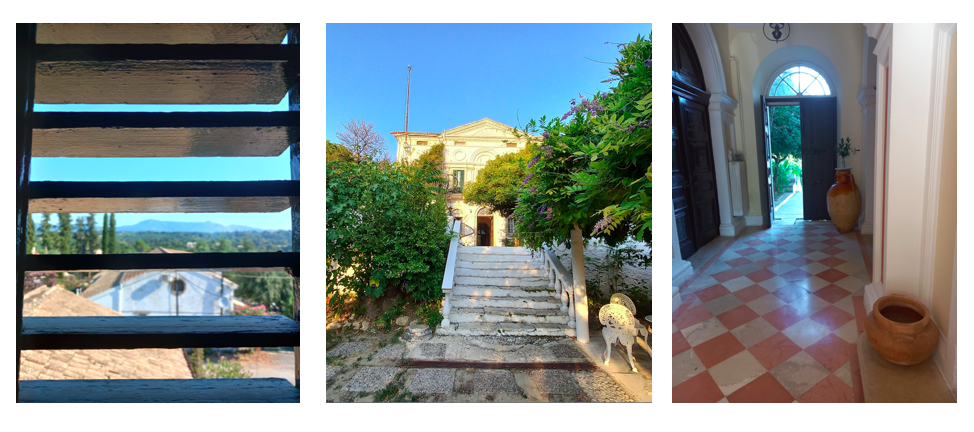
Our end of holiday splurge — a beautifully renovated historic building in a quiet Corfu village, with a pool overlooking the countryside.
Where to stay in Saranda
Elena Apartments
We stayed here for five nights. Simple but clean and with a view of the sea, and a very kind host. Once we’d found the stairways the town centre and seafront were only a short walk away.
Hotel Ari and Hotel Ari 2
In high season this was beyond our budget but we would have loved to stay right on the beachfront!
 Steppe in Style
Leave a comment