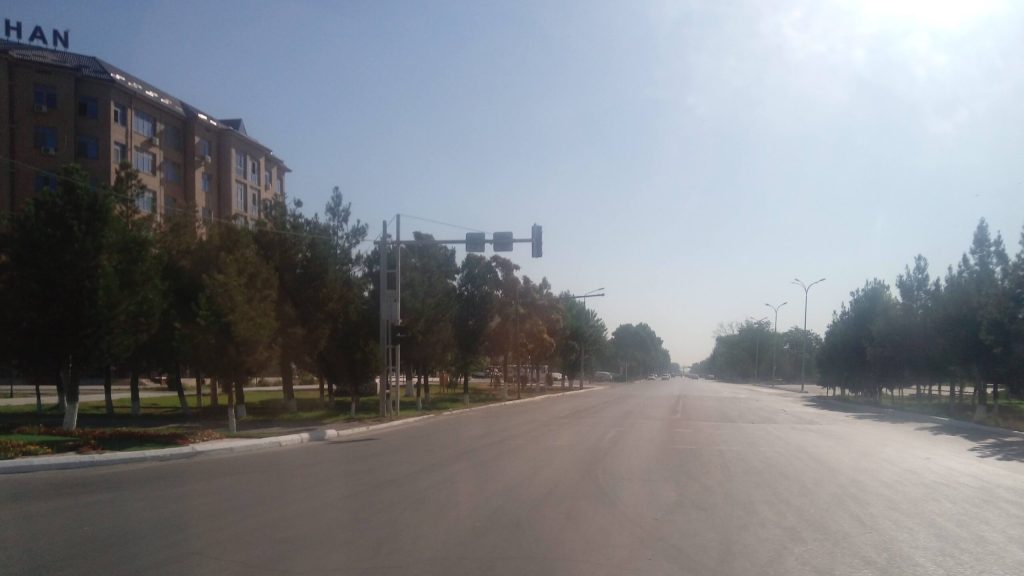
Situated between the two renowned Old Road cities of Samarkand and Bukhara, the Soviet built city of Navoi is hardly an obvious place to visit.
Yet the city — renamed in 1958 then rebuilt as a centre for the growing hydrocarbons and mining industry — is pleasantly green and while most of it is modern, it’s surrounded by monuments of the area’s Silk Road history.
I visited on a business trip, staying in one of the many luxurious modern hotels whose fancy facades and tinted plate glass stand out among the Soviet era blocks along Navoi’s wide tree-lined streets.
Navoi is the administrative centre of the huge Navoi region, which covers almost a quarter of Uzbekistan’s territory, most of which is desert. Underground, the land is rich in oil, gas and valuable metals, which has led to a sharp increase in industry in the region as these are exploited.
Historic Kermine
Navoi stands on the banks of the Zerafshan river, surrounded by the Kyzylkum (‘red sands’) desert. While most of the present day city is new, it’s the site of the old town of Kermine (or Karmana) within the Emirate of Bukhara.
Kermine was on the Shokh Rokh or Royal Road, an important strand of the Silk Road that ran through the ancient cities of Samarkand and Bukhara, along the Zerafshan Valley. Some of the old mud walled houses are still standing in the Karmana district, in stark contrast to the modern city.
The Mir Said Bakhrom Mausoleum is in this district, a simple brick mausoleum originally built in the 11th century. The mausoleum is on the UNESCO Tentative List for World Heritage Site status. It is believed to have been the model for later mausoleums such as the Samanid Mausoleum in Bukhara.
Next to it is the Kasim Sheikh mausoleum and the main city mosque. They are part of a complex built by the then emir of Bukhara as a ‘khanagha’ or hostel for Sufi holy men.
21st century Navoi
While lacking the beauty of these historic buildings, the modern city is pleasantly green — in the heart of the city is the Alisher Navoi national park with an artificial lake and statues poised among the trees including a huge one to the city’s namesake.
The poet and statesman Navoi is one of Uzbekistan’s national heroes, celebrated across the country including in Navoi.
Another favourite for me was Navoi bazaar — I’m a big fan of Central Asian bazaars and the city’s main market is big and well worth a visit whether to buy fresh fruit, vegetables and other groceries or just to wander around and stare.
You can also learn more about the region’s role as a major mining centre at the free Navoi Mining and Metallurgical Company History Museum.
Around Navoi
Outside the city on the road that leads west to Bukhara is the Rabati Malik, a fortified 11th century caravanserai — one of the many inns along the old Silk Road. While most of the Rabati Malik was sadly ruined by the 1968 earthquake, the portal — 12 metres high and decorated with carved terracotta— was not toppled and has been partially restored.
Nearby in the village of Khazar, Deggaron Mosque is believed to be one of Uzbekistan’s oldest Islamic buildings, dating back to around the 11th century AD. The 14 century theologian Mavlono Orif Deggaroniy was buried here.
Further away is probably the most important site in the Navoi regon, the spectacular petroglyphs of the Sarmysh gorge. There are close to 4,000 petroglyphs on the dark shale rock of the gorge, which is around 45km from the city. They date over a period of many centuries, from the Bronze Age to the Early Middle Ages. Among the images are humans — some of them startlingly well endowed — animals and mysteriously one that looks like a spaceman (there’s not yet any explanation for this).
How to get there
Navoi is on the Uzbek rail network, served by trains from Tashkent and Samarkand to Bukhara. Buses — from Tashkent, Samarkand or Bukhara — are somewhat quicker and more frequent. Navoi has an airport around 25km west of the town, with three flights a week to Tashkent.
Where to stay
Zarafshan Grand Hotel, 8 Navoi Street. Very central newly built hotel. Mid range prices but lavishly decorated, with a lively restaurant.
Grand M Hotel, 77 Khalklar Dustligi Avenue. A high end, more expensive option. Great service from English speaking staff, luxurious rooms, outdoor pool, sauna and restaurant.
Maximum Hotel, 9 Galaba Street. Further out from the centre and cheaper. Cean confutable rooms with air conditioning, outdoor pool and garden.
Where to eat and drink
Cafe Cinema, 12 Zarapetyana Street, Navoi, Uzbekistan. Cosy cafe with decent coffee.
Baraka Cafe near the Yagona market is a stylish cafe with a decent range of salads and other meals, and rather tasty desserts.
Zarafshan Grand Restaurant, 5 Navoi Street. Good food in fancy surroundings..
 Steppe in Style
Leave a comment