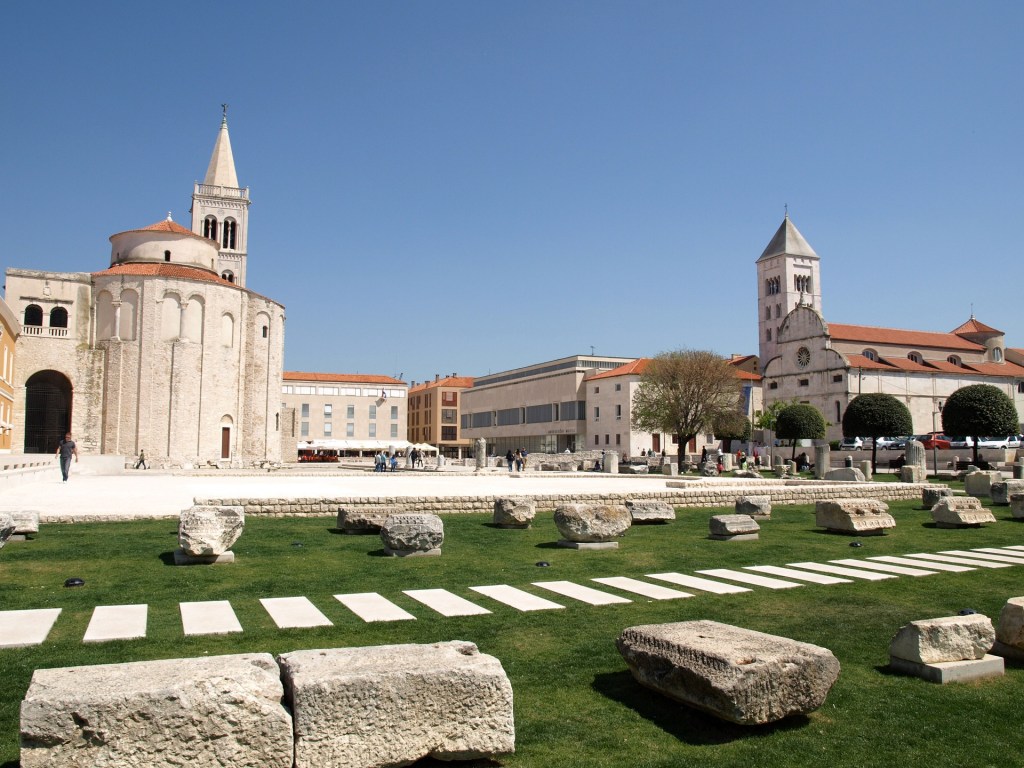
In a country where it’s common to do your grocery shop next to a medieval church or sip a coffee among Roman remains, Zadar stands out as Croatia’s oldest continuously inhabited city.
The first signs of human life in what is now Zadar date back to the late Stone Age. Among its early settlers were the Illyrian tribe of Liburnians in the 9th-century BC, who built a settlement where the old city now stands.
It sits on Croatia’s Adriatic coast, facing the islands of Ugljan and Pasman across the narrow strait of Zadar.
In the first century AD, parts of Croatia were conquered by the Roman Empire under Julius Caesar. Zadar’s Roman Forum — the largest on the eastern Adriatic — was built between the first and the third centuries on the orders of his nephew, Emperor Augustus. It became the centre of daily life in the city.
However, the buildings surrounding the forum were destroyed in an earthquake in the 6th century AD, and while you can visit the site of the forum today only parts of it remain, including the pavement and stairs of the temple and two columns.
Another relict of this era is the partially preserved Roman aqueduct.
Medieval Zadar
Zadar changed hands repeatedly in the Middle Ages, being ruled by Franks, Byzantines, Venetians, Hungarians and ottomans.
There are several stunning medieval churches in Zadar. The striking Church of St. Donatus is the biggest pre-Romanesque building in Croatia. Construction of the circular building was completed in the ninth century. During its history it was several times put to use as a warehouse and during socialist Yugoslavia as an archaeological museum.
The Roman Catholic Cathedral of St. Anastasia is the biggest church in the coastal Dalmatia region. A Christian basilica stood here as early as the fourth century, and much of the current cathedral was built in the 12th and 13th centuries.
Other notable churches include St. Chrysogonus and St. Simeon, both in the Romanesque style.
The tall white terracotta roofed buildings of Zadar University stand prominently on the sea front. The university was re-founded in 2002, but it actually dates back as many centurities; there were references to the city’s university in 1396 as pat of a Dominican monastery. It closed in 1807, only to be reopened almost two centuries late.
Venetian rule
Zadar came back under Venetian control in the 16th century, when Hungarian king Ladislaus I sold it to the Venetians. It became an important outpost fo the Venetian empire in its struggle against the expanding Ottoman Empire.
Made the administrative centre of the Venetian territories in the Dalmatia region, it was an important cultural centre during the Renaissance era.
Narodni Arg (People’s Square) is in the heart of the old city, where the narrow winding streets open out into a lovely stone paved square.
On one side is the 16th centre City Sentinel with clock tower. Also on the square is the Gradska Loza gallery with its pillared frontage, as well as several cafes and restaurants. When we visited, the square was also hosting the annual Zadar meat festival.
While under Venice’s control, Zadar was fortified with new defensive walls on the landward side. The old city ramparts were turned into promenades in the late 19th century.
Set in the walls is the 16th century Land Gate that was once the main entrance to the city. The triumphal arch, built by Venetian architect Michele Sanmicheli, has a central main arch for traffic and two smaller arches for pedestrians. The ornate arch is decorated with representations of the city’s patron saint St. Chrysogonus and the Shield of St. Mark.
Afte the decline of the Venetian city state, Zadar came under Austrian rule fo most of the period until the Fist Wold War, aside from a shot period under France. It was even to Italy under the 1920 Treaty of Rapallo and bombed by the Allies doing the Second Wold War. After 1947 it became part of Yugoslavia.
21st century Zadar
Today Zadar is the fifth largest city in Croatia with a population of around 75,000.
Not all the sights in Zadar are historic. The Sea organ has become part of Zadar life since it was installed under the Nova rive on the seafront in 2005. The huge musical instrument is installed under the promenade’s marble steps, and as the sea’s waves flow in and out of its tubes it makes harmonic sounds.
Learn about Zadar’s history
The Zadar National Museum is a great place to start for an overview of the city and region’s history. Within this is the Zadar City Museum, also worth a visit.
Just like its exhibits, the Archaeological Museum Zadar is old; it was founded in 1832 and is the second oldest museum in Croatia. Its collection covers the Stone Ages through the Bronze and Iron Ages to the Roman and Byzantine Periods.
The Museum of Ancient Glass has a collection of over 5,000 glass objects dating from between the 1st century BC and the 5th century AD. As well as the unique exhibition, it’s also a chance to see inside the 19th century Cosmacendi family palace.
 Steppe in Style
Leave a comment