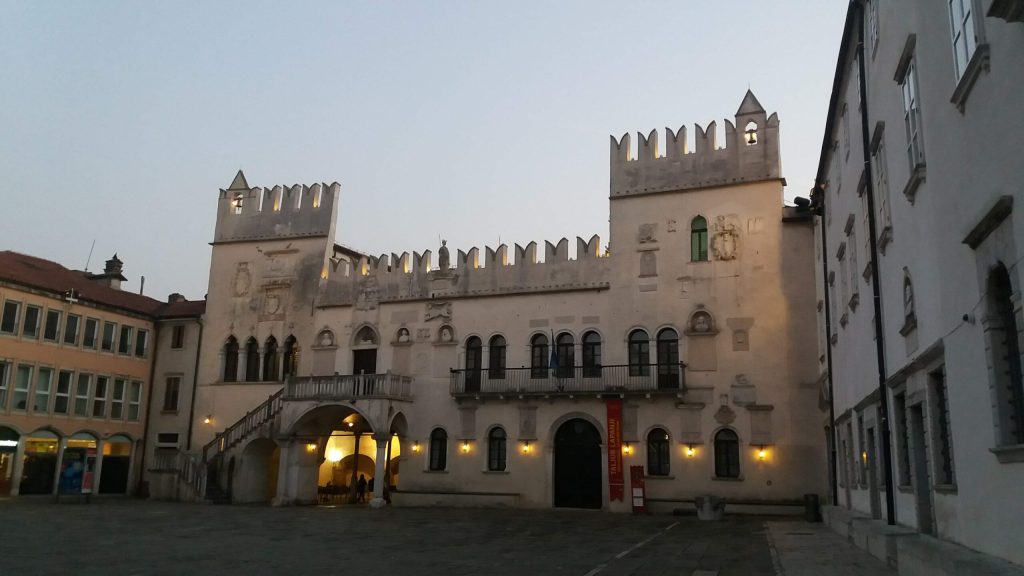
Koper, Slovenia’s fifth largest city, used to be an island, though that’s hard to believe today. What was once a causeway connecting the island — named as Insula Caprea, or Goat Island, by the Romans — to the mainland is now a busy highway surrounded by big box stores, car showrooms and office blocks.
It’s a stark contrast to the narrow winding streets of the nearby old town, a legacy of Koper’s years under Venice’s control, and with many renaissance palaces and mediaeval churches to discover and explore.
After an early morning flight and a train journey, we eventually arrived by bus from Italy’s Trieste in the early evening, when it was already dark.
Just five kilometres from the Italian border — the highway from Trieste to Koper swoops seamlessly along the coast as both countries are in the Schengen zone — and with large parts of its history spent under Italian control, Koper has a strong Italian connection even today. Italian is one of the official languages of the city, along with Slovene.
Kindness of strangers
The bus dropped us outside the railway station, on what was once the landward side of the causeway. Our task: to figure out which direction would take us along the highway to the fringes of the old town where I’d booked a hotel.
It was one of those journeys that didn’t seem worth taking a taxi for because of the short distance, yet did seem worth it because it was late and dark and we were in an unfamiliar town and my phone wasn’t roaming.
Big mistake. I started to think there was a mistake when the taxi shot off in what I guessed (it turned out correctly) was the opposite direction to the old town. He dropped us off in a quiet residential street, relieved me of most of my euros and drove off.
There was no one around, the address clearly wasn’t a hotel and we were now much further away from the centre than previously.
Just as I was looking around wondering what to do and if there was any way to summon another taxi (without a working phone or the number of a taxi company), a woman drew up to a nearby house in her car.
Spotting me and my daughter standing in the road with our luggage, she called out in very good English to ask if we were ok.
When I explained the situation, it turned out that her road had a very similar name to the one where the hotel was located.
She immediately offered to drive us to the hotel, loaded us into her car and went all the way back to the city centre. She even waited make sure we made it safely into the hotel before handing us her card and driving off.
Her kindness to two complete strangers was so overwhelming that even when we woke up to find Koper grey, cold and foggy and ate uninspiring pastries and bitter coffee in a tiny smoky cafe outside a nearby supermarket we felt warm towards the city.

Lost in the fog
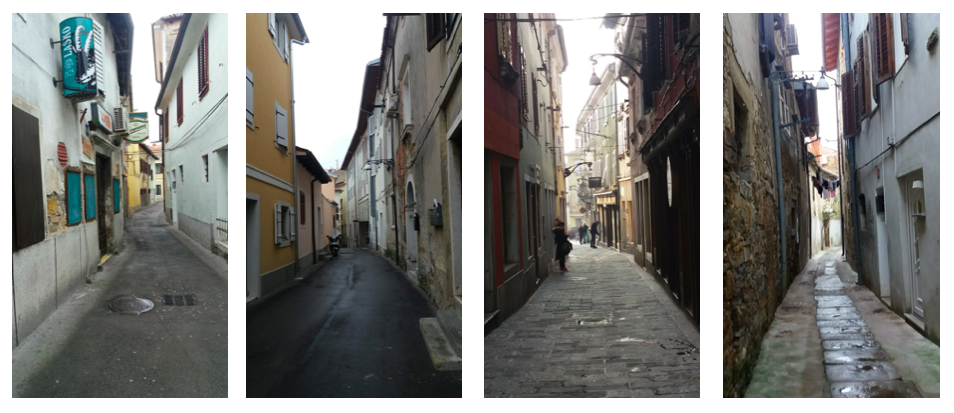
Fed and (in my case) caffeinated, we explored the damp grey streets, where the overhanging upper floors of the buildings loomed out of the mist. Every now and again we had a clear view of something — a statue, a fountain, some graffiti on an old stone wall — before the mist descended thickly again.
Unable to get our bearings, we were surprised to suddenly exit the old town on the sea front. Ahead of us was a small marina, beyond which a huge cargo ship with towering stacks of containers was gliding into the port for unloading.

As well as the old city Koper is the site of Slovenia’s only container port. There has been a port here since Roman times. Today it’s one of the entry points for shipments from the Far East to central Europe.
Just around the corner from the port is the promenade and what I’d loosely call a beach (if steps going from a flagstoned walkway can be called a ‘beach’. Koper city beach is dubbed ‘Mokra mačka’ or ‘wet cat’, and in summer the small patch of grass next to it is packed with sunseekers, while the cafes and restaurants are full.
We were there very much out of season so rather than taking a dip — though I did see one brave man diving into the waters of the port — I people-watched on the promenade while my daughter arranged her dolls into tableaus on one of the curved concrete benches along the sea front, charming elderly local ladies.

Koper’s historic centre
When the mist started to lift, we headed back into the old town, finding Tito Square, for many centuries the city’s central square and still the heart of city life.
Among the historic buildings surrounding the square is the iconic 15th century Praetorian Palace, which houses the city tourist office.
The 12th century Cathedral of the Assumption is home to the Renaissance artist Vittore Carpaccio’s Sacra Conversatione and other important artworks. Initially built in the romanesque style, later renovations mean the cathedral now tends towards the gothic.
Also on Tito Square is the Venetian Gothic Loggia Palace, under whose arches is one of the oldest cafes in Slovenia. We sipped a coffee there before wandering through some narrow side streets until we found a pizza restaurant to suit my daughter’s taste.
Apart from a few delivery vans and electric municipal vehicles, the town centre was almost empty of traffic, so we could wander freely through the narrow streets.
Getting lost in the streets of the old town is a pleasure in itself, but one particular street worth seeking out is Zupanciceva street, home to numerous historic buildings. Among them are the Carli Palace, the Venetian-Gothic Filiputti House, a medieval apartment complex and the Vida Vidacovich Baroque palace.
Viewing Koper from the Bell Tower
Despite warnings about the deafening chimes from the top, we had to climb the Bell Tower on Tito Square.

The 54 metre high tower is interesting in its own right — it’s believed to have been built back in the 12th century though later reconstructed — but it also gives an unparalleled view over the old town and surrounding countryside.
The tower, originally a standalone structure, was later joined to the cathedral. The clock itself is believed to date back to 1463, and the bell of St Nazarius is even older, being cast back in 1333. It is the oldest working bell in Slovenia.
Getting to the lookout at the top of the tower requires a speedy scramble past the bell, where signs inform visitors when it’s set to chime and warn them to stand well away.
From the top of the tower we could see down into the streets of the old town, as well as overlooking the industrial area around the port.
In Roman times, the original town on Goat Island grew into the city of Aegida, which was later renamed Justinopolis as a complement to the Byzantine Emperor Justinian II. Doing the middle ages it was occupied successively by Lombards, Franks and briefly Avars. Then in 1278, Koper joined the Republic of Venice.

The origins of the name Koper come from its time as the capital of Venetian Istria, when it was renamed Caput Histriae, meaning ‘head of Istria’, a name that later evolved into Capodistria in Italian.
Koper lost its island status in 1825 when it was connected to the mainland by a causeway. Later drainage works to make way for industrial development altered the landscape so it’s hard these days to picture it cut off by water as it once was.
More travels in Slovenia from Steppe in Style
8 fun city beaches along the Adriatic and Ionian coasts
How to be a more eco-friendly traveller
My 14-item travel capsule wardrobe for Slovenia
BUCHAREST TO LJUBLJANA: The dark side of Slovenia’s gorgeous capital Ljubljana
 Steppe in Style
Leave a comment