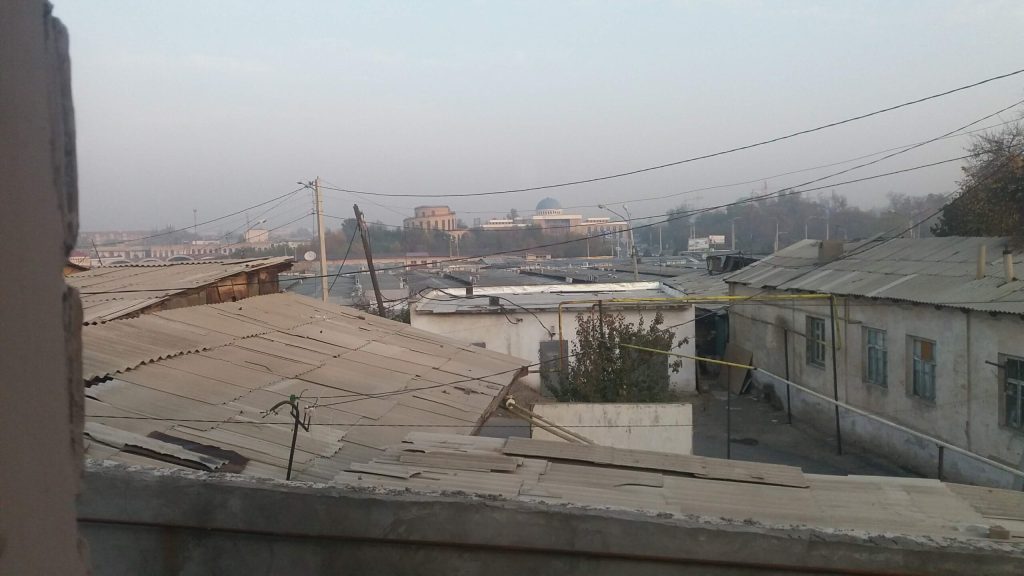
Coming back to Tashkent after almost a decade — I wasn’t able to get a visa for years — I was delighted to find myself staying in the old part of the city, just 100 metres from Chorsu bazaar. As I’ve written before in this blog, I’m a big fan of Central Asian bazaars, and despite my busy schedule I managed to find time to wander through the aisles, perusing fresh vegetables, pungent spices, exotic dried fruit and clothes and household goods (these last mostly from China).
Unlike Bishkek or Almaty which are built on grids and therefore very easy to navigate, Tashkent is a complex puzzle of old medressa districts — still with their mud walled traditional houses — soviet blocks and brand new concrete and plate glass residential developments, offices and malls, all connected by swooping highways and flyovers, these days mostly clogged with traffic.

Today Tashkent is the biggest city in Central Asia with a population of over 2mn people. While it’s the site of ancient settlements — it was first settled somewhere between the fifth and third centuries BC — much of the city was destroyed in the devastating earthquake in 1966.
While there are pockets of ‘old Tashkent’ among the 20th and 21st century constructions elsewhere in the city, the areas around the Chorsu bazaar and Khast Imam Square — arguably the heart of the old city — in my opinion are the best places to experience historic Tashkent.
I was staying at the Mulberry hotel, a small and friendly hotel, where they served fresh lipyoshka breads with sour cream and sweet, fruity jam for breakfast. My room looked out over the pale honey coloured roofs of the old districts.
I arrived house before check in time, so went out to wander the streets, breathing in the frosty morning air scented with spices from the bazaar and the dense pollution from thousands of cars.
The two-storey brick building is located in a district mostly taken up by the Chorsu bazaar — there are separate areas for various types of food, flowers, clothing, jewellery and so on.

Around it is one of the old mahalla districts that reveal the Uzbekistan must have been like centuries ago (if you ignore the cars, phone lines, Yandex taxis and kids on bikes with mobile phones). In these districts, people kept their home lives private. Facing towards the road are windowless and high walls and closed gates, though which you might peek to see a tidy small courtyard with decorative tiles and vines creeping over the low walls of the house inside.
Tashkent mahallas are included in UNESCO’s Tentative List of World Cultural Heritage. Mahalla, by the way, is a somewhat confusing term as it refers both to the traditional quarter in ancient Central Asian cities and to the way communities are organised — which has been employed for ancient times to the present day.
To the south of the bazaar, close to the corner of Navoi Avenue and Beruni Avenue, is the Zhuma mosque, also known as the Khoja Ahror Valiy mosque. Construction started in 1451 under Sheikh Ubaydullo Khoja Akhror, though there have been many changes since then.
Nearby is the 16th century Ko’kaldosh Madrasasi built from traditional yellow brick, with decorative tiles.

Not far to the north of the bazaar is Khast Imam Square, flanked by historic mosques and medressas. That is the location of the medieval Hazrati Imam Mosque, the Barakhan Madrasah and the Muyimuborak madrasah, home to an ancient Quran.

My first visit to Tashkent
Drinking coffee 110 metres up in the air at the Tashkent TV tower
It took all day to get cash in Tashkent
Other locations in Uzbekistan
Inside the ancient city of Bukhara
Bukhara’s intimidating Registan
This how women dressed in 19th century Bukhara
 Steppe in Style
Leave a comment