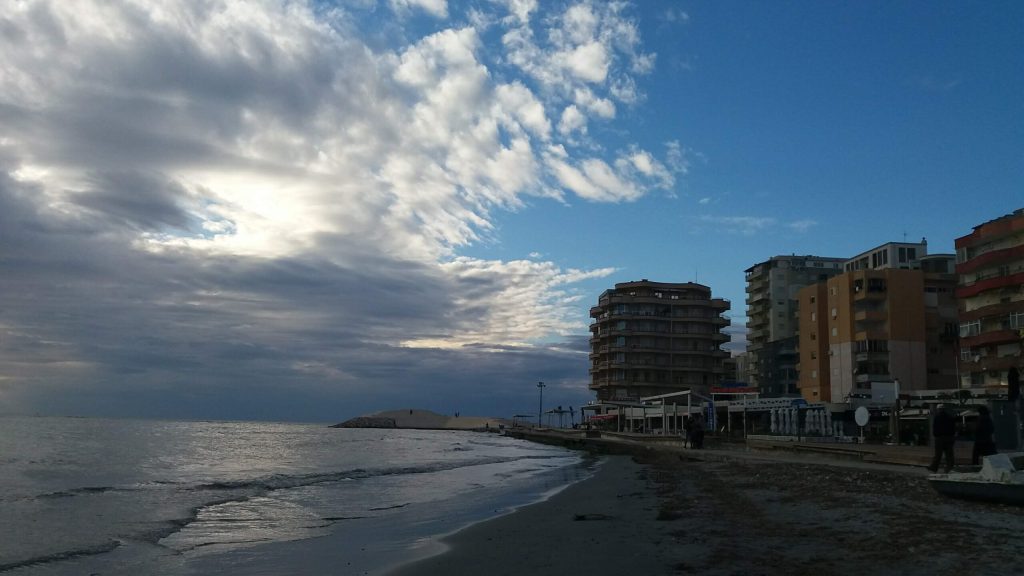
A big industrial port city that caters to thousands of package tourists in summer? I’ll admit I wasn’t expecting much from Albania’s second city Durres. I was so wrong.
Not only does Durres have some spectacular Roman and Byzantine remains — the amphitheatre is the biggest Roman amphitheatre on this side of the Adriatic — it also has a charming old town and a stunning seafront promenade.
After the intense busyness, traffic and noise of Tirana’s huge boulevards, the small, quiet streets of the old town were soothing, and even more so was the car-free promenade along the sea front.
We were staying at the Amfiteatri Boutique Hotel, just around the corner from the 2nd century amphitheatre.
Despite its huge size — it measures 132.4 metres by 113.2 metres by 20 metres and had a capacity of 20,000 people — it was only discovered in the 1960s.

We visited the amphitheatre in the late afternoon — too late, really, because the dusk then darkness arrived quickly, and despite the spotlights we ended up stumbling around the half submerged passages and crumbling seats.
Yet having the huge amphitheatre virtually to ourselves was truly magical.
Despite its historical significance, the amphitheatre was allowed to deteriorate after the discovery and initial excavation, until the University of Parma stepped in to save it in 2004. Set right in the heart of the city, there are modern houses built in part of the arena, though there are plans to remove them. In 2013 it was shortlisted as one of the most endangered cultural heritage sites in Europe by the heritage NGO Europa Nostra.
Even the Romans were quite late arrivals to Durres, which is one of the oldest cities not only in Albania but in the world. The area has been populated from the Eneolithic period, the transition period between the Neolithic and the Bronze Age.
It was known as Dyrrachos by the Greeks and Durrachium by the Romans. The ancient Greeks considered the god Poseidon to be the father of the city, which archeological research has shown was one of the richest of the ancient Greek world.
We learned more about the ancient times in the city now called Durres at the archaeological museum, the biggest in Albania.
There are thousands of artefacts from the ancient Greek and Roman era, including more than 3,200 from the nearby site of Dyrrhachium.
The museum was vandalised and looted during the violent unrest in 1997 but following the initial repairs it underwent a major reconstruction, reopening in 2015.
From the Romans to the Byzantine empire. The fortified city walls around Durres — some of which are still standing — were originally built by the Byzantine Emperor Anastasius I, a native of Dyrrhachium. Seeking to protect his home town, he turned it into one of the most heavily fortified cities in the Adriatic region.
We visited the Venetian Tower, one of several guard towers added by the Republic of Venice when the Venetians reinforced the city’s defences.
Durres is many times older than Albania’s capital Tirana, which was founded as a city as late as 1614, when present day Albania was under Ottoman rule.
Under the Ottomans, Durres gained the Fatih Mosque, built in 1502, the years after the Ottoman conquest of Durres — one of the last towns of Albania to gall under Ottoman control.
For the most part, however, Durres’ importance waned under the Ottomans, the harbour was neglected, trees and vegetation grew over the Byzantine ruins and the city generally fell into disrepair.
Mostly overshadowed by Tirana, Durres was briefly Albania’s capital between 2018 and 2020. Even after losing this status, it was the recipient of many Italian investments in the inter-war period during which it developed into a major seaport and experienced an economic boom.
A relic of Albania’s more recent history is the Royal Villa, better known as Zog’s Villa, after King Zog, whose summer residence it was during the brief period when Albania was a monarchy.
The villa is located on a hill behind Durres with a striking view of the sea from three sides. Notably, the villa was built in the shape of an eagle — the Albanian national symbol.
It remained the country’s main port in the communist era, which also left legacies like the dramatic monument to an unknown soldier on the sea front.

The Port of Durres, at the northern end of the Bay of Durres, is the biggest seaport of Albania. The cranes are easily seen from the old town and they, combined with the ships gliding to and fro from the port, highlight the city’s industrial character.
Durres gained international notoriety after the collapse of communism in 1990, when shocking images appeared of tens of thousands of Albanians cramming themselves onto ships that were hijacked at the port and sailed to Italy. In August 1991 alone, more than 20,000 people left for Italy from Durres.
There was further turmoil in 1997 after the collapse of several massive pyramid schemes brought the country close to civil war, and Italian peacekeepers were deployed in Durres and other cities. Now, however, that history of turmoil is a couple of decades away, and these days the pretty streets of the city centre have been cleaned and repaved to welcome the thousands of tourists that arrive every summer.
A broad promenade runs along the seafront. We spent much of our first day at the funfair close to the old town, which was open despite it being out of season and had plenty of activities suitable for younger kids — including a rather terrifying inflatable slide.
Further along, the landward side of the promenade was lined with cafes, restaurants and shops. Even though by late November some were closed for the winter, we managed to eat well each evening, after watching the sun sink low in the darkening sky before disappearing over the horizon.

 Steppe in Style
Leave a comment