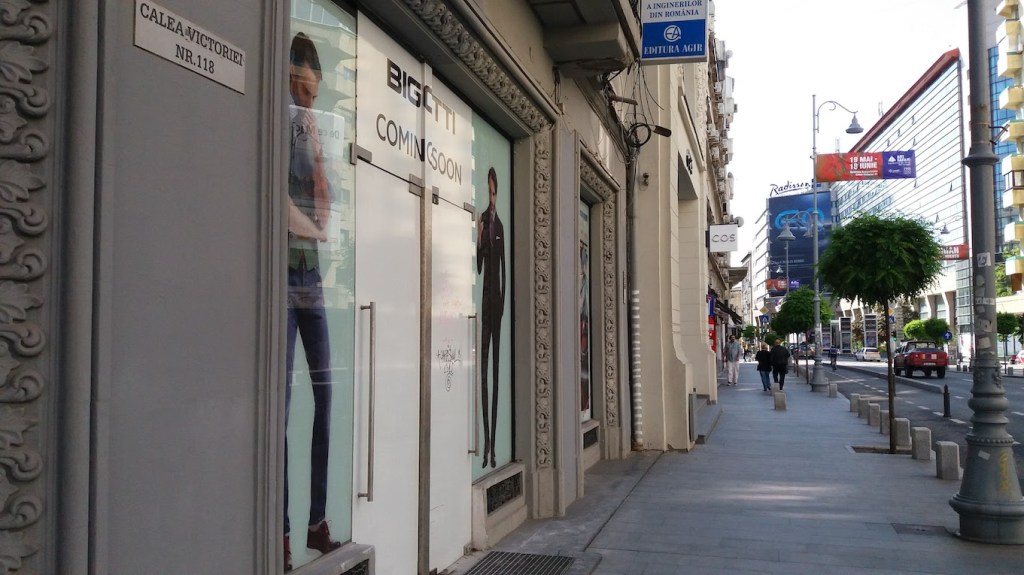
I’m always proud to give my address in Bucharest because I live on the Romanian capital’s most fashionable street for centuries, the Calea Victoriei (Victory Street). Walking up and down the street daily past gorgeous historic buildings and tempting shops and cafes inspired me to write a north to south guide to what you will see on a walk down the Calea Victoriei.
Piata Victoriei
The street gained its current name in 1878 after victorious Romanian armies returned down the street after from battles against Romania’s Ottoman rulers. Calea Victoriei starts on the huge Piata Victoriei, the site of the mass protests in early 2017.
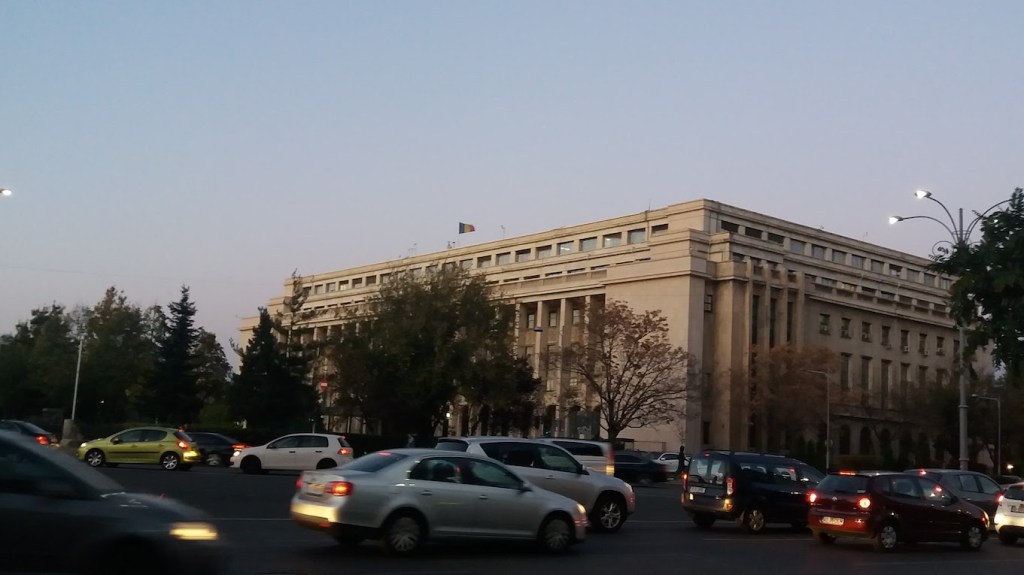
An empty plinth at the entrance to the square has been daubed with the worlds “Monument to Corruption”. On the right of the square are the main government offices, while to the north are the Peasant Museum and Natural History Museum.
Entering the Calea Victoriei, the first site is the recently rehabilitated Casa Filipescu-Cesianu is the home to a newly opened museum, Muzeul Vârstelor or the Museum of the Ages, dedicated to urban anthropology.
Close by is the Casino Palace in the historic Casa Vernescu, one of the showiest of the 19th century palaces built along this street. After the fall of communism, it was the subject of an acrimonious ownership dispute.
Step away from the noise and traffic of the Calea Victoriei for a few minutes in Nicolae Iorga, a pleasant green space named after the historian, politician and playwright.
Then comes one of the largest buildings on the Calea Victoriei, the Museum of Art Collections.
On the right is the gracious but neglected Ştirbei Palace. The extensive garden behind the palace is home to Gradina Eden, one of Bucharest’s most popular outdoor bars in summer.
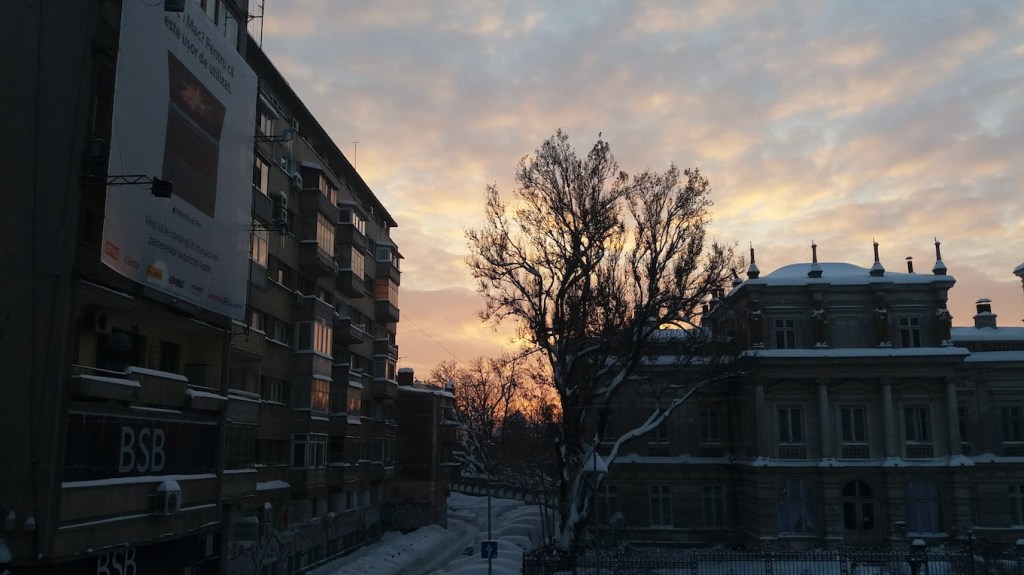
About 100m further south is the White Church, with its beautifully restored interior.
Revolution Square
Revolution Square is the site of one of arguably the most significant moment in recent Romanian history, Ceausescu’s final speech in December 1989.
As the uprising in the city of Timisoara threatened to spread across the country, the communist dictator decided to address the population in a televised speech from the balcony of the Central Committee building in what was then known as Piaţa Palatului, or Palace Square.
However, just minutes into the speech, the crowd started to chant “Ti-mi-șoa-ra! Ti-mi-șoa-ra!” Ceausescu’s attempt to placate the crowd failed, and he was hustled off the balcony by security. The speech marked the beginning of the Romanian revolution that rapidly toppled Ceausescu and his regime.
On the left on entering the square is the Athenee Palace Hilton, probably Bucharest’s most famous hotel, and the site of many WW2 intrigue.
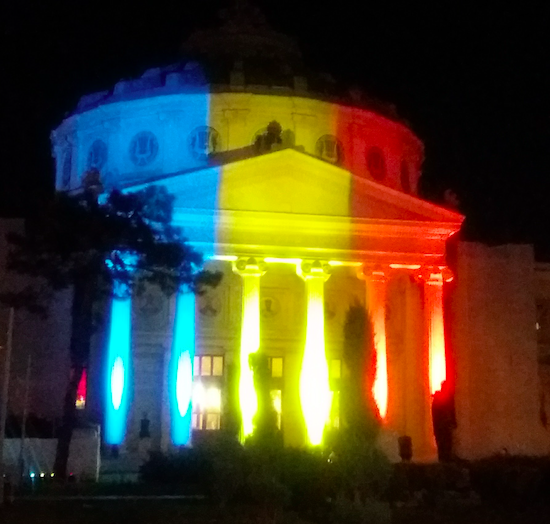
Past it is the Romanian Athenaeum. The garden in front of the domed building is a popular place for families to sit in summer.
Then on the left hand side of the square is the former Royal Palace, which now houses the National Museum of Art of Romania.
The Central Committee building, which still houses government offices, dominates the right hand side of the square, which has since been renamed Piaţa Revoluţiei or Revolution Square.
Another monument to the revolution is the Memorial of Rebirth, a 25-metre-high marble pillar with a metal crown, rather like a tangled ball of wire, close to its peak. The €1.5mn monument was the source of controversy, and was criticised for failing to reflect the significance of the revolution. It has gained various mocking nicknames such as the “olive on a toothpick” and “the potato of the revolution”. In 2012 bright red paint was spattered close to the top of the spike, and has never been removed.
The plaza surrounding the memorial is popular with skateboarders, even after it was surrounded by a display of spiky metal sculptures.
Kretzulescu Church
On the southern corner of Revolution Square is the Kretzulescu Church, was commissioned in 1720–1722 by the boyar (aristocrat) Iordache Kreţulescu and his wife Safta, one of the daughters of Wallachian prince Constantin Brâncoveanu.
The facade was originally painted, but has been redbrick since a restoration in the 1930s. The church was damaged in the earthquakes of 1940 and 1977, and the 1989 revolution, and narrowly escaped demolition in the early days of the communist regime.
In front of the church is a bust of politician Corneliu Coposu (1916-1995), who served 17 years in prison under the communist regime.
Bucharest’s designer heaven starts around here, with the Mingotti store followed by Emporio Armani and several high-end jewellery stores.
Yet another variation on the palace, this time the art deco Bucharest Telephone Palace, now owned by Telekom Romania. At 52.5 metres high, this was the tallest building in Bucharest until the 1950s.
The project was launched by the American trust Morgan, one of the predecessors of giant financial services firm JP Morgan Chase & Co, which got a 20-year monopoly on Romanian telephone services in return for issuing a loan to Bucharest after the 1929 Wall Street Crash hit the Romanian economy.
A major reconstruction project was launched in the 1990s, which included reinforcing the roof to bear microwave antennas and rebuilding the exterior. This became Romania’s largest architectural reconstruction project.
Another intriguing reconstruction project is right next door, where the modern plate glass structure of the Novotel rises out of a replica of the old baroque facade of the National Theatre Bucharest. The theatre, which has also been immortalised on RON100 banknotes, was destroyed in the Luftwaffe’s bombing of Bucharest in August 1944.
Passageways on the Calea Victoriei
On the other side of the road a couple of passageways, Pasaj Victoriei and the English Pasaj lead through to Academy Street.
The English Pasaj is particularly notorious. When the building was bought by Grigore Eliade, who transformed it into the English Hotel in 1885, the passageway was built, modelled on the passages in fashionable West European capitals. Most of the hotel’s rooms were located along the tall (several stories high) but narrow passage. However, the rooms were too small for the hotel to withstand competition from other newer hotels, and it was transformed into a luxury brothel. Customers allegedly included King Carol II.
The accommodation is now private housing — be discreet taking photos as the residents don’t like it. It is poorly maintained, and many of the balconies where ladies of the night once advertised their wares, look close to collapse.
Cafe Capsa on the left is one of Bucharest’s oldest cafes, opened in 1852. While it’s generally fairly quiet now, it featured in Olivia Manning’s Fortunes of War as a popular hangout for locals at the beginning of the second world war. The interior reflects its history, with chandeliers and baroque furnishings.
The management claims this was once the finest pastry shop in Europe, selling mainly oriental confectionery, although in the second half of the 19th century it introduced the western delights of lemonade, cakes, bonbons and chocolates, often imported from Paris.
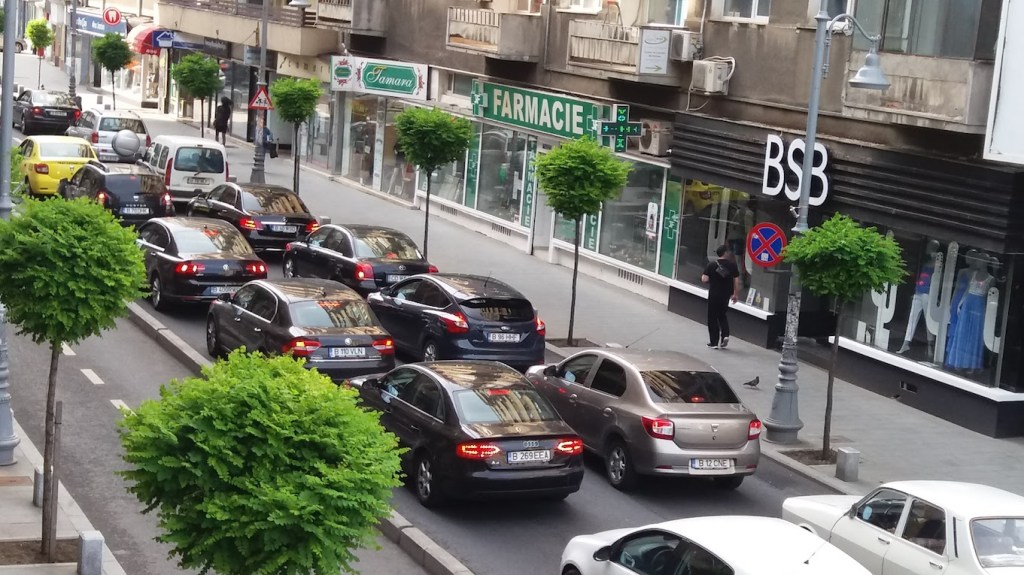
Regina Elizabetta street and beyond
Immediately before Regina Elizabetta street on the right is the Cercul Militar Național, the Palace of the National Military Circle, also known as the Officers’ Circle Palace, with its name etched on its neo-classical facade. It was built on the site of the old Sărindar monastery for the officers’ circle of the Bucharest military garrison, hence the name. The restaurant and the terrace are open to the public. The 1960s building opposite was designated for military officers.
The busy Regina Elizabetta street intersects Calea Victoriei here, close to the university district.
Next comes the fork-shaped Pasajul Macca-Vilacrosse, a glassed in arcade leading off the Calea Victoriei into the old town. The site of an old inn, in the 19th century it was replaced by the current two story buildings, with the small passages — Vilacrosse and Macca — leading between them. The passage initially housed Bucharest’s first Stock Exchange, then jewellery shops, and is now mainly populated by bars and restaurants.
The small Zlatari Church on the left is known as the church where miracles come true. It hosts the right hand of Saint Cyprian of Antiochia, who legend has it was a wizard. He later converted to Christianity and died as a martyr. He is believed to have the power to defend people against spells and wizards — probably the reason this church often has a queue waiting outside! The original 17th century church was damaged by earthquakes in the early 19th century and the current church was started in 1850.
Around the old town
Here, Calea Victoriei skirts the old town. The first street on the right, into the old town, is unloved and shabby too, with many boarded up windows — completely unlike the renovated streets further along with their bustling cafes and restaurants. The street is named after Ion Filitti, a historian and diplomat who secretly opposed joining the tripe Entente in the First World War. To the left is Forza Rossa, the Ferrari owners’ club of Bucharest.
Opposite is one of the most dramatic contrasts of the Calea Victoriei. The gorgeous CEC Palace hosts Romania’s oldest bank Casa de Economii și Consemnaţiuni (CEC). The palace was built on the site of a former monastery, which fell into ruins and was knocked down in 1875. 25 years later, the CEC Palace was opened.
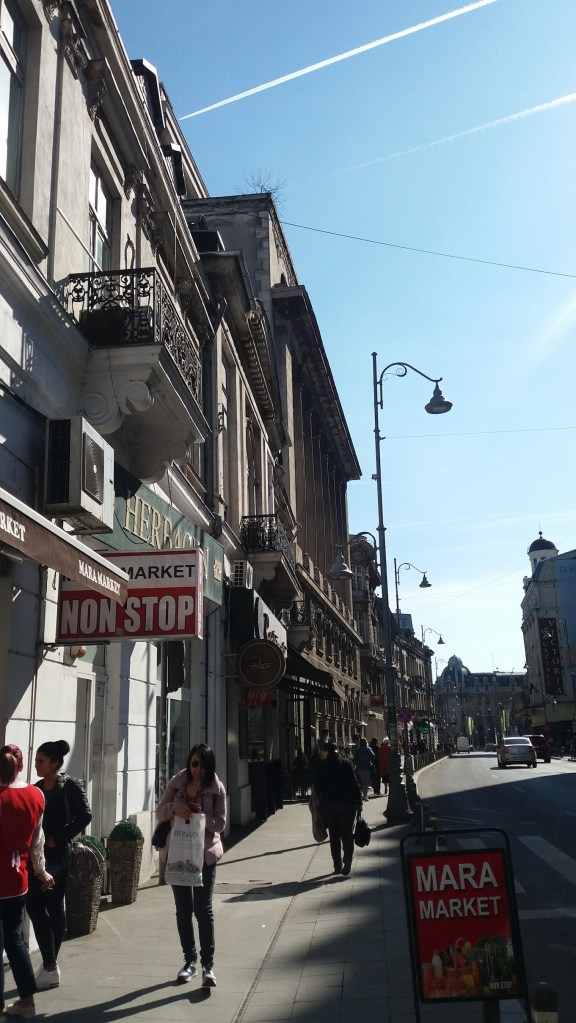
Right next door to the CEC palace is the brand new plate glass headquarters of Romania’s largest bank BCR, which is owned by Austria’s Erste bank. You can see the old glass and metal dome of the CEC Palace reflected in the walls of BCR.
Further along to the left is the National History Museum. At the weekend there’s usually at least one wedding party getting photographed here, and probably a group of schoolchildren too.
The museum used to be the Postal Services Palace, built back in 1892, and modelled on the Geneva post office. The large rectangular building has a portico at the front, supported by 10 Doric columns.
Later the left is yet another of the street’s many palaces, now looking very grimy and sorry for itself.
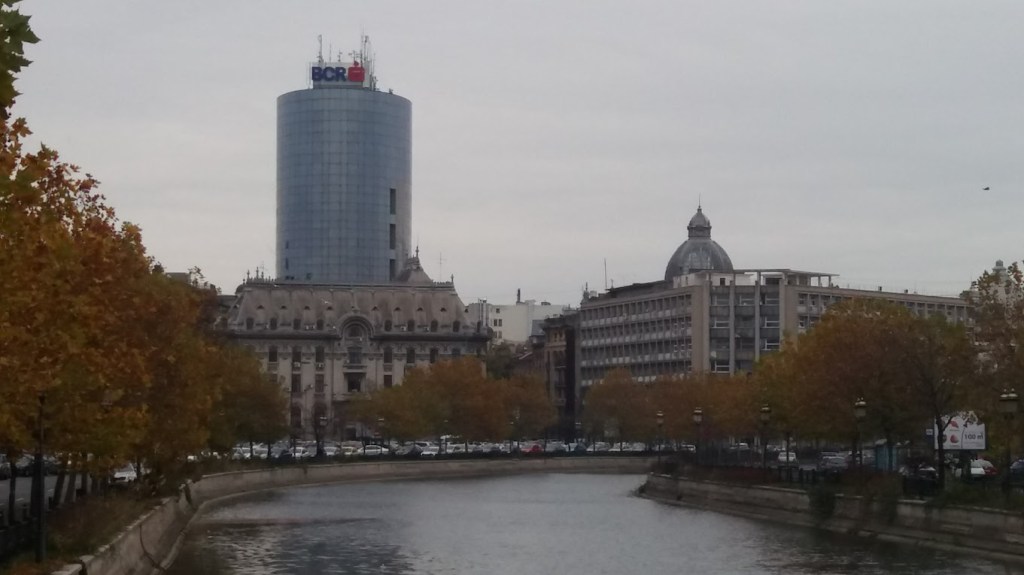
Calea Victoriei finally ends where it meets the Dambovita river, diagonally across from the Bucharest court of appeal.
 Steppe in Style
Leave a comment