After our alarming arrival in Curtea de Arges on an extremely dark, stormy and dog-ridden night, we woke the next morning to find a calm sunny day, with the town sparkling after the previous night’s deluge.
After breakfast at the Pensiune Montana, we set off to explore what was once the capital of Wallachia, one of the predecessor states of present day Romania.
Curtea de Argeș was the first capital of Wallachia and an important political and economic centre during the medieval era. It declined after the relocation of the capital to Targoviste from the beginning of the 16th century, and its people started to depart for more dynamic cities
However, it remained significant because of the designation of the cathedral at the Curtea de Arges Monastery as the burial place for Romanian rulers.
It was then revived under King Carol I, who gave it the status of royal city in 1886, the same time as he designated the monastery’s cathedral as a royal necropolis.
Carol I was also behind the decision to build the railway connecting Curtea de Argeș with Pitesti then on to Bucharest.
Open air museum
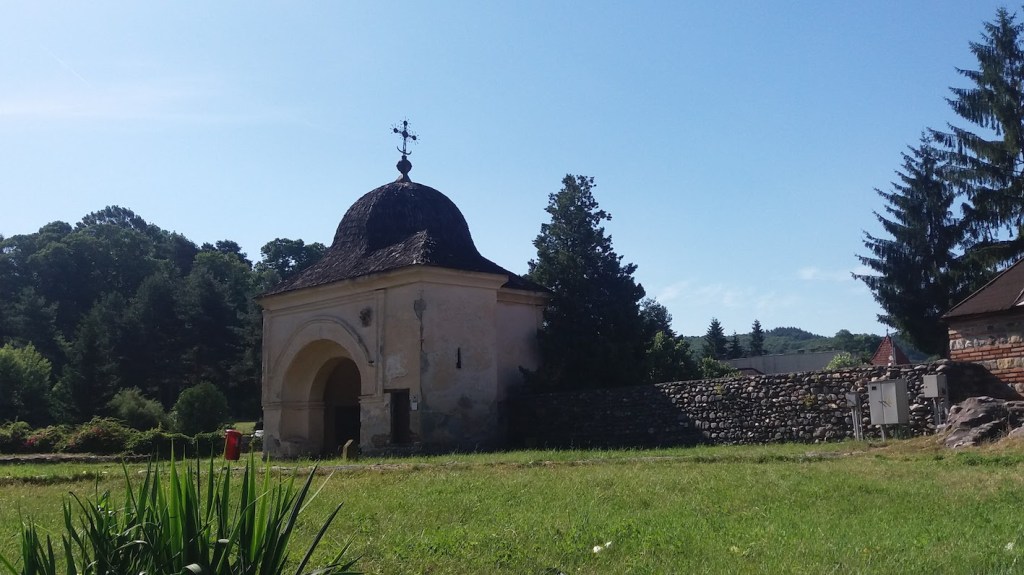
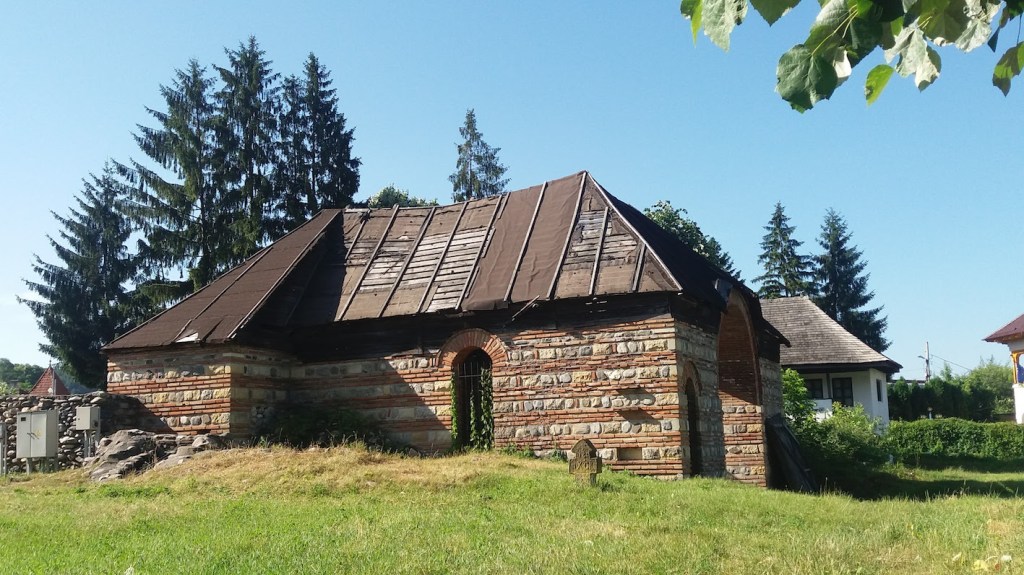
We stated the day by exploring the old Curtea Domnească or Royal Court of Curtea de Arges, an open air museum of historical monuments close to the town centre.
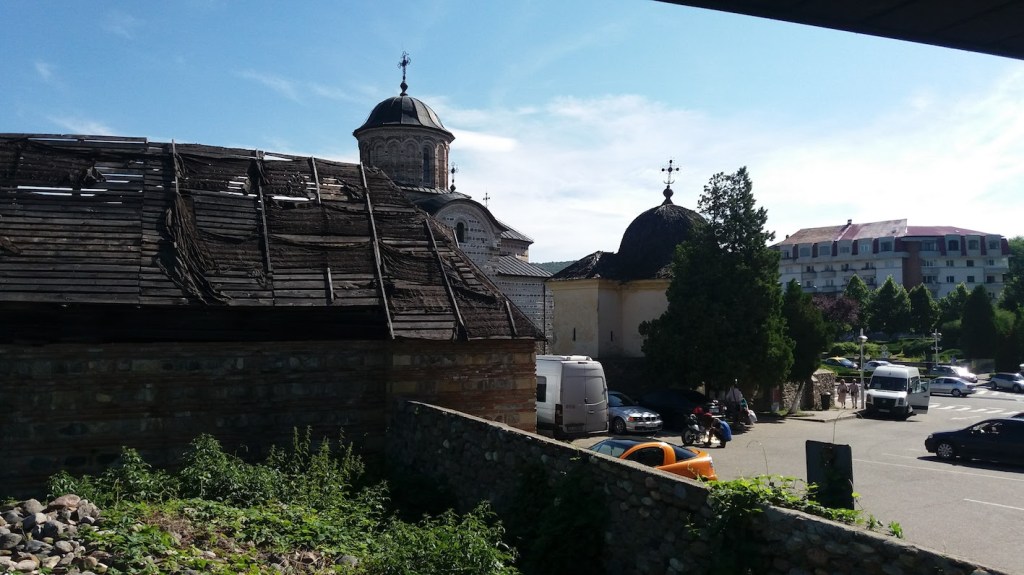
While ToddlerB played in the long grass, I examined the ruins of princely houses and other old buildings, as well as the Romanian Orthodox Princely Church of St. Nicholas.
Unfortunately the church was closed to visitors that day, so we didn’t get a chance to see the 14th century frescoes, but as the only visitors at the Royal Court we were able to wander happily among the old buildings and ruined walls.
The small Municipal Museum nearby gives a brief overview of the town’s history, and there are some interesting exhibits.
We also came across the Municipal Museum of Ethnography and Folklore in the historic Casa Norocea quite by chance; the museum and has a big collection of artworks and other items.
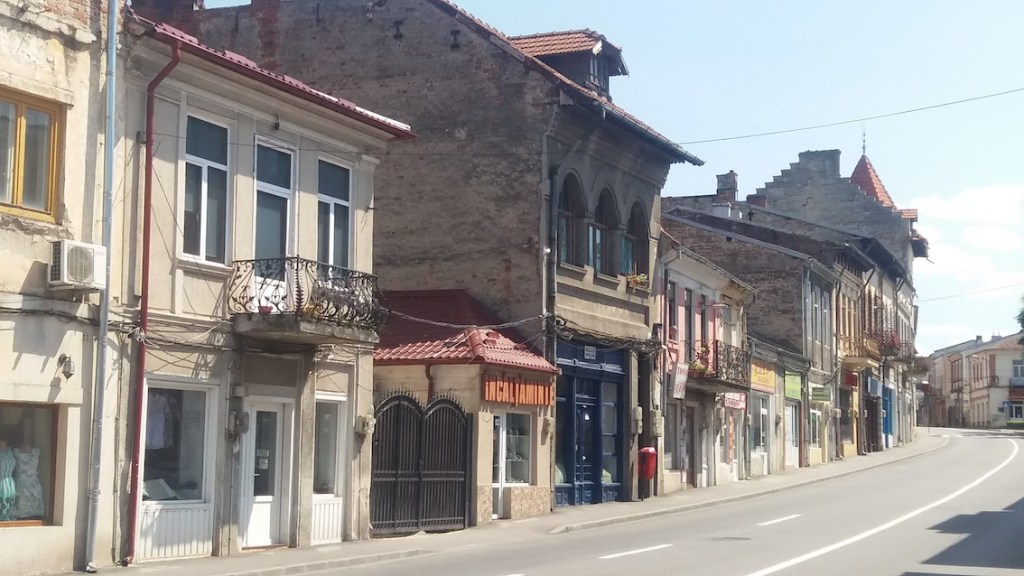
When the midday sun got too intense, we retreated into one of the cafes on the town’s main street for fresh orange juice and lemonade.
We sampled several during our stay and found the menus heavy on the pizza and chips … which was exactly what I wanted travelling with a two-year old (and there were plenty of strong cappuccinos for me).
That though got me reflecting on the differences between what I looked for on a trip as a single persona and what I look for now as a single mum (but that’s a post for another day…)
Curtea de Arges monastery and cathedral
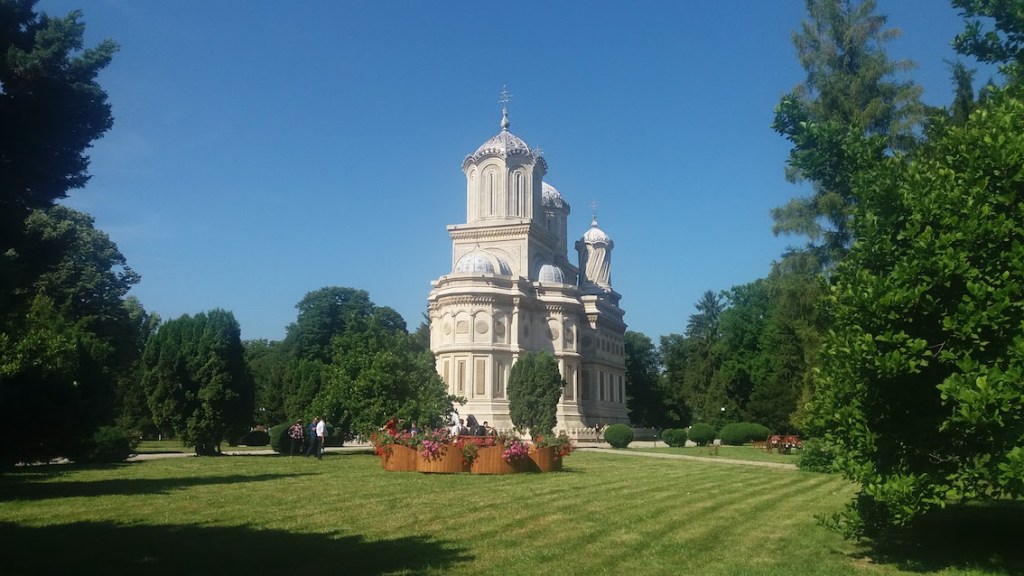
I’d noticed tour buses arriving and departing through the day on their way to the Curtea de Arges monastery, which is one of the most important religious sites in Romania, so we set off for our visit to the monastery early in the morning, hoping to avoid both the crowds and the heat.
It was built in the early 16th century by Prince Neagoe Basarab. The limestone cathedral was built in the Byzantine style with a large central dome, and the Patriarch of Constantinople attended the consecration ceremony in 1517.
Despite the fanfare with which it was opened, there followed centuries of damage from fire, earthquakes and other attacks that almost demolished the monastery.
However, later leaders such as Matei Basarab, Serban Cantacuzino and especially King Carol 1 rebuilt the monastery — though this unfortunately resulted in the destruction of the original frescoes, of which only a few pieces remain in Bucharest’s National Museum of Art.
A macabre legend
Legend has it that the work of the men building the monastery kept being mysteriously destroyed during the night. To break the curse, the prince ordered the builders to sacrifice a woman. When all the other builders sent their families into hiding, one builder by the name of Manole sacrificed his wife by burying her alive inside the wall.
Manole came to an unfortunate end too; he and his colleagues unwisely told the prince they could build an even better building. To stop them, the prince left them stranded on the roof. They made wooden wings and tried to fly down but plummeted to the ground.
While most of this is clearly made up, it is true that the man in charge of construction in the 16th century was an Armenian by the name of Manoli of Niasia.
What we didn’t do
There are two spectacular Romanian attractions close to Curtea de Arges, neither of which was practical with a two-year-old.
The medieval Poenari Fortress was used by the 15th century Wallachian ruler Vlad the Impaler — the inspiration for Count Dracula — who expanded it several times as a stronghold against the Turks. It’s located high in the mountains, up a steep 1,480 stairs. I considered a visit but we heard bears had been spotted around the stairs in the last few days so decided not to take the risk.
The Transfagarasan highway starts near Curtea de Arges, running though the Fagaras mountains to connect southern Romania with Transylvania. The 90-km road is a spectacular feat of engineering. It rises as high as 2,042 metres above sea level near Balea Lake, making it Romania’s second-highest road. It was a flagship project of Romania’s communist dictator Nicolae Ceausescu that took almost five years to build, being completed in 1974 by armies of soldiers and engineers, and 6,500 tonnes of dynamite were used to blast a path through the mountains.
 Steppe in Style
Leave a comment