If you go outside of the main towns and cities in Central Asia, and visit anywhere that’s not a soviet-built or post-independence building you will encounter the pit toilet — and it probably won’t be pleasant.
And on Kazakhstan’s immense expanse of steppe, usually even these smelly, fly ridden outhouses are in short supply.
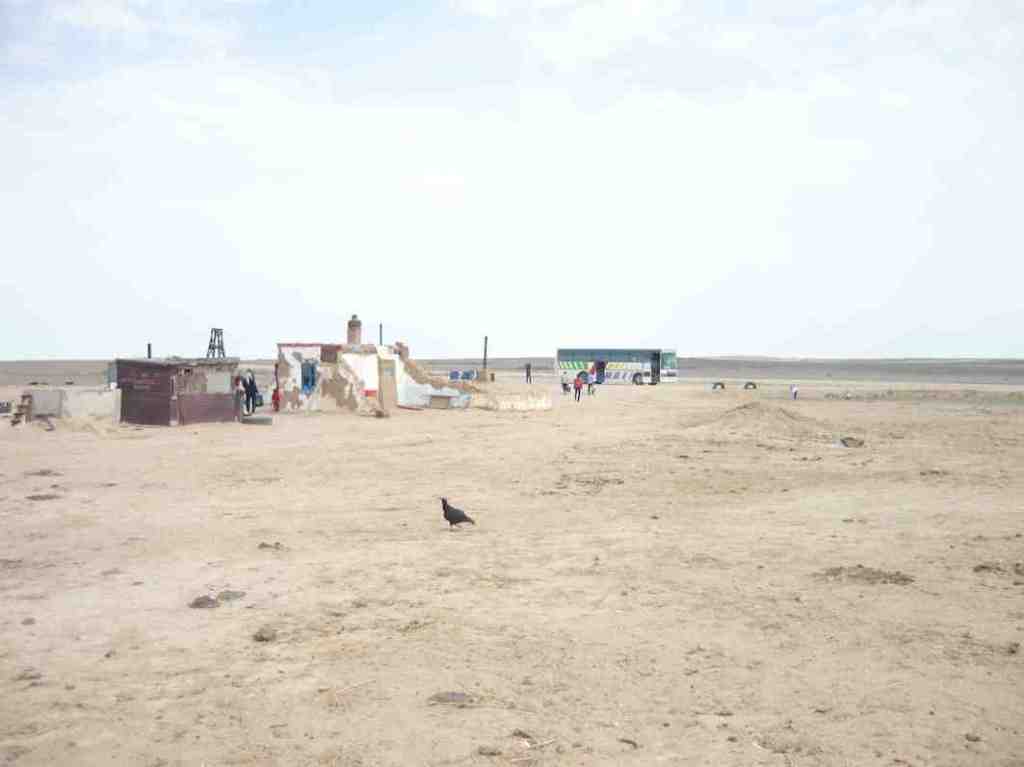
The reality of toilets in Central Asia came home to me on the excursion from Kyzlyorda to Baikonur, a journey of around 260km mainly across empty steppe and semi-desert.
Big distances, few conveniences
Toilets in Central Asia aren’t pleasant but no toilets at all is even worse.
After driving for two and half hours at least we came to a better paved bit of road and past a T-junction there were a row of cafes and a petrol station.
Our party was overwhelmingly male, and as the men gathered in front of a few wooden huts housing toilets, I wondered what to do. I joined a small group of Kazakh women who also looked uncertain. Unlike most of the women in Kyzlyorda they were wearing western clothes, although two were wearing headscarves.
“Do you not want the toilet?” one of them asked.
“Yes, but there are too many men,” I answered.
They conferred briefly in Kazakh (Russian wasn’t much spoken in the south and west of the country), then we set off for the cafe next door. There was a toilet in a wooden shack in the yard, a plank and drop affair.
When we got to Baikonor nearly two hours later, after a look around the cosmodrome, we were shepherded into the banquet hall, and presented with a smorgasbord of meat, salads and cakes along with lashings of beer, vodka and soft drinks.
What about the ladies?
I noticed that like me the other ladies we sitting primly perhaps taking a sip of water but nothing more while the men knocked back the drinks; it seemed I wasn’t the only one worried about the lack of loos on the return journey.
After the men had eaten and drunk their fill we moved on to the round table on investment opportunities in Baikonur, before starting the long journey home in the early evening.
As I had predicted we made several stops for the men in the party to discharge their beer and vodka onto the steppe, and I was relieved that I didn’t have to join them.
The world’s 9th largest country
As I’ve said before, it’s hard for someone from a small island that’s home to over 60mn people to compute the sheer size and emptiness of Kazakhstan.
On the main intercity roads, you can drive for hours without coming to a major town, just a small settlement or cluster of isolated houses here and there.
There’s also the occasional pit stop with a cafe or two and an outhouse — sometimes a wooden shack, sometimes a metal transit container — where the toilets are.
Central Asians have a peculiar fondness for transit containers. In fact, give a Central Asian a container and a blow torch, and he will happily convert it into a market stall, a cobblers shop, or — along most of the highways — a public lavatory.
Mooning in the moonlight
Sometimes toilets in Central Asia are so stinky people just head off into the steppe. That’s what happened on an overnight bus journey from Almaty to Balkhash.
When we stopped by some conveniences, the women headed off in one direction and the men in the other. I followed the women about 50 metres from the bus where they squatted down.
On the way back I asked one why they didn’t use the toilets.
“We prefer this toilet,” she said, indicating the moonlit emptiness.
Risking frostbite
A few months later, I was skittering on an uneven rink of frozen urine in a metal container somewhere between Astana and Ekibastuz, trying desperately not to slide into the reeking hole, which made me realise that perhaps the field was not such a bad idea.
An icy wind was howling up through the hole, as I clutched the unfastened metal door with one hand and my trousers with the other. Outside, I suppose we’d have risked frostbite in some embarrassing places, as the wind chill that day was -50C.
But even this was preferable to the horrible discovery an hour or so from Kyzlyorda — where I had cheerfully but unwisely downed two cappuccinos and a bottle of water with lunch — what there would be no toilets at all for another two hours.
Informed that this was impossible, the driver sadistically stopped in a place even more flat and featureless, I felt, than the last 100 kilometres of empty steppe. The one good thing, I suppose, was that no cars passed on the empty road while I was crouched behind the bus doing my business.
None of the passengers had any choice at our first stop in the over 400km bus journey from Zhezkazgan to Kyzylorda. Apart from one tiny cafe with a single outhouse about halfway between the two cities, there was simply nothing beside the road.
So we stopped in the steppe. The men went to the front of the bus, and the women to the back.
MP’s ‘striptease’ for foreign guests
There’s a growing feeling that toilets in Central Asia aren’t really acceptable for the kind of modern nation Kazakhstan aspires to be.
One MP actually brought it up in the parliament, where he complained about the quality of the public lavatories on Kazakh highways. He recounted that he’d been on a trip wth foreign guests and had been mortified to have to “perform a striptease” when they stopped for the toilet.
Still it isn’t only public toilets that aren’t connected to plumbing. My very first press conference in Bishkek, Kyrgyzstan was all about unlined pit toilets and the health risks of leaking sewage.
In rural areas across Central Asia, there most likely isn’t mains water or a sewage pipe, so the toilets in private houses or outside restaurants will be pit toilets.
And when you’re on the road between cities, forget about toilet paper or a place to wash your hands. It’s worth travelling with a packet of tissues and some wet wipes.
A new use for pebbles
Maybe not in Tajikistan though… I’d read in the guidebook that Tajiks traditionally use pebbles instead of toilet paper. I actually assumed it was a misprint as I couldn’t figure out how this would work. That is, until I was in a shared taxi driving from Istaravarshan down to Dushanbe and the driver stopped, scooped up a handful of pebbles and disappeared behind some shrubs for five minutes.
That’s one local custom I won’t be adopting.
 Steppe in Style
Leave a comment