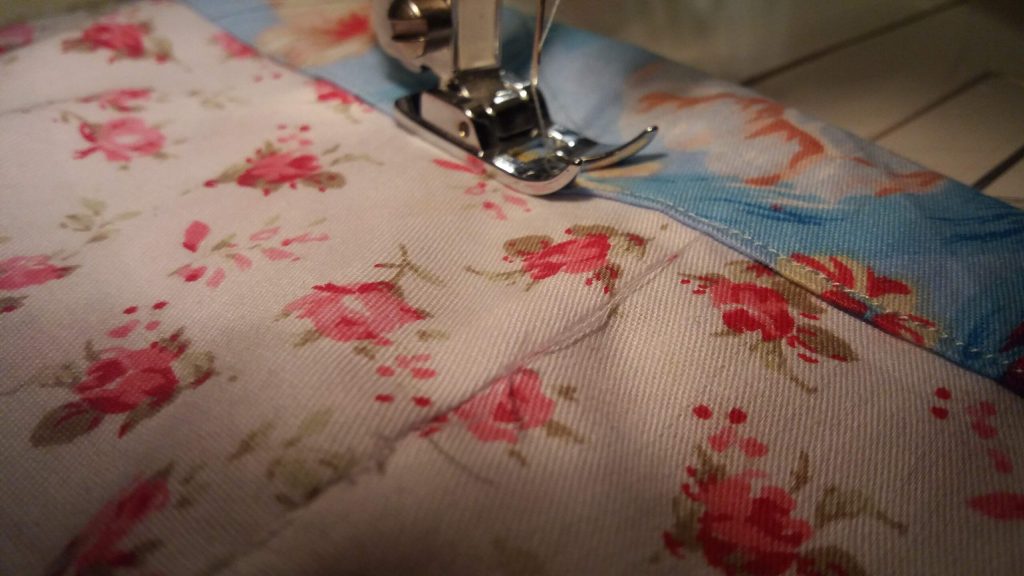
Shortly before I turned 35 I decided I wanted to enrich my life, which during the winter in Astana had mainly been spent working or hanging round the flat eating comfort food and watching box sets.
One thing I’d wanted to be able to do for a while was to learn dressmaking so I could make my own clothes. I’d though about it a lot but had been put off by my poor performance in textiles classes at school — when I only managed to distinguish myself only by accidentally running the sewing machine needle into my own finger.
During the winter I’d got into watching Project Runway, which inspired me to actually do something about learning dressmaking.
Finding the atelier
This being Astana, learning dressmaking wasn’t as simple as just looking on the internet for a course or finding an adult education centre.
After an unproductive Googling session, I posted a question with the International Women’s Club, and one of the members got back with an address of a local atelier that offered lessons.
This turned out to be round the back of the big market on the right bank, a trip that required an entire free afternoon, and several bus journeys.
When I eventually found it, the shop was in a mini arcade down a dirt track with little old Russian houses in a state of disrepair. I struggled along through the driving rain that was so cold it felt like sleet. Underfoot, the ground was thick with mud as the snow had recently melted.
The shop was upstairs along with clothes shops and a nail salon. There was nobody there and the door was locked, but peering through the glass I could see bolts of fabric and sewing machines.
There was a number on the door so I called it and to my pleasant surprise a woman answered and invited me to their new shop on the Left Bank.
Helping out with the road-sweepers uniforms
This was in another small arcade not far from the wedding cake building. Intorg was obviously quite a big concern as it occupied a whole wing of the arcade.
The owner was late, but a couple of young Kazakh women were there, and they invited me to join them. They were cutting fabric pieces for green uniforms for men cleaning the streets.
I helped as we rolled the fabric out on a big table, folded it, smoothed it scrupulously. One of the women chalked it, then cut as I held it steady
The owner, a charismatic middle aged woman with long grey hair, arrived about half an hour later, just as I was checking my watch yet again.
She explained they would be starting a dressmaking course within the next two weeks and there was one other student already signed up.
An unexpected job offer
“You can do the course then come to work at the atelier,” she said.
I explained that I already had a job.
“At an atelier?”
“No I’m a journalist. I want to learn to make clothes as a hobby.”
She looked a bit surprised but didn’t make any objections. Instead, she showed me around the atelier and explained that as well as dressmaking commissions, they also make clothes for workers — like the green uniforms I’d been helping with.
The factories that used to make them have all closed down so now they farm them out to small places like Intorg.
Where’s the teacher?
That Saturday, I turned up promptly to the class at five to 10.
At five past, the owner turned up and opened the classroom for me. I sat down and laid out my A4 pad (a conference freebie), notebook, pens and pencils.
At quarter past, a slight young Kyrgyz woman arrived and we introduced ourselves. She was the other student, and planned to work at the atelier after her training.
At 20 past I rearranged my pens and pencils and checked my phone for messages.
At half past I went to find the owner and asked her what was happening. She said the teacher would be there soon.
At 35 minutes past the dressmaking teacher arrived in a flurry.
High-level course
It wasn’t the best start to the course, but once she got into the lesson it was very interesting, and much higher level than I’d been expecting.
Rather than looking at pretty fabrics and learning to sew, the dressmaking course started with pattern-making, which was more like geometry.
We learned how to take measurements of a women’s body, then a man’s and a child’s. These would then be inserted into a complex series of formulae, and used to draw a pattern from scratch.
She then taught us how to do a similar thing with “blocks” which were used to create mass market patterns.
It wasn’t easy to keep up with her rapid Russian but I took notes as best I could and copied down the formulae from the blackboard.
As she went along, the teacher barked questions at us, and we were supposed to regurgitate the information she had given us.
Right at the end of the first lesson, we measured each other the used tracing paper to made a small scale model of the skirts we would be making.
The teacher told us to buy greaseproof paper and graph paper and make our full size skirt patterns for homework. We were also given a shopping list of drawing and sewing tools, and told to buy some fabric.
This was the first of the course of eight lessons and by the end we would have made four garments: a skirt, trousers, blouse and dress.
Astana’s fabric district
The teacher gave me directions to some fabric shops, which were in a cluster on the right bank, about a 15 minute walk from the akimat (city hall).
After getting some lunch, I spent a lovely afternoon browsing the huge and cavernous shops, pushing between hundreds of rolls of fabric.
In the end I chose a beautiful silk georgette with print on it that looked like colourful spatters of paint — there was something about the blues and reds that reminded me of Astana’s colourful new buildings against the evening sunset with just a hint of the fresh green leaves.
I also bought some gold linen fabric for the trousers, and both a white cotton for the shirt.
The fabrics weren’t cheap as they were all imported — some from Europe and the less expensive ones from China.
I hadn’t been able to find either a curve rule or a large roll of graph paper, so I sellotaped together sheets of A4 squared paper from a pad I’d picked up at a conference at the Hyatt, and spent a happy Sunday afternoon mapping out the skirt pattern.
Late again…
When I got to class the next Saturday the teacher was 25 minutes late.
“Do you live at the Hyatt?” she asked when she saw my pattern.
She then complimented me for coming with pens, pencils, graph paper and greaseproof paper — which the other student hadn’t managed so I shared mine with her.
“Foreigners are good at doing this,” she commented.
Good at what, I wondered, buying stationery?
The next week the teacher was 45 minutes late, the other student didn’t turn up at all, and I had forgotten to bring my Kindle.
When she finally arrived, I was fuming even though I was keen to start on the trousers.
“How long can you stay after the class?” was her first question.
“No time at all,” I said firmly. I was meeting friends for lunch.
She then left to speak to to the owner — “I am having a work moment” — and told me to ask the girls in the salon for instructions.
Staffing issues
Mid-week, the owner phoned to say she was sacking her because she was always late. This seemed a bit harsh — though her lateness was infuriating — and I said I didn’t mind if she could just try to be on time in future.
“No, it’s not just for your lessons,” explained the owner. “She is always late to the atelier in the mornings and then the girls are sitting around with no one to tell them what to do every day.”
The new teacher was a young Uzbek woman . She was in her early 20s, very slim with a dark bob and a nice smile. Her clothes weren’t expensive, but she chose them well and always looked stylish.
I found her teaching style even harder to follow than the first teacher’s but she was never more than 10 minutes late for our lessons, so on the whole I was pretty happy with the change.
We chatted as we worked, and one day she told me: “I met a Turk over Skype and he is coming to stay with me in Astana.”
Fashion show
By the end of the two-month course we managed to finish all four garments, and I took part in a fashion show cum graduation ceremony with 15 local women who had been attending a group dressmaking class at the same atelier.
We modelled our clothes in the corridor, which served as a runway, drank squash and ate biscuits. The owner and an official from the ministry of industry and new technologies presented us all with our certificates from the course.
I wore the new linen trousers I’d made to an important event: a Q&A session with British Prime Minister David Cameron at Nazarbayev University.
More posts about clothes
How I went from terrible packer to travel capsule wardrobe expert
I cut my closet in half after an international move: here’s how I did it
How I rescued my boring travel capsule wardrobe for Tirana
My 12 item capsule wardrobe for Corfu and Saranda
 Steppe in Style
Leave a comment