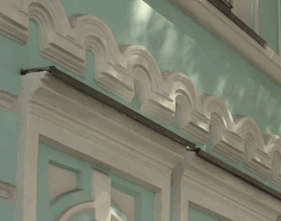
Astana is more than just a modern city; people have lived in the area since ancient times, and its oldest buildings date back to the mid 19th century.
It’s hard to remember this when walking around with the city’s spectacular (and sometimes kooky) modern architecture towering above, but every now and then among the iconic buildings and brand new apartment blocks I stumble upon a relic of old Astana.
Buildings like the Astana supermarket, the Museum of Saken Seifullin and the church of Konstantin and Elena all bear witness to the city’s pre-soviet past.
The history of old Astana
Long before it became a metropolis complete with gleaming skyscrapers and modern infrastructure, nomadic people lived in the Astana area since the Stone Age.
The town was officially founded as Akmola in 1830 by a Russian military fort named after the nearby river Akmolinksaya.
In 1824, Cossacks established Akmola Fort on the left bank of the Ishim River to protect trade routes from robbers and raiders. The fort was officially renamed Akmolinsk in the first of what would be many name changes in 1861 after Russian Tsar Alexander II gave permission for settlement outside the fort walls.
The town quickly grew into an important centre for trade and industry in Central Asia, especially after the Trans-Aral Railway opened in 1898, connecting Europe and East Asia via Russia.
Astana’s oldest building, the Merchant House
The oldest building in Astana is the Merchant House, now the Museum of Saken Seifullin on Auezov Street. The single-story building was built by local merchants as an office in 1846. It has since served as a kindergarten, but now houses a museum celebrating the poet, writer and statesman Seifullin.
Seifullin was an important figure in the early 20th century. He wrote about the independence of Kazakhs from Soviet and Russian control, but because of this he was considered a threat to society. He was executed in Almaty in 1939.
Today, he is remembered as one of the most important Kazakh thinkers and a major influence on Kazakh culture and literature.
The museum officially opened in 1988 in the building where Seifullin once worked, and is a research centre as well as a museum.
Next door is an old wooden building, marked as the House of Dr F. I. Blagoveshchenskiy, where the administrative offices for the museum are now located.
Cathedral of Konstantin and Elena
Another old building is the Cathedral of Konstantin and Elena on Respublika Street. It was built in 1854-1856 and consecrated in July 1856. In the late 19th century, the church was moved from its original location to where it stands now, a process completed in 1902.
In 1938 the church was closed, and crosses and bells were removed. In 1940, the building was converted into a Museum of History and Local Lore. During World War II, it housed a battalion of the 29th rifle division. In 1942, after numerous requests from believers, worship was allowed to resume in the church.
The cream coloured church, with blue domes, is 33 metres long and eight metres wide. The bell tower is located above the western entrance to the building.
It is significant as the only religious building in the city that has survived from the 19th century.
Legacy of the Kubrin family
The old building I visit the most is the Trade House of the Merchant Matvey Kubrin, which is now home to the Astana supermarket. Photos of the city’s merchants hang on the walls inside (though I’m more often to be found searching for ingredients I can’t find at my local supermarket).
Another merchant, Vassiliy Kubrin, lived in the nearby building that now houses the Ukrainian embassy. He is believed to have fallen in love with a Russian actress, who only agreed to move to the Kazakh town if he would build her a mansion.
Soviet to independent Kazakhstan
What came next was the construction of the Soviet era still prevalent on the right bank, though rapidly being overtaken by new builds.
Akmolinsk became Tselinograd when the disastrous Virgin Lands campaign was launched in north Kazakhstan in an attempt to turn the steppe into a new breadbasket for the growing Soviet population.
The name was changed again, this time back to Akmola, after the collapse of communism, as Soviet names were switched for Kazakh ones.
In 1998, President Nursultan Nazarbayev declared Akmola to be the new capital of Kazakhstan and renamed it Astana. ‘Akmola’ means ‘white tomb’ in Kazakh, which was considered insufficiently positive for the glittering new capital.
The new name ‘Astana’ simply means ‘capital’, an unremarkable name that inevitably led to speculation there are plans to name it after the president at some point in the future.
And in this era, Astana got the architecture that has made it internationally famous – the likes of the Khan Shatyr mall, which resembles a massive tent made out of glass and steel, the Baiterek Tower whose design represents the tree where the mythical bird Samruk laid her eggs or the huge Nur-Astana Mosque.
More posts about daily life in Astana
Astana, Kazakhstan’s glittering capital on the steppe
Hanging out at the malls in Astana
 Steppe in Style
Leave a comment