Karaganda used to be a byword for remoteness when Kazakhstan was part of the USSR, a kind of Soviet Timbuctoo. There was a joke that went:
“Gdye?” (“where” in Russian)
“Karagandye!” (“in Karaganda” – meaning, I don’t know where)
Not far from Karaganda is Dolinka, the headquarters of the Kazakhstan gulag — named Karlag — that used to stretch over an area of mostly empty but resource rich land the size of France.
Astana to Karaganda
Regular buses run from Astana to Karaganda and other major cities, but taking a minibus or a shared taxi from the car park outside the bus and train stations is quicker and only slightly more expensive.
It’s not always easy to find which bus or taxi to take though.
I made for a white minibus halfway across the carpark.
“Karaganda?” I asked a man standing nearby.
He looked at me in shock and said nothing. We eventually found the right bus – another unmarked white minibus – close to the train station.
I was with a friend but we had to sit separately as we were the last passengers to board, which was good timing because minibuses leave as soon as they are full. I sat in one of the single side seats, while my friend was in the back row with three Kazakh lads.
As soon as the bus started, everyone except us two English girls immediately fell asleep, as they always do on bus journeys in Kazakhstan. The three lads slumped over towards my friend like a row of dominoes.
Teleserial in the steppe
We were the only ones watching the Russian serial shown on a TV mounted at the front of the minibus. It was an action-packed saga set in Siberia with fights, kidnappings and passionate love scenes; we got through a lot of ground during the 200 kilometres to Karaganda.
“It’s the longest series ever,” hissed my friend to me over the heads of the sleeping passengers. “By the time we get there, they’ll all have grandchildren.”
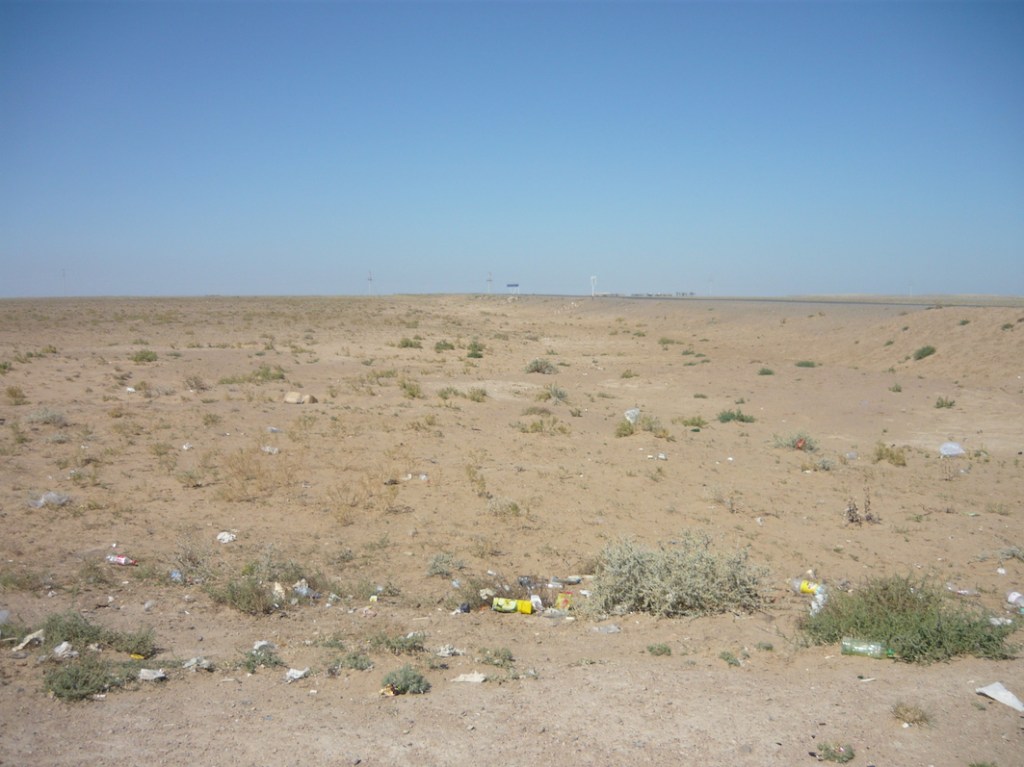
Outside the flat greenish-brown steppe flashed past, broken only by occasional tiny villages or old concrete monuments. Eventually we reached the industrial outskirts of Karaganda, a major centre for coal mining and metallurgy, and Kazakhstan’s fourth largest city.
I had visited several times, so I knew we were getting close to the centre when the semi-derelict factories gave way to apartment blocks and the bus entered the central Bukhar Zhirau Avenue that ran right through the city.
We passed the small park with a new independence monument that had replaced the giant Lenin statue a few years ago. Then there was the Communist era miners’ palace of culture, with a row of statues of workers mounted along the roof.
Opposite it, in front of the entrance to Karaganda’s central park, was another statue of two miners holding up an enormous chunk of coal — a geologist friend once told me that this much coal would weigh several hundred kilos and would be impossible to lift.
Hotel Karaganda
When we passed the miners, I knew we were nearly at the Hotel Karaganda, the main hotel back in the Communist era.
I had stayed there once before, when memorably my room had been so full of the fun of cigarette smoke and air freshener it had caused an instant headache and I’d had to sleep in my coat and hat so I could keep the door to the balcony open despite the sub-zero temperature.
However, we didn’t want to pay the money to stay at the new (and much nicer) Art Nouveau hotel, and the cheaper hotels were even worse, so the Hotel Karaganda it was.
After dropping out bags in our (non smoking) twin room, we went across the road to the shopping centre, where we had lunch at Il Patio, a restaurant chain with a huge menu offering Italian, sushi and traditional Russian and Kazakh dishes.
We opted for Russian, lunched on bowls of vareniki (pasta stuffed with potato) and sour cream, before heading to the taxi rank to find a car that would take us to the gulag museum and back.
Karaganda to Dolinka
Karaganda isn’t a large city, and the concrete apartment blocks soon gave way to steppe interspersed with occasional hills as well as industrial works (some looking abandoned) and slag heaps, most of them old and covered in grass.
The mines around Karaganda were originally built using slave labour from Stalin’s prison camps. In fact this whole region used to be the giant Kar-lag prison camp, which stretched from north of Astana halfway across the country.
Dolinka, where the camp’s headquarters were, was a 20 minute drive from Karaganda. Considering its history, it was a surprisingly pretty little town with low whitewashed houses set in well tended gardens.
A bigger white building with a large rose garden in front was the former camp offices, now turned into a museum.
The collectivisation disaster
The museum display started with the story of collectivisation in the early 1930s. Kazakhstani peasants suffered like those across the former Soviet Union when they were forced to give up their farms and join the new collectives.
On the eve of collectivisation, they held mammoth feasts, slaughtering their own animals and gorging themselves on their produce. This was followed by two years of famine, and photos from the time showed emaciated Kazakh families, children with bloated bellies, and the dead stacked in carts.
Then there was the next wave of turmoil after the Second World War when Chechens, Germans, Poles, Tatars, Koreans and many other nationalities were loaded into train cars and forcibly relocated to Kazakhstan. Plastic mannequins in traditional costumes represented the nationalities that had been sent here.
Blood-stained basement
Then we descended into the barely lit basement. In the stairwell I noticed that the walls were painted with a mural of hands, intwined with twisted barbed wire.
The first room in the dungeon like basement was a replica of the old prison camp dormitory and more of the rather spooky plastic mannequins this time in prison uniforms.
At the end of the dark corridor was the interrogation room; a cell with red paint smeared on the walls to indicate blood.
As always in Kazakh museums, the display ended with a room dedicated to modern Kazakhstan and its president. There were the pictures of Nazarbayev with Putin and other world leaders, Nazarbayev beaming from a field of grain, Nazarbayev surrounded by smiling schoolchildren in traditional clothes, Nazarbayev inspecting a factory, and so on.
Back in Karaganda, night had already fallen. In need of the comfort of good food, good beer and a roaring fire, we went to the local branch of Line Brew for dinner.
 Steppe in Style
Leave a comment