My trip to Balkhash was my first long bus journey in Kazakhstan, a 10-hour overnight trip.
On the way to the bus station, I get talking to my taxi driver, a sweet old Kazakh man, who introduces himself as Nulet.
When I told him where I was going he immediately warned me that it was very dangerous to go from Almaty to Balkhash by bus because the temperature can be as low as -30C out in the steppe.
“Why didn’t your friends tell you this or help you to buy train tickets?” he asks.
“The train was full.”
“They tell you that because you speak with a foreign accent,” says Nulet. “If you give them a little money, they will find a place.”
No room in the bus
Despite the chill outside, the bus is warm and stuffy, because it’s crammed full of people. There’s no room for me to stow my bag or bulky winter coat, so I sit down in my window seat with them bundled on top of me.
My neighbour, a large man, is bundled into a big smelly coat, and when the young woman in front puts her seat back it completes my feeling of claustrophobia.
As we set off, my neighbour asks if I want a sip from his bottle of beer.
I politely decline.
He asks if I want to put one of his earplugs in my ear and listen to his music.
I decline again.
I wonder if he’s going to suggest any kind of social interaction that doesn’t involve exchanging bodily fluids. He doesn’t, and falls asleep quickly, leaving me to look out the window as the busy streets of Almaty give way to the almost complete darkness of the steppe.
Camels in the snow
I can see almost nothing from the bus by night, except when we pass through occasional villages. By their lights, I can see low wooden houses by the road.
Out in the steppe again, the bus slows suddenly and yellow brown humps loom beside us — camels, some 15 of them, travelling north along the road. We overtake them.
A Russian detective drama plays on the TV at the front of the bus through the night. Its bloody fist fights in the snow and the occasional laughter of passengers at witty comments I don’t understand merge in and out of dreams.
When we stop halfway for a toilet break — the women head out into the empty space by the road instead of braving the stinking wooden hut — thousands of stars glitter overhead.

At 6.15am, I suddenly see the lights of Balkhash ahead. Approaching the city, we cross a flyover — very unusual in Kazakhstan — and a woman says into her mobile: “We’re on the bridge.”
We drive through wide streets flanked by four story apartment blocks to the bus station.
Outside it’s the coldest I’ve experienced since coming to Kazakhstan: -18C.
The disappearing lake
I’m here on my way to a conference in Astana where the UNDP is organising a workshop on Lake Balkhash, which is drying up.
This is a result of increased exploitation of the rivers that feed the lake — mainly the Ili river that starts in China’s Xinjiang region then flows across the border into Kazakhstan.

Rather than fly, I decided to travel by bus, stopping off in Balkhash for the weekend, and see the town and the lake for myself.
But first, sleep. I collapsed exhausted into bed on arrival at my hotel, ignoring the smell of sewer gas in the bathroom and the flashing Christmas tree outside the window.
I just dropped my bag on the floor and my purse on the table — bearing both an ashtray and a “no smoking” sign — and fell asleep.
Small town charm – and a giant smelter
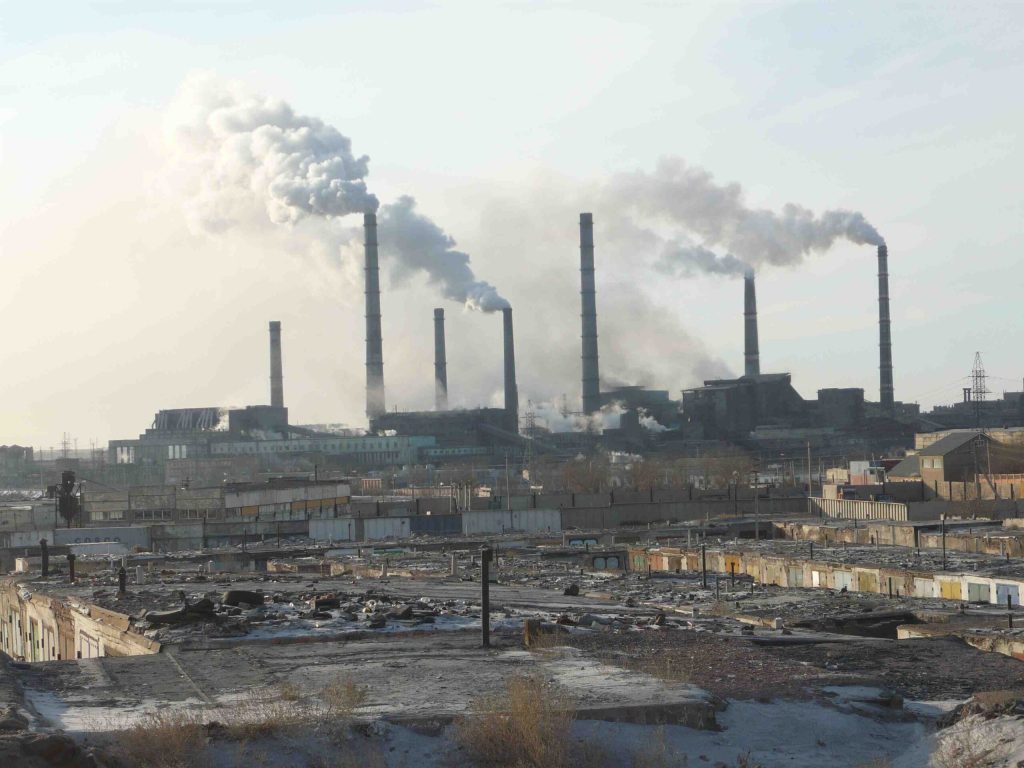
By day, the Russian-style cottages and yellow painted Soviet era buildings of Balkhash have a small town charm, despite the entire town being overshadowed by the massive Kazakhmys copper-smelting complex.
I trudge around on streets covered in a thin layer of snow trodden into the ground. In patches beside the road, the dirty grey surface scuffed off to reveal powerdry white snow — before the emissions from the smelter’s huge chimneys billowing smoke turned them to grey.
Outside the centre, there are taller blocks, painted sunny yellow, ochrous brown, brick red.
The people are bundled up in big coats — fur or padded. I see lots of big fur hats. Stray dogs slink around near the bazaar and Friendship Park.
The frozen lake

The lake is covered in a thick layer of ice, turned grey by the smoke. Dark figures are standing around out on the ice, fishing. As I stand there, a woman and child set out from the shore.
By the shore there’s a statue and tank mounted on a plinth. A man with videocamera waits for the arrival of wedding party to film their arrival at one of the town’s main sights.

There’s something apocalyptic about the smoke billowing from the plant and the steam rising thickly from manholes beneath the snow. Cats sit on the manhole covers, soaking in the warmth but squinting their eyes against the steam.
Next I got to the Workers House of Culture, where they are preparing for an event. In the white and pink marble interior, people are hurrying around in big coats. I ask about the museum, sparking a row between a helpful blonde woman and a nearby man.
Eventually the woman turns to and says I can go ahead and look inside the museum.
Afraid for the future

I spoke to one of the curators, who told me that people in Balkans ae afraid their lake will go the same way as the Arall Sea ad disappear if China keeps using more water from the Ili river.
“It’s not just because of the fishing industry. We love the lake and the nature around it,” she told me.
In summer this is a popular beach resort, but Nastya, a local beautician who gave me a manicure, said there’s nothing to do in winter. “The nearest city is 400 kilometres away,” she complained.
Nastya gave me a manicure while her colleague discussed what alcohol they would buy for a party that night. I smudged one of the nails almost immediately — i couldn’t go out without putting my coat on in the -18C cold.


“Snacks to bear”
I ate in the hotel that evening, in a brightly painted bar with decorated with Beatles posters.
The menu had an intriguing collection of cocktails — yellow beer, which was apricot brandy, orange juice and draft beer, or an IVF Martini made of absinth, liqueur, cream and espresso coffee.
The menu was disturbingly focussed on liver, offering things like “liver in pot, 877 tenge” and some endearing misprints: “lover meals”, “chick meals” and “snacks to bear”.
When I went outside into the frozen dark and quiet, the colourful blocks of flats looked like they had been dropped at random like toy building blocks by the shore of the lake.

The next afternoon I took the bus north to Astana, a journey that takes from 2pm to midnight.
Apart from a stop at the industrial city of Karaganda around 8pm, we passed almost no settlements, just clusters of little cottages, painted blue and white, with smoke wafting through metal chimneys.


 Steppe in Style
Leave a comment