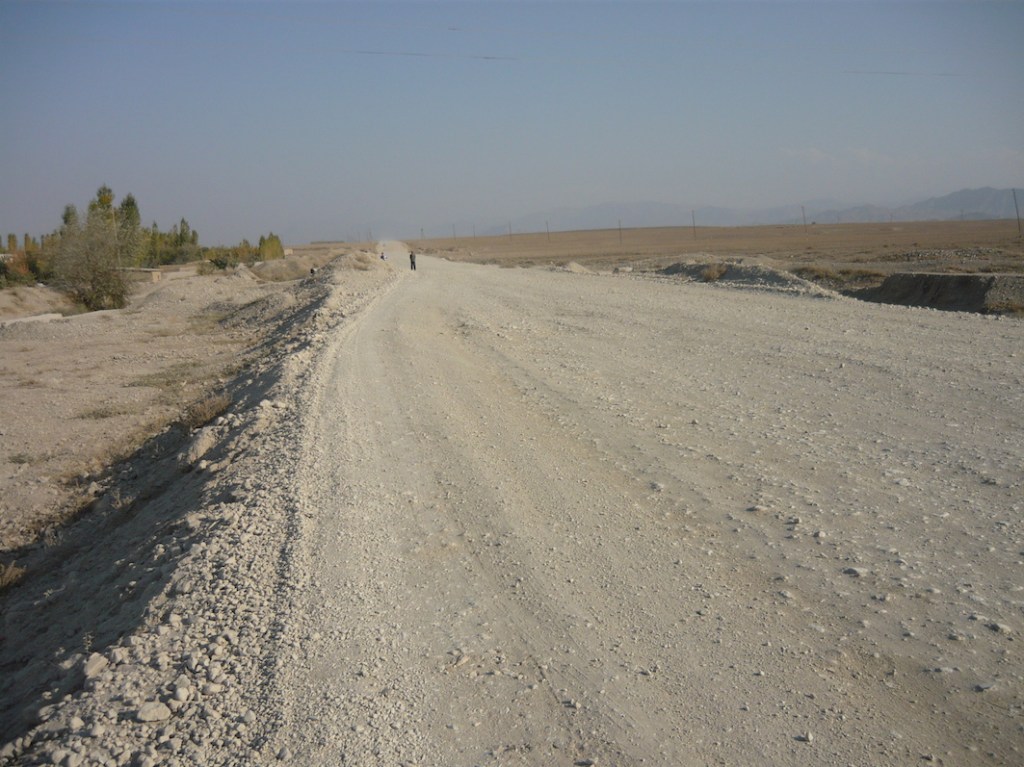
I need to get from Osh to the Tajik border. For $100 the hostel has organised a car to take me the long way around to Batken, avoiding several small Uzbek enclaves within the Kyrgyz Fergana Valley. The bus and most shared taxis go the direct route, but only holders of Kyrgyz or Uzbek passports can travel through the enclaves.
With me is Jyldyz, an ethnic Kyrgyz gynaecologist heading back to her home in north Tajikistan, just across the border. As I’m travelling from Osh to the Tajik border alone with the taxi driver on remote and little used roads, the hostel has thoughtfully provided me with a chaperone.
It means a much longer journey for Jyldyz, but with me the only other passenger in the car she’s happy to stretch out on the back seat and sleep.
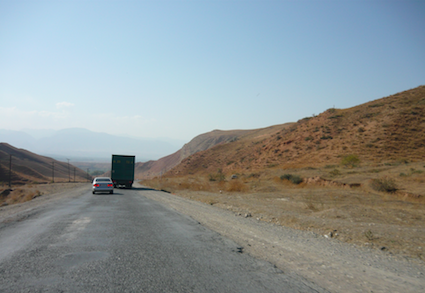
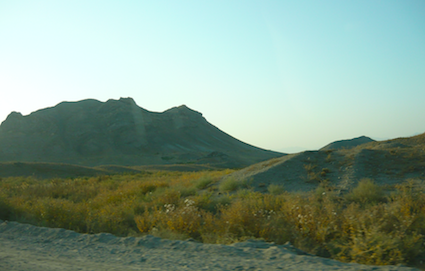
Outside the city of Osh, the road winds among rolling hills like sand dunes, reddish brown pale and sandy, with patches of scrubby grass.
Breakfast in Nookat
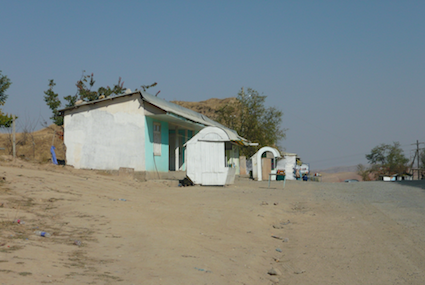
Jyldyz hasn’t had breakfast so shortly into the journey we stop in the small town of Nookat, where a cafe serves up a pot of tea with bowls of chickpeas, bread and salad. It’s delicious.
Superficially, Nookat is a pleasant town with poplars and weeping willows along the main street, but it has a darker recent history.
Last year, fighting broke out between local people celebrating Eid al-Fitr festival and the security forces. 32 people were convicted on charges of inciting unrest and fomenting religious enmity with some getting sentences of up to 20 years. This summer journalist Almaz Tashiyev died under unclear circumstances; his relatives said he was beaten by eight police officers.
Leaving Nookat behind, we race along a straight flat road with the speedometer reaching 120 kilometres per hour until we pass smashed up cars at the side of the road. Sobered, the driver, a 43-year-old called Buryam, reins in his speed.
Off the beaten track
He has to slow down again when we turn off the main road heading for the first of the enclaves onto a gravel track skirting round them. We’re one of only a small number of cars though we pass several trucks that send up clouds of dirt and dust in their wakes.
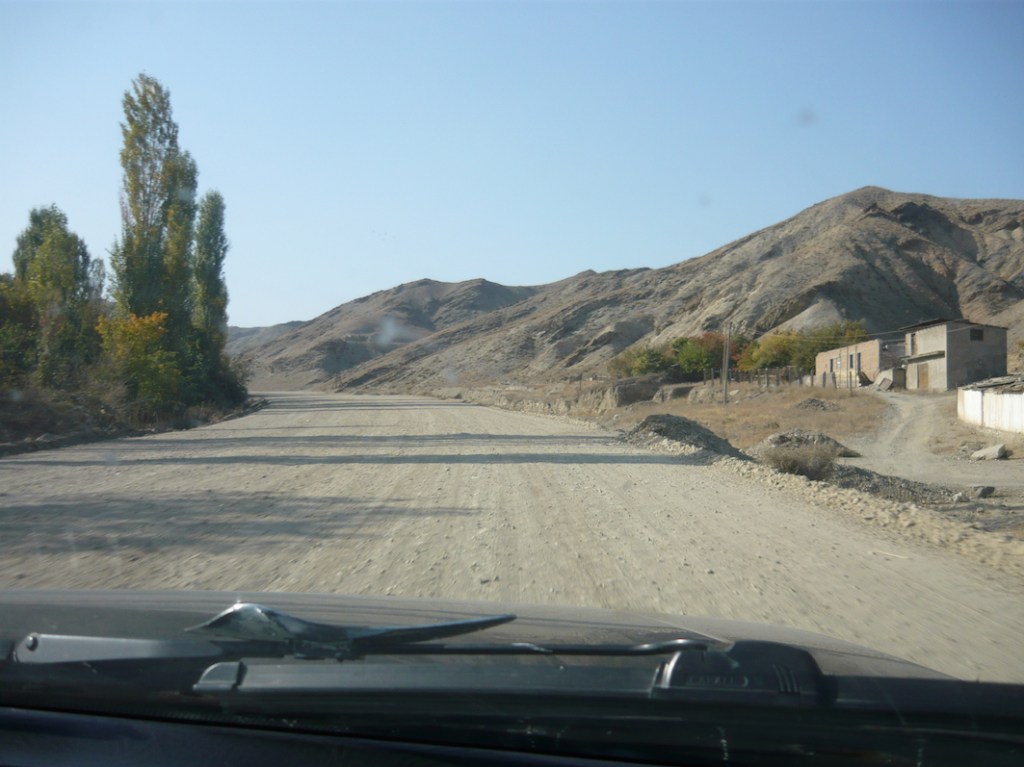
The gravel takes its toll on the car, and we have to stop and get out while Buryam changes a tyre.
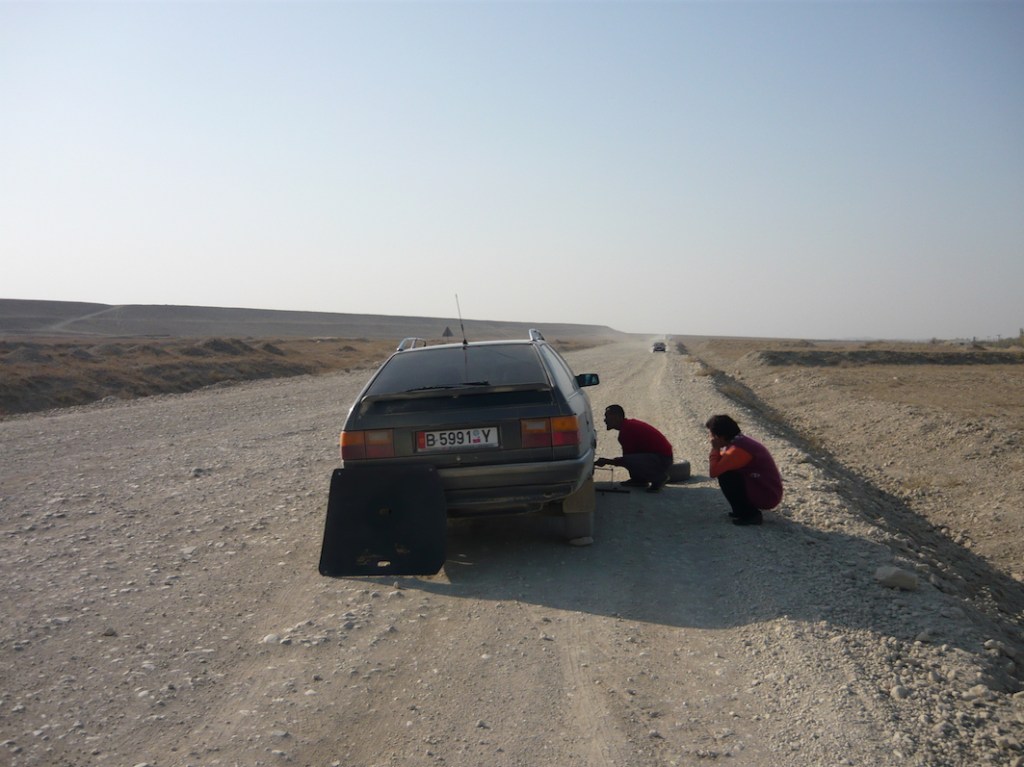
There are few settlements here, though we pass occasional mud huts by the road, and at one point a petrol station.
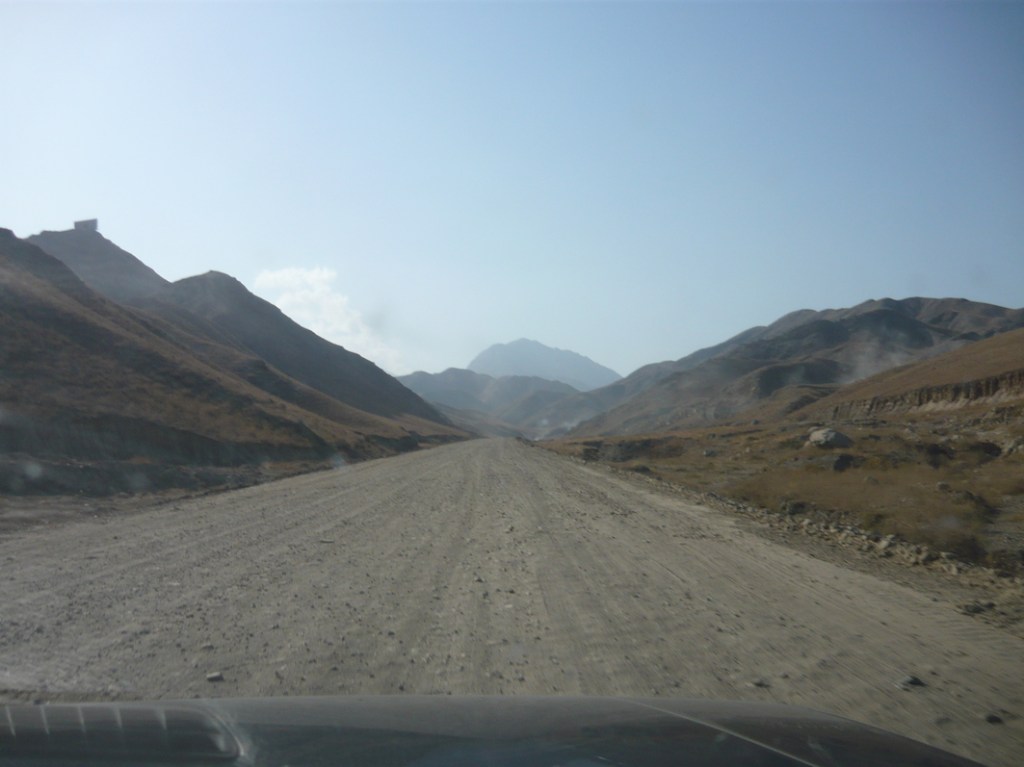
Eventually, mountains loom ahead of us, with red, yellow and green leaved trees on their misty slopes.
The journey from Osh to the Tajik border is a long one. After a brief spell on the main road, we turn off it again, this time into a green and irrigated landscape, with orchards and rice paddies. An old lady is sweeping the ground with a broom, sifting the dust for grains.
On bad roads without a spare
“This road is very bad for the car — haha!” says Buryam, exposing gold teeth when he grins cheerfully at me.
“Yes”
“I don’t have a spare!”
“I know.”
“How many miles have I been doing without a spare?! Hahahehaha!”
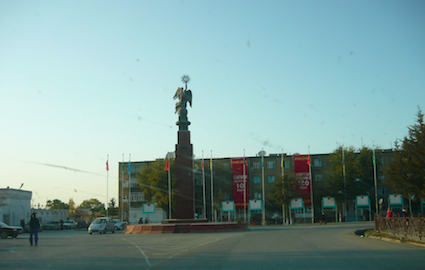
Fortunately we make it to Batken without another blowout. It’s a pretty small town with little white and blue houses surrounded by trees. A freedom monument, similar to the one in Bishkek but smaller, marks the central square.
“That’s Batken,” says Buryam as it flashes past.
On the outskirts of Batken he says goodbye to me and Jyldyz and puts us into a different taxi, for reasons unclear.
“Don’t show the Tajks where you keep your dollars when you get your passport out,” says Jyldyz.
“Why do I need to get my passport out?”
Romance on the Kyrgyz-Tajik border
Just then we draw up at a border post with Kyrgyz and Tajik flags, and I remember — rather belatedly — that na granite means across the border. Okay, so we’re not just going from Osh to the Tajik border today, we’re actually entering Tajkistan.
Jyldyz explains that the new driver, from Tajikistan, can take her to her home near Isfara then take me on to Khujend — where I was planning to head to tomorrow. This gives me an extra day sightseeing in Khujend.
It’s just us, a couple of border guards and one other car bursting with a large party of women. Jyldyz gets into a long conversation with the border guards in Kyrgyz, which I think is about me based on their looks and gestures in my direction. Am I going to be allowed to cross the border?
“May I have your phone number?” asks the younger and cuter of the border guards, suddenly turning to me and switching to Russian.
“Er well…” I try to explain to him that I have a Kazakhstan SIM card and it doesn’t work here.
“Give him your number! Give him your number!” chant Jyldyz and the women from the other car.
Jyldyz produces a pen and paper and I write down my mobile number while the guards take my passport off to stamp it.
On the Tajik side of the border we see the car full of women again. An old lady in the front seat points at the Tajik border guard and asks: “Did he want your phone number too?”
Somewhere past Isfara…
Isfara, close to the border, has lots of white houses like those in southern Spain, but older and more crumbly, then modern Soviet blocks and the city centre with a Lenin statue.
We stop for gas — by which I mean liquefied petroleum gas (LPG), not the American word for petrol — and the driver tells us to stand well away from the car.
“It’s dangerous.”
“Do they have gas in England?” he asks when the car is filled up.
“I don’t think so.”
“Small money,” he explains, rubbing thumb and finger together.
Darkness descends after we exit Isfara and I can no longer see where we’re heading. As far as I can make out, the driver is unhappy with Jyldyz’s directions to her home. Turning to shout at her, he nearly rear ends another car and slams on the breaks. Then we swerve off onto a rough country track strewn with straw. It’s hard going.
Fire!
An acrid smell fills the car, and smoke starts rising from the bonnet. We all leap out. The driver discovers some straw has got stuck in the engine and caught fire. He and Jyldyz argue some more, their voices drowning out the moos of cows and cries of chickens.
Jyldyz pulls me aside. The driver can’t go on to Khujend, he has to go back to Isfara and take the car to the garage. She invites me to go home with her — we’re nearly there — and her husband will drive me to Khujend in the morning. We pick up our bags and walk into the night.
 Steppe in Style
Leave a comment