Jyldyz and her husband were busy getting ready to attend their neighbour’s son’s circumcision ceremony, so she deputed her bother to drive me to Khujend.
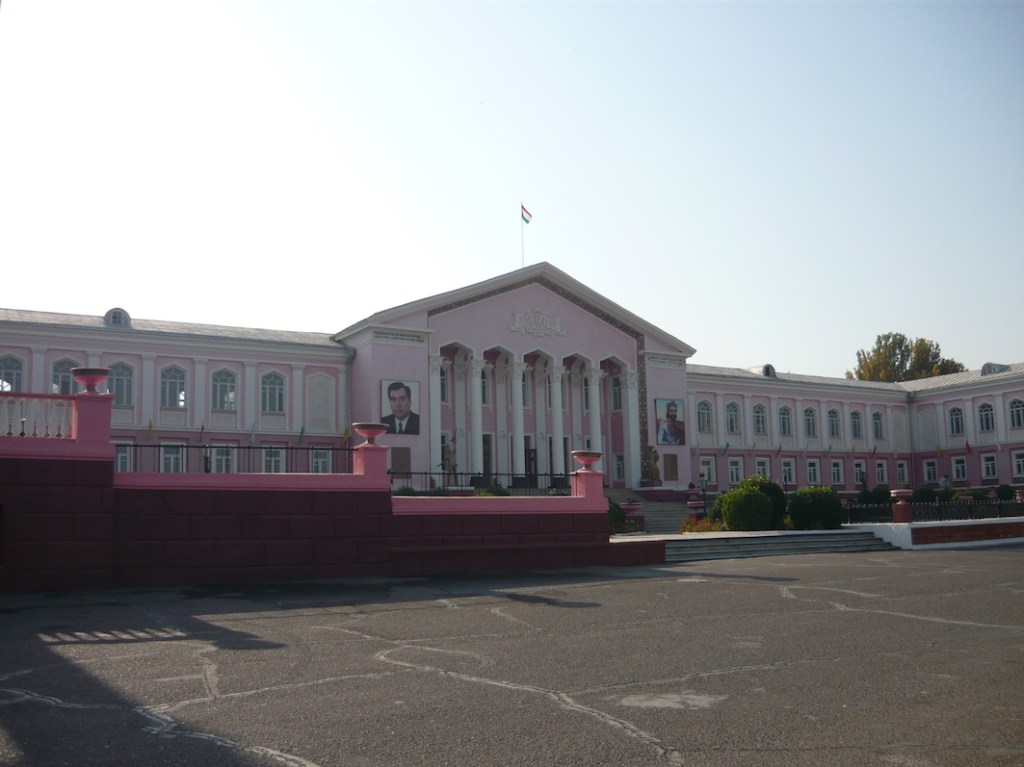
Rather than dropping me off directly at the hotel, he decided to show me arguably the most impressive site of the city, and took me first to the Arbob Cultural Palace.
We drove there along wide streets bordered with trees and roses, rhododendrons and other flowers. One of the main roads had eight lanes and a bed of bright red flowers down the middle.
“You don’t see this in Bishkek,” said Jyldyz’s brother proudly.
The Arbob Cultural Palace, modelled on St Petersburg’s Peterhof palace, was stunning, and completely unexpected in a former cotton farm in south Central Asia.
The building, which dates back to the 1950s, is the former headquarters of a cotton kolkhoz, or collective farm.
Moments in Tajik history
The Arbob Cultural Palace has more recent significance too as it was where the Tajik Soviet declared independence from the Soviet Union in 1992.
Later that decade, peace conferences on the end of the Tajik civil war were hosted here.
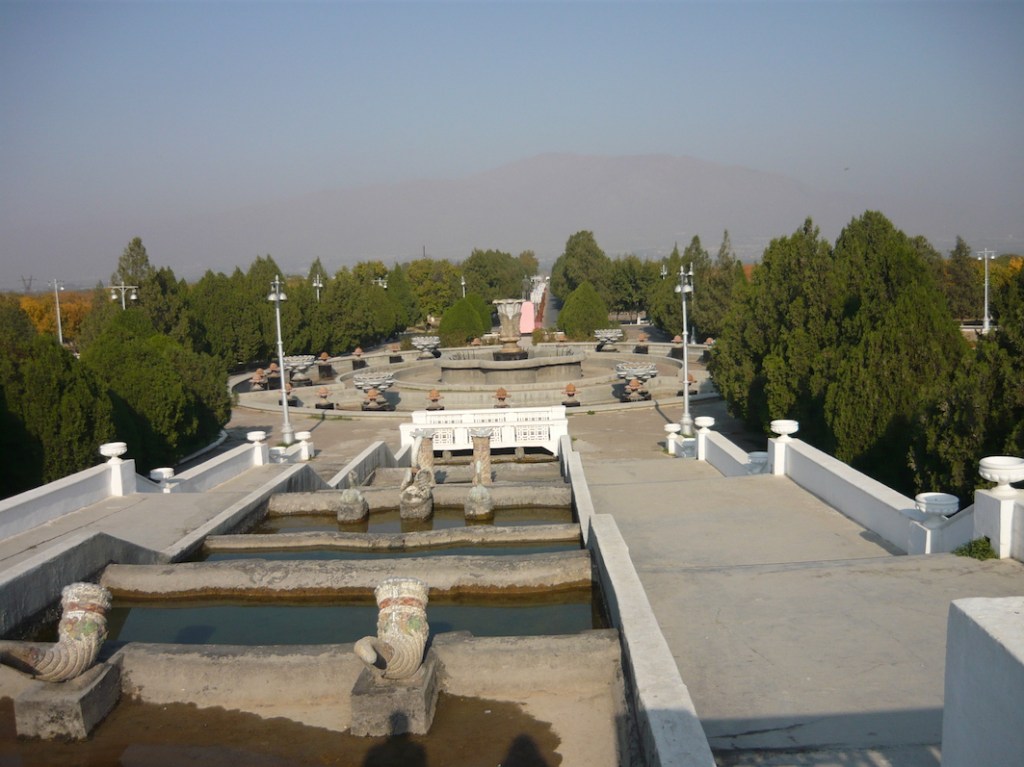
It was a beautiful, peaceful place with the scent of flowers carried on the light breeze, that ruffled the nasturtiums around the empty pond. Behind it, curved white staircases led up to the pink building with pillars.
“Is it Russian style?” I asked. I didn’t find out until later that it had been modelled on the Peterhof.
“No, Tajik style,” said Jyldyz’s brother.
Heroes and leaders
The door opened into a pillared marble hall, with pictures that Jyldyz’s brother said were ‘heroes’ on the walls. All of them now dead, except one that he pointed out.
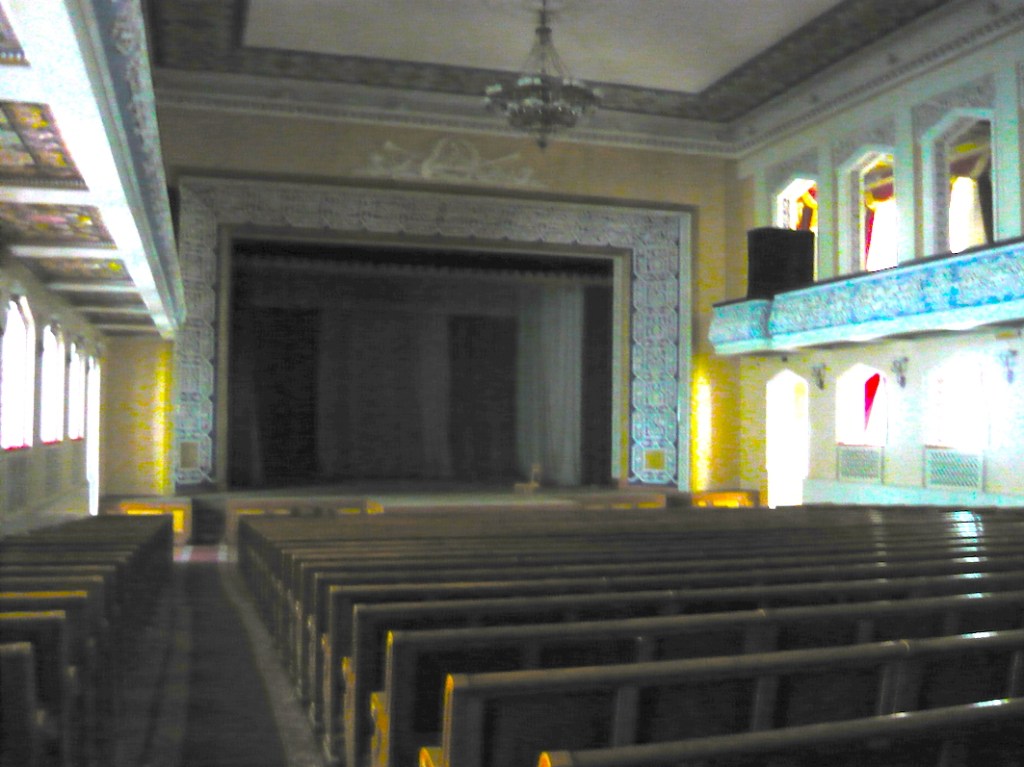
As we wandered through the Arbob Cultural Palace, I admired the vividly decorated walls, ceilings and pillars, where cotton, apricots, pears and other fruits of the kolkhoz were worked into the designs.
In the main room of the palace, a cavernous theatre, a portrait of Tajikistan’s President Emomali Rakhmonov glowered down from the wall.
“Our supreme leader,” said Jyldyz’s brother, possibly genuine or possibly sarcastic.

The kolkhoz museum
Upstairs, we exampled the farming implements and old photos in the kolkhoz museum, including some picture of the palace being built.
There were pictures of the Kolkhoz’s head Urukhojaev with Stalin and other high ranking Soviet officials like Kalinnin and Khushchev.
“Why was he so important?” I asked.
“Everyone looked up to him in Tajkistan,” said Jyldyz’s brother.
We moved on to more pictures of heroes.
“Heroes of the USSR,” said Jyldyz’s brother, “not of the kolkhoz.”
They were all men except for one solitary woman. I pointed her out and asked who she was.
“She was a director of the kolkhoz. Everyone looked up to her.”
Urukhojaev’s wardrobe
Finally we examined some of Urukhojaev’s clothes — we could even have touched them if we’d felt so inclined as there was no one around.
We looked at his huge coat, a buttonless shirt, a belt — Jyldyz’s brother showed me the groove where it had been fastened indicating how large he was — a pair of boots and some vast galoshes.
Later, eating lunch outdoors by the Syr Darya river, he told me that he was the director of a pipe factory. He wants to get married and have a family. But, he added thoughtfully, perhaps he will travel first.
 Steppe in Style
Leave a comment