Underground in Sofia railway station it’s dark, dingy, a bit sinister and all the signs are in Cyrillic. I immediately feel at home here. This is the Eastern Europe I remember.
People are loitering, holding cigarettes and tiny plastic cups of very black coffee or — at 6am! — beer. The little shops have almost empty cabinets with dry looking pastries, sausages and cheese.
I go to search for where the bus goes from while my friend stays with our bags. Upstairs is a big oblong hall, very gloomy despite the pale marble and huge plate glass windows along one side. There’s a metal fresco on the wall depicting, I think, the hand of friendship.
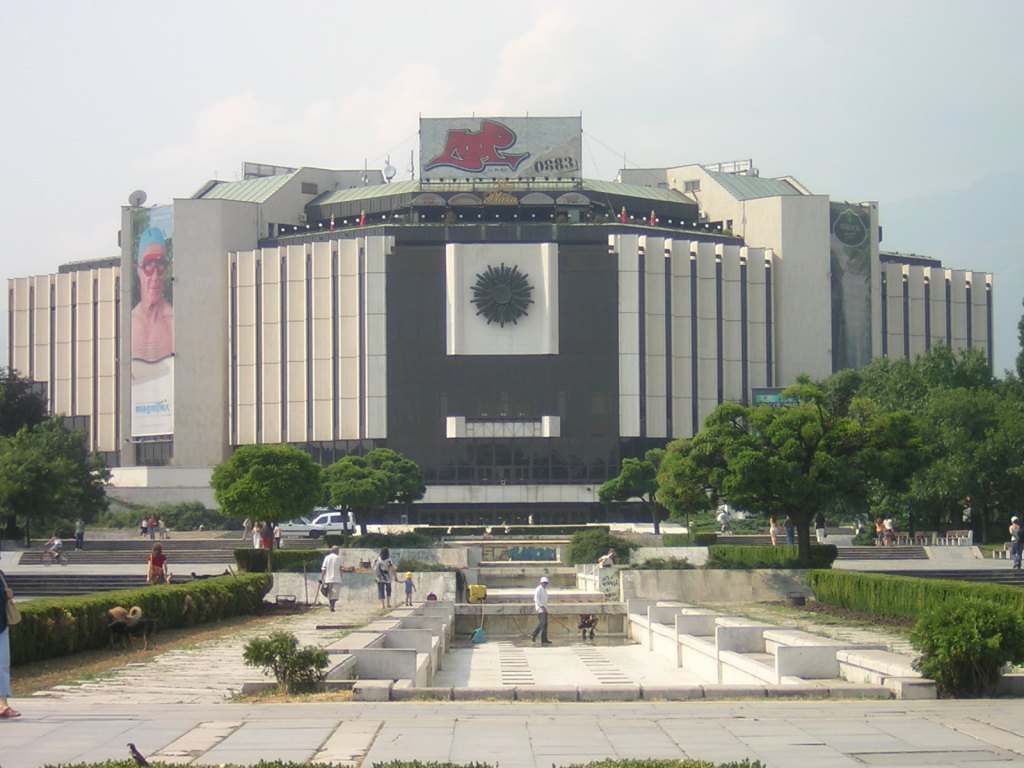
Construction of this Brutalist building started in 1971, after the old Sofia Central Railway Station, opened in 1888, was demolished. It’s a huge structure with two underground and three overground stories.
Outside, I dodge around a mangy, waif-like dog and approach a Bulgarian woman and her boyfriend, who is wearing an Aston Villa t-shirt, for directions. They advise me to take a taxi.
“But they will change you more because you are foreign!” Again, this feels familiar.
Out in the streets, Sofia had the leaden feeling of a town before a thunderstorm, but we didn’t mind the rain when it falls and afterwards the clouds lifted and we could see the Vitosha mountains looming above the city.
There has been a settlement here, under the mountain and west of the river Iskar, since ancient times, originally known as Serdica. It changed hands many times over the last two millennia, as armies of Romans, Huns, Goths, Slavs and Ottomans captured the city. At the time of Bulgaria’s independence its population numbered a little over 11,000; it now has around 1.2mn people.
Exploring Sofia
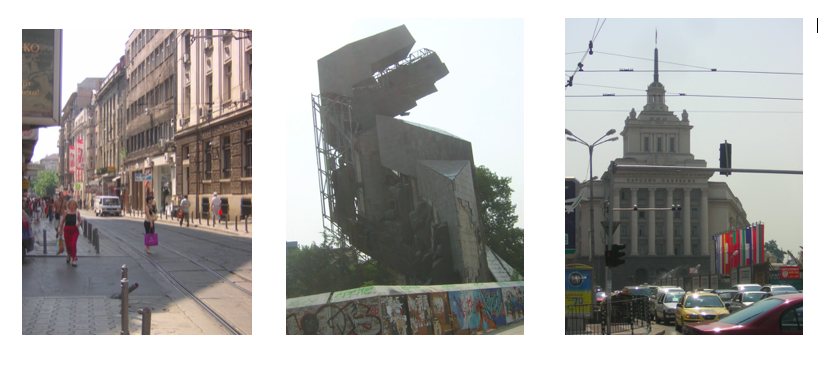
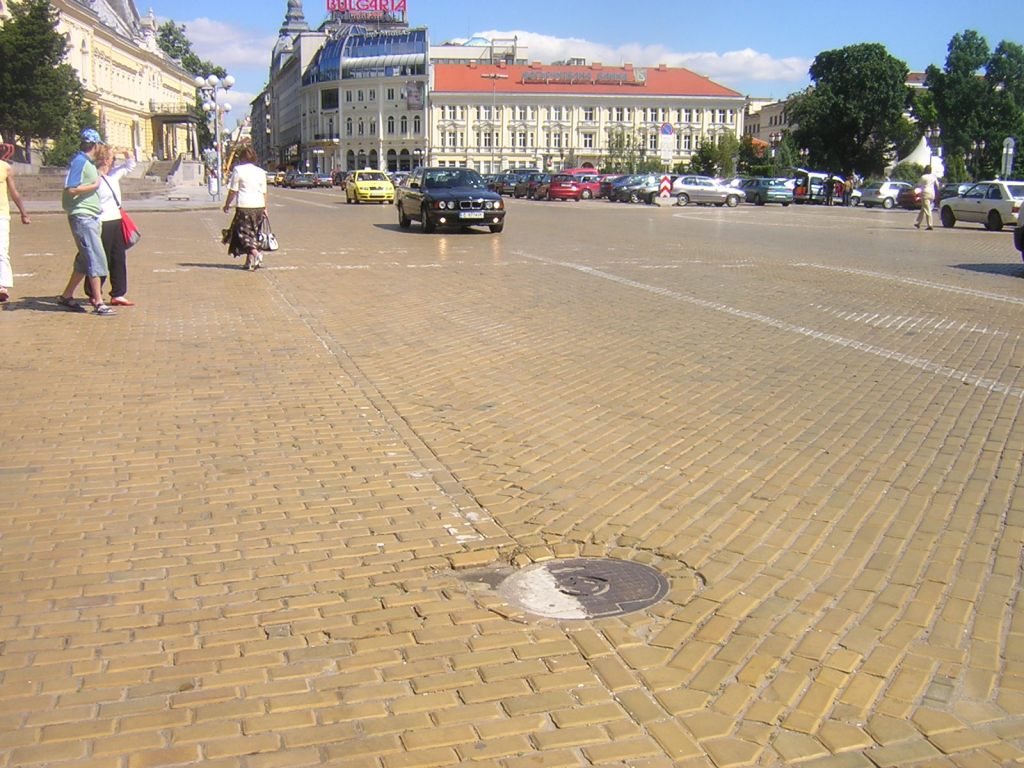
On our first walk around the centre we peered into the shops and cafes along Vitoshka street, the main shopping street in Sofia. It runs from St Nedelya Square to the Southern Park, and we walked along it many times during our stay, admiring the stately buildings (not to mention the expensive designer clothes in their windows).
Stopping for a much needed cup of coffee, we watched shopkeeper dress a mannequin in a vile orange and brown dress with bring orange ribbon lacing down the front. The shopkeeper surveyed the mannequin, went back into the shop and attached a plastic arm.
“What every well dressed woman is wearing this season. An arm,” said my friend.
We may not have liked it but oddly, women kept stopping to stare at the dress and one – clearly several sizes too large – stopped to look. She went away, despondent.
We noticed that while the men wore plain trousers and shirts, the women’s clothes were flamboyant, tight, colourful, designed to attract attention.
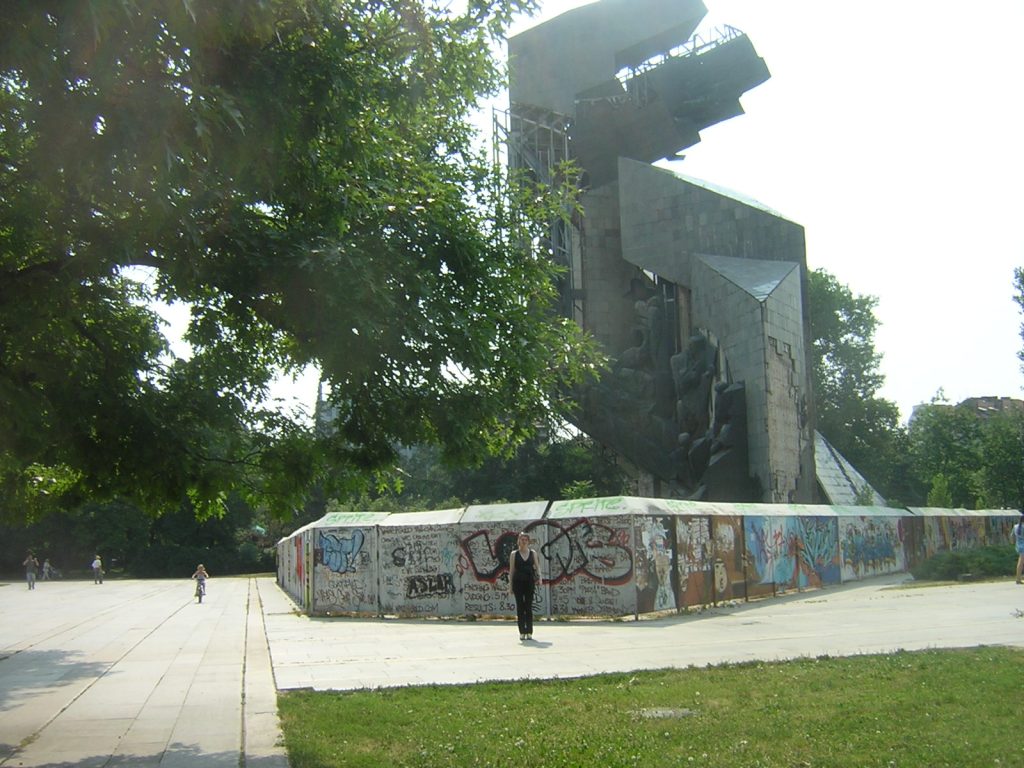
From coffee and window shopping we moved on to the sinister 1,300th anniversary memorial. It was built in 1981 and was supposed to symbolise the past, present and future of Bulgaria. But it was bizarre, and looked to me more like a big metal dog looking over its shoulder, surrounded by a heavily graffitied wall.
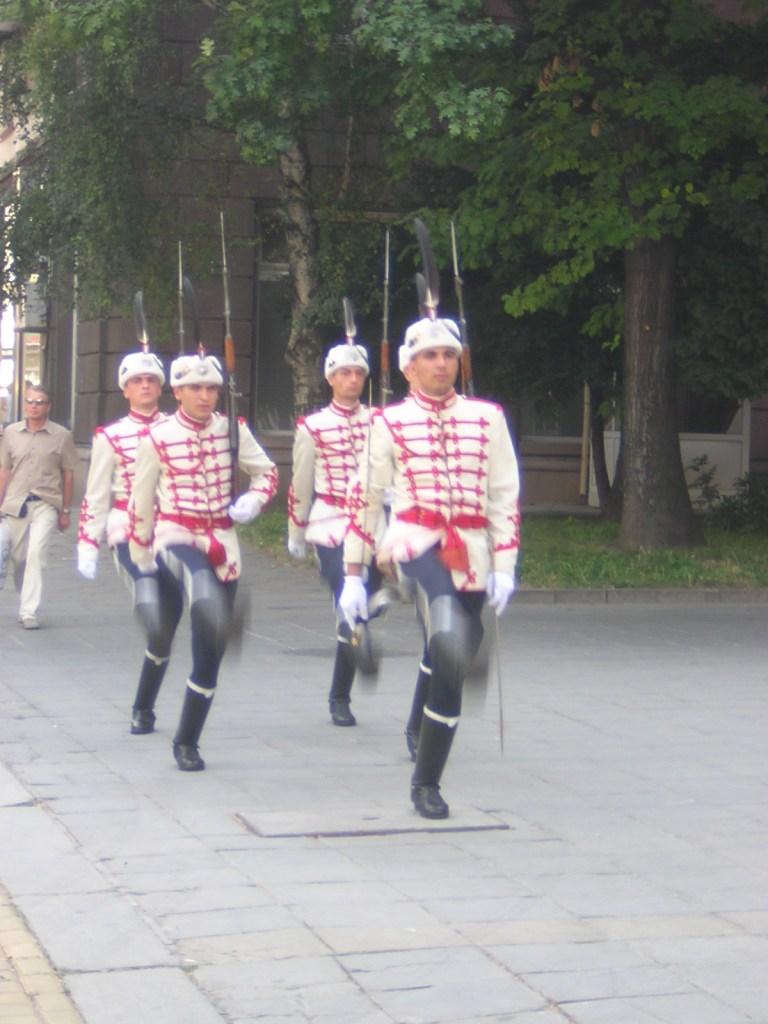
Outside the presidency, we managed to see the changing of the guard, a ritual introduced four years ago. The official changing of the guard takes place on the first Wednesday of each month at 12 noon as well as on national holidays.
The National Ethnographic Museum was founded in 1892 and since 1954 has been housed in the former royal palace, built in the late 19th century. It was worth seeing as much for the beautiful but crumbling old rooms as for the exhibits.
The exhibits led us through Bulgaria’s history and traditional culture. The museum’s entire collection comprises over 50,000 items including clothes, embroideries, woodcarvings, ceramics, metalworks and other items.
“The girls bake little pieces of ritual bread in the shape of human fingers and give them away in honour of ‘Granny Measles’,” said one of the captions.
This was a reference to St Barbara, who was killed by her father for adopting the Christian faith, and is also the patron said of children. In parts of Bulgaria she is known also as Granny Measles because she is believed to protect children from measles and other diseases.
At the Ladies Market, we saw women smoking cigarettes behind piles of tomatoes, onions, thin pale green peppers and watermelons. In the air was a strong reek of fish being cooked in batter.
The open-air market dates right back to Bulgaria’s liberation from the Ottoman Empire in 1878. During Ottoman times, women were only allowed to go shopping in the area that is now the Ladies Market, and then only on Fridays. As Sofia, capital of the newly independent Bulgarian state, began to grow so did the Ladies Market, as a place for city dwellers to buy fresh and affordable farm products.
Our favourite Sofia restaurants
Unfortunately we couldn’t cook for ourselves as we were staying in a small hotel and didn’t have a kitchen so instead we sampled some of the restaurants.
Garden Spaghetti on Piroshka Street quickly became a favourite, as did a vegetarian restaurant we found — as much for the quirky language on the menu as for the food itself.
“We appreciate sprouts very much. They really are ‘food for the gods’, so we have increased their presence in the menu,” read one.
“The buffet starts at 12.00 and continues until there are people willing to join,” said another.
But the place we went to again and again was a little outside cafe whose menu had its own oddities like “spicy nervous rissole” and “shaving cream soup”.
The third time we went, the maitre d’ greeted us like old friends and sat down to chat, with the waitress hovering to translate — when she could drag her attention away from her big Turkish boyfriend in the corner booth.
Another man gifted us a plate of pastries with spinach and cheese. We thought it might be because we were the only foreigners, but shortly afterwards we heard English spoken in a booth behind us.
“Are those Americans?” we asked the waitress.
“Yes. They are all gay.”
Confounding expectations
The contrast between the edgy look of the city and people and the friendliness we encountered continued though the visit.
Noting the glamorous Bulgarian women in cafes held them, I bought a cigarette holder in a small shop in the underpass. The shopkeeper also stocked knives, guns and various terrifying looking implements as well as pipes, lighters and fishing gear, prompting us to nickname him the “Dealer of Death”.
The Dealer of Death sported a big brown moustache and a red and white stripy shirt. He was very friendly, and talked to me in French.
Near to his store were basement shops with windows build around them. Off licences simply said ‘ALCOHOL’. There was a lot of graffiti including “Stop Bush” signs with a swastika, as well as billposters and stickers with links, among them “sexwell.bg”.
At a cafe in a little park, I saw under a canvas canopy on one of the smart greige canvas sofas clustered around cubic wooden coffee tables. The clientele were either businessmen in ones and twos or big men with ultra-glam women – dyed, teased hair, and slim, toned bodies. I noticed a redhead in low-slung white knee length jeans, belt, white sleeveless top. A brunette was practically busting out of a skin-tight green dress. Everyone had cigs in front of them.
An unpleasant encounter
Our only unpleasant encounter was when we took the tram to Vitosha national park. A pleasant way to spend a few hours before our next overnight train to Belgrade. That was the theory at least. What happened was rather different.
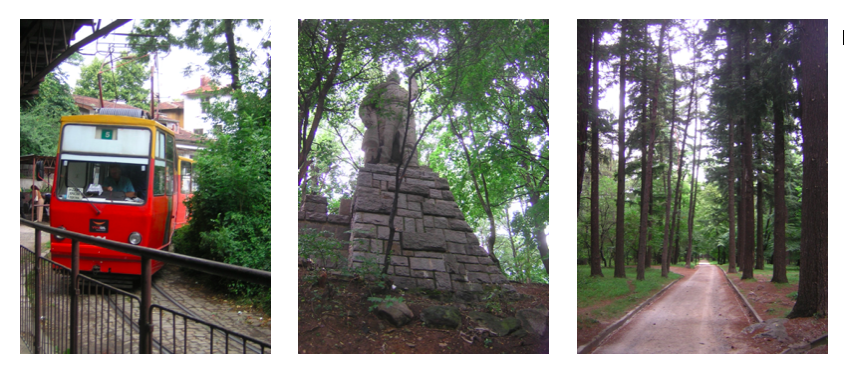
We took tram no 5 — which had a poster on the side advertising Marks and Spencer, which was opening soon — right to the end of the line.
After stopping for another coffee and a weird wet pastry, we walked up steps into the forest park. It was cooler under the trees and there was a lovely piney smell. We could hear the toots of trams and faint traffic sounds from down in the city.
We passed statue of a man in a greatcoat holding a gun. A damp log bridge took us over a small stream full of litter. Dotted among the trees were a few houses.
While some passed, we were the only people on foot until we saw a man walking towards us. He was tall, wearing jeans and a blue and white t-shirt. We thought at first he was rearranging his bits. Then we realised this was very protracted and vigorous.
“Is he…?”
“Yes, he’s having a w**k.”
My friend — who is braver than I am — wanted to go past him up the hill to continue our walk, but I was too scared. We veered off the path and walked away downhill. He was shouting after us in Bulgarian, and we heard his footfalls speeding up to a run. Just as we broke into a run too, we saw a car coming towards us and when we looked back he had disappeared.
Tour of the Balkans
Sofia was the second stop in our five-country tour of the Balkans. Read about the rest of the trip here:
Late 20s angst and a tour of the Balkans
Bucharest changed almost beyond recognition in nine years
Delving into the recent past in Belgrade
 Steppe in Style
Leave a comment