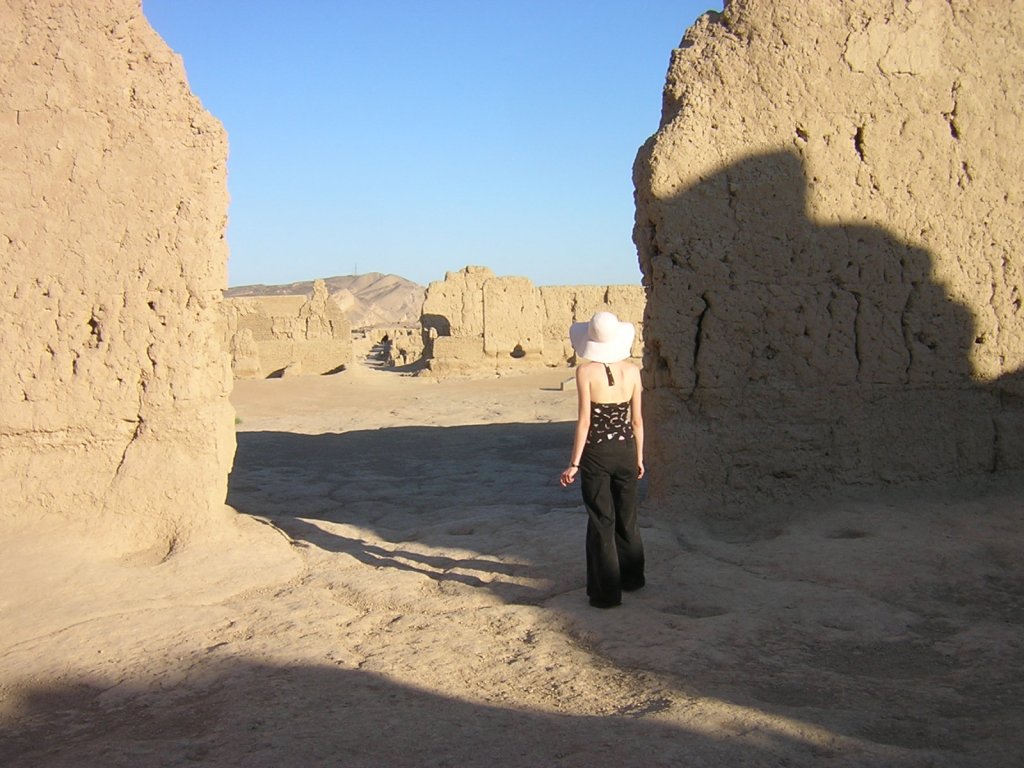
The next day we hire a car and go first to the other ruined city in the oasis, Gaochang. We arranged a car through the hotel that for $10 will also take us to the Flaming Mountains, the Astana Tombs and the Bezilik Caves. This time we leave in the heat of the afternoon in order to fit everything in.
Gaochang is further than Jiaohe, some 30 miles from the centre of Turpan, so to stop us getting bored, the driver pulls down the shade thing above the front passenger seat. Instead of a mirror, there’s a tiny screen on its underside. The driver fiddles with the radio, and a second later the car is filled with Uighur music and garlanded Uighur women in traditional dress appear on the screen.
“Wow!” I exclaim.
The driver shrugs, as if it’s no big deal, and says a long sentence in Chinese in the middle of which I think I hear ‘MP3 player’. He says something else, and hands back a CD case full of films we can watch on the miniature TV screen. Then we arrive at Gaochang.
After paying their entrance fees, all the Chinese visitors are being loaded onto open-sided donkey carts and jolted round the city’s roadways. It looks very uncomfortable. We slip off down a side path and find ourselves pursued by small Chinese boys.
No to the donkey taxi
“Donkey taxi! One dollar! Donkey taxi!”
“NO donkey taxi!” I say firmly. They give up and run back to the next batch of sightseers. We find ourselves wandering almost alone through the ruined city, occasionally passing a crowded donkey taxi when we near what seems to have been the main street.
The heat at Gaochang is almost unbearable even under a shady hat and F40 sunscreen. I can feel the sun beating down through my cotton top and trousers, and scorching the skin on my arms. The plastic soles of my flip-flops start to melt and stick to the sand and stones underfoot.
Built in the first century BC, Gaochang used to be a garrison town and later, like Jiaohe, became a key point along the Silk Road. By the seventh century it held sway over 21 other towns, and had many Buddhist monasteries and temples. In the ninth century, the Uighurs established the Kharakhoja Kingdom here, and Manicheamism flourished. The city was burnt down around the 14th Century, during a period of warfare lasting forty years.
The ruins originally consisted of three parts: the inner and outer cities, and a palace complex. The outer city was 3.4 miles long, with 11.5 metre high and 12 metre thick enclosure walls. Some sections of the tamped earth were reinforced with adobe. Nine city gates were built on cardinal points, three in the south and two each to the north, east and west. We entered through one of the western gates, which is the best preserved.
Preserved in death
The most touching thing we see is the mummies preserved in tombs in the desert, and in the Turpan museum. We go from Gaochang to the Astana Tombs (Astana means ‘capital’ in Uighur as well as in Kazakh), where the imperial dead of Gaochang and noble officials were buried.
A steep narrow passage leads 10 metres down into a small dark chamber where the corpses lie. The dried corpses remain complete and intact, more so, a notice says, than the Egyptian mummies.
The climate here is an extreme one. Although it regularly reaches 40°C in summer, temperatures plummet at night, and it is freezing in winter. Bodies buried in the sandy desert (most likely in winter) froze and dried out before they could begin to rot. The high salt content of the soil speeded up the drying process, since the salt sucked the water from the atmosphere. By the time summer came, the bodies had mummified. Because they were already dry, they did not deteriorate in the summer heat. Other bodies, probably those buried in summer, became skeletons.
Yesterday we saw the ones they have extracted to lie in glass cases in the museum in Turpan. They were brought here from the Tarim basin around the towns of Cherchen and Loulan, the driest, saltiest part of Central Asia, where the climate allowed some to be preserved for as long as 4,000 years.
They are so well preserved we could see the weave of their clothes and the pattern of their knitted scarves. They have mummified differently. Some have skin that has rubberised, dark mahogany coloured, and merging seamlessly with their clothes.
A 4,000 year old tragedy
Others are as fragile looking as burning paper the instant before it disintegrates into ash. Their cheeks have started to crumble, revealing the teeth and jawbones within. Yet they are still human and moving, especially the tiny mummified baby, a tragedy that happened 4,000 years ago.
Some have lost part of their clothes, or the fabric has fused into their skin, and the museum curators have draped velvet to cover them from their stomachs down to their knees, to protect their modesty.
After the Astana Tombs, we drive on through a valley of pink sand and hills of rolling pink rock. It is completely desolate of any sign of life. This is where we’re expecting to see the ancient cave paintings in the Bezilik Thousand Buddha Caves, but we’re dropped instead at a bizarre hillside theme park, where lots of Chinese tour groups in blue baseball caps are being shouted at through a megaphone.
Unfamiliar territory
It’s then that I realise it would take far, far longer than the week we have allocated to get to grips even with this small corner of Western China.
There are many similarities between Xinjiang and the Central Asian republics – both are Islamic, both have a Turkic language and culture, and both were colonised and became part of Communist states. Bishkek was an obscure regional capital in a totalitarian state, just as Urumchi is today, yet because one became Chinese and the other Russian, they have developed in completely different directions.
 Steppe in Style
Leave a comment