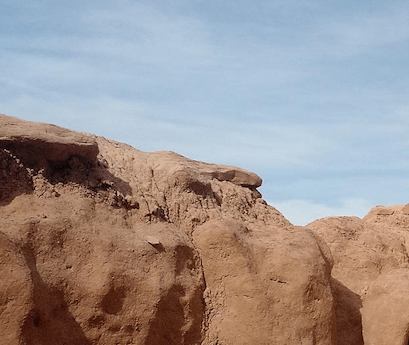
Eight miles west of Turpan, still in the oasis, is the ancient ruined city of Jiaohe. It is in the confluence of two rivers (Jiaohe means ‘the city of joining rivers’) and surrounded by greenery. Yet the city itself is nothing but golden sand and ruined sandy walls.
Screened by precipitous cliffs, Jiaohe, built on a 20 metre high plateau, is 1,650 metres long and 300 metres wide.
It once used to be the capital of South Cheshi, one of 31 states in western China. In the 8th and 9th centuries it was occupied by Tibetans (Tibet is just to the south of Xinjiang), the destroyed by Mongolian rebellions in the 19th Century.
At one end, the temples, workshops and houses of Jiaohe are still visible, divided by roads and alleys. A road bisecting the city into east and west leads to a grand Buddhist temple. In the southeastern part of the ruined city there used to be office buildings and homes made of bricks and tiles.
Faraway memories
According to a plaque, a half-underground, two-storied complex is supposed to have been the Anxi Military Viceroy’s office. Buildings in Jiaohe were two-storied, and with no windows or doors on the walls facing onto the streets. The gates were hidden in deep lanes. Each house was built half-underground, and caves served as downstairs rooms.
At the far end, past the temple, the city is completely destroyed, walls scorched down into the ground, and little black mounds where houses used to be.
It’s not until we have walked all over the city and are on our way back to the entrance, among the long shadows of the half-ruined walls, that I think of my old flat on the Holloway Road in London. I remember coming home to find a smoking, blackened shell, filled with the charred remains of my possessions. It seems like something that happened a very long time ago.
 Steppe in Style
Leave a comment