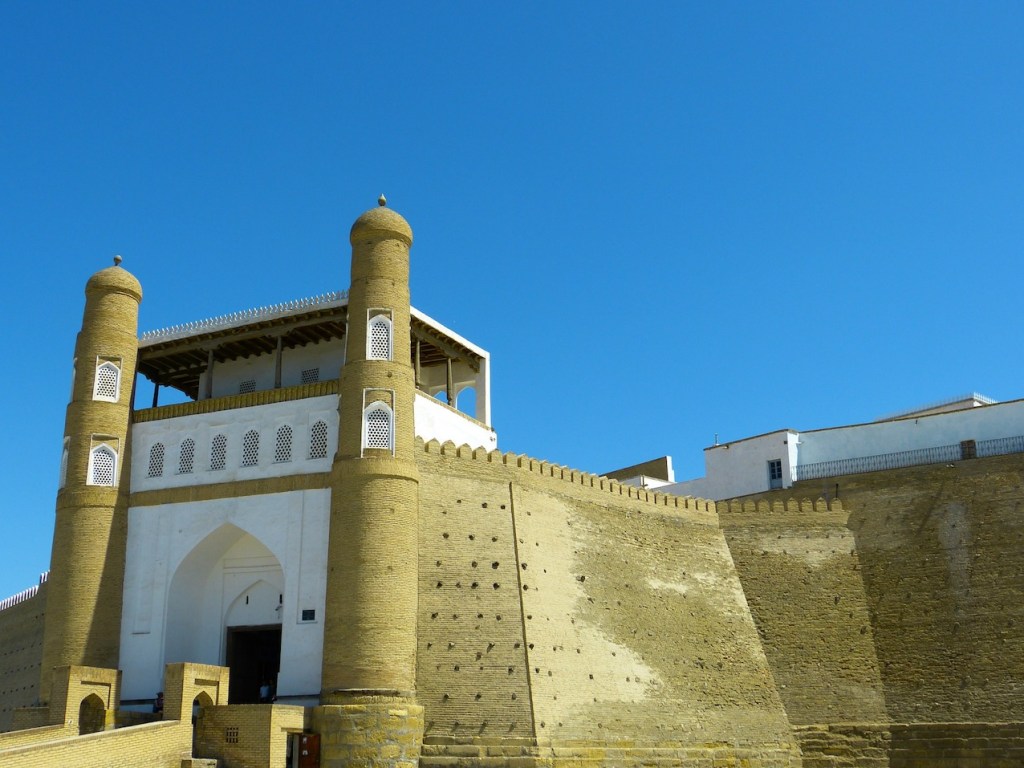
There is something brutal and intimidating about the Registan that is not unlike the communist-era architecture of Tashkent. The former Emir’s palace is in a walled citadel raised on a huge mound above the expanse of dark flagstones.
The square is empty except for a handful of tourists and some small children begging, but it used to be where the Bukharans came to do their shopping and see what was going on. If the chain was off the entrance to the Registan, or Ark, that meant some exciting public spectacle – an execution or perhaps a flogging or some torture – was on that day.
British envoys executed
A large part of the historic British revulsion for the Bukharan emirs stemmed from the execution here of two envoys, Colonel Charles Stoddart and Captain Arthur Conolly, in 1842, when Britain was vying with Russia for influence in Central Asia.
Colonel Stoddart had had been sent here three years before on a mission to reassure Emir Nasrullah Khan that the British invasion of Afghanistan was not a threat to Bukhara. Stoddart managed to insult the megalomaniac Emir by riding rather than walking to the Registan, and arriving with no gifts and with a letter from the governor general of India instead of Queen Victoria. Stoddart was thrown into the notorious ‘bug pit’, a gaol behind the Registan full of rodents and insects.
When Conolly arrived to try and obtain Stoddart’s release, the Emir assumed he was part of a British plot with Khiva and Kokand, and threw him into gaol as well. Meanwhile, the British invasion of Afghanistan ended in disaster, and on hearing of the retreat from Kabul, the Emir became convinced that Britain was posed no threat to Bukhara, and had no further qualms about executing his prisoners.
Souvenir stalls by the ‘bug pit’
We go past the spot where Stoddart and Conolly were executed, up to the main entrance to the Registan into a sloping tunnel with stone and timber walls. Vendors have set out stalls selling handicrafts, postcards and artefacts on the stone floor. On the walk up there we are accosted by people holding out their wares.
Afraid that we won’t learn much otherwise, we decide to take one of the many guides hustling for custom in the courtyard at the top of the tunnel. She is a middle aged Uzbek woman, with large eyes and full lips, and long brown ringlets.
Straight in front of us is the Bolo Hauz Mosque, the official place of worship of the last Emirs. It’s a tall square building supported on wooden columns, with beams and plaster not unlike a Tudor house.
“First there was a Zoroastrian temple here,” says the guide, referring to the fire-worship that was the religion here before Islam. “The temple burned down, and when the Arabs came they built a mosque here. This one was built in 1718 and is of a Shaybanid design.”
‘You want to buy bracelet?’
Inside, a woman is sitting at a wooden table, knotting a bracelet in coloured wools. A variety of other bracelets are laid out on the table in front of us.
“Woman making traditional bracelet. Look!” says the guide, picking up one of the bracelets and holding it around my wrist. She adds pointedly: “You can buy. You want to buy bracelet?”
“We will look at everything first and then decide if we want to buy,” my mother says.
The guide isn’t quite quick enough to hide her look of annoyance, but she shrugs and leads us outside. Shading our eyes against the sun, we stand on the raised area around the mosque, looking out over the haze and beige roofs of Bukhara and the muddy Zeravshan River that peters out among the salt plains around the city.
The guide draws our attention to the walls encircling the Registan. “Look, this was made with earth, and then dried earth bricks, and then the wall is covered in glazed tiles. You can see where it has been destroyed and then rebuilt.”
3,000 inhabitants
She takes us through to the rooms, now semi-ruined and roofless, where the servants and courtiers used to live. “In the early 20th century, more than 3,000 people lived in the Registan. There were more buildings then – the Emir’s palace, the harem, the throne room, many reception halls and offices.
“There were three treasuries, with separate mints for gold, silver and copper coins. The Bukharans had no paper money until 1917. Most of this was destroyed in 1920, but you can still see the royal quarters, the reception and the coronation room. Through here is the throne room.”
She leads us into an arena between half-ruined stone walls, with some of their rich colours and carvings still intact. At the end is a stone dais with a carved throne, but the roof is entirely gone and above us the sun burns down.
We go from there into an exhibition of artefacts – coins, household tools, clothing, photographs, weapons – from the first days of the Bukharan khanate to the Bolshevik revolution. The guide describes every exhibit in exhausting detail until we are glad to escape at the end of the tour.
 Steppe in Style
Leave a comment