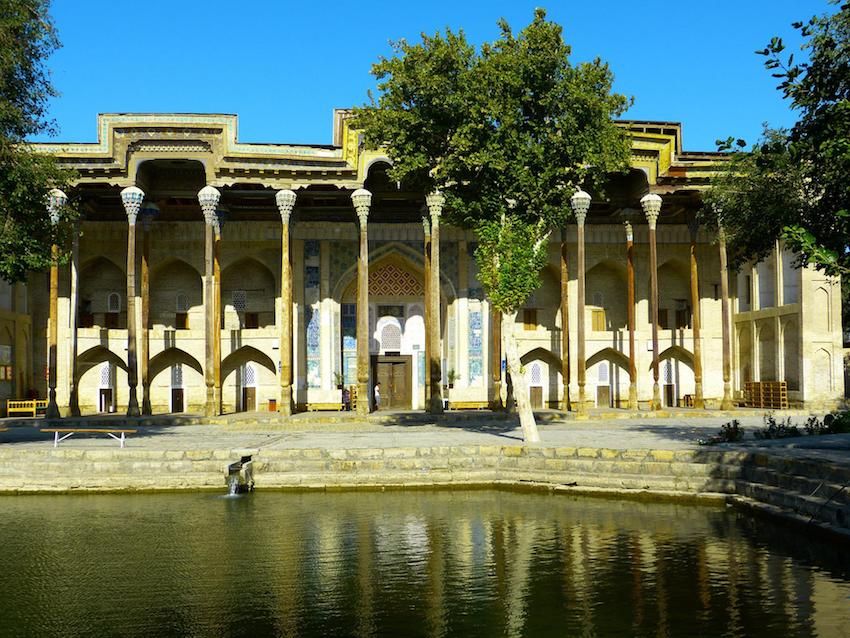
There is little sign in central Bukhara of 150 years of Russian rule. The streets are too narrow for cars here, the people are covered from neck to foot, many of the men wearing cotton skullcaps, and family life is hidden behind the crumbling walls.
Vines cling to the pillars and tiles in the courtyard of the Sasha & Son guesthouse, originally the home of a 16th century Jewish merchant. The walls in our room are covered in delicate carvings and latticework in soft, muted colours, while the bedspreads are woven in rich reds and purples. One pair of French doors opens onto the courtyard, while the other leads to a cool marble bathroom.
Over the last year I have become accustomed to rooms that are functional, if not ugly, and forgotten the pleasure of being in a beautifully decorated house.
Everything about the ancient city of Bukhara is so completely unfamiliar, the intense excitement of travel that I experienced last autumn starts to return. Among Tashkent’s rain-washed concrete blocks and leafy oaks, thoughts of Bishkek were ever-present, but Bukhara is otherworldly.
At the Labi-Hauz
Here, at the heart of the Bukharan oasis, a morning haze is just beginning to lift. We follow the road past mud houses with pastries and soft drinks being sold through their open windows. Almost immediately, it opens out onto a pool of water, some 40 metres square, shaded by gnarled and twisted mulberry trees. This is the Labi-Hauz, one of the public pools where travellers and merchants used to bathe, and flights of stone steps still lead down into the murky water.
Around it are old men with wispy beards and felt hats, hunched over their tea at those traditional Uzbek benches that look like bedsteads with a raised table in the middle, a few backpackers, and Bukharans just passing the time of day.
Two medressas, Islamic academies, face each other across the courtyard. Mosaics of narrow green and blue tiles surround the tall arches over their entrances. Bukhara was once considered to be so holy that light ascended from the city to the sky.
When Samarkand, 200 miles upstream along the Zeravshan River, became the regional seat of power, the ancient city of Bukhara was the centre of religion, science and education. 1,000 years ago there were around 250 medressas here, with students from as far away as Spain and North Africa.
Breakfast at the chaikhana
We sit down at the chaikhana (teahouse) and order some food. After the long train journey, the green tea, yoghurt and fresh vegetable ragout are delicious. It comes with a round flat loaf similar in shape to the lipyoshkas we eat in Bishkek, yet smaller and doughier.
We watch the old men stirring sugar into their glasses of green tea, and the little brown boys who climb up to the highest branches of the mulberry trees then jump yelling into the pool, throwing up a shower of droplets.
We aren’t the only foreigners her; there’s a group of German-speaking backpackers in shorts and t-shirts at the table behind me.
Then comes a sudden, perceptible change in the atmosphere around the pool. A middle-aged American man has arrived at the pool with a young Central Asian woman wearing a tight white shellsuit in semi-sheer material. She has a tiny silver mobile phone dangling from a cord around her neck, and he is carrying an expensive camera. It’s obvious that the Bukharans by the pool disapprove. A silence falls, and conversation does not resume until the couple have left the chaikhana and walked out of sight.
Behind closed doors
This sentiment is not altogether surprising. Islam has always been a much stronger force in the settled areas of Central Asia than among the nomadic Kyrgyz and Kazakhs. In Bishkek, most people are nominally Muslims, but they drink and eat pork and sleep around. Here, it is very different. Even in the last degenerate years of the khanate, before the Soviet revolution, vice took place behind closed doors rather than being paraded in the streets.
This was when a 19th century writer described holy Bukhara as “the most shameless sink of iniquity that I know in the East”. The trade in Russian slaves and the men with their catamites (this remained a touchy subject well into the Soviet years) shocked European visitors, while the government was stifled by bureaucracy and corruption, and half its officials addicted to hashish or opium.
Physically as well as mentally, it would be hard to imagine an unhealthier place. Epidemics of smallpox, cholera, measles and typhoid regularly swept through the city, people died from leprosy, tuberculosis and a host of other ailments. Life expectancy in the 19th century was just 32 years.
Cursed by the rishta worm
Due to the foul water that sat in stagnant pools and canals where people washed and obtained drinking water, in the late 19th century one third of the population suffered from ‘rishta’, a white worm that grew in coils of up to 4 feet long. Some Bukharans had up to 20 worms in their bodies at a time, and Bukharan barbers mastered the skill of unravelling them from under the skin like a ball of wool.
The worms were so difficult to extract that many people had scarred faces from botched attempt, and European travellers might have to return to Bukhara to have them removed, which must have been very inconvenient, even after the railway was built and it took days rather than months to get here.
After seeing the reaction to the American and his girlfriend, I start to feel very self-conscious in my tight Bishkek clothes in the ancient city of Bukhara. I feel the need to get something to cover myself up more, like a big shawl or a loose shirt, so we head off in search of a clothes shop or market.
The other ladies are wearing flowing caftans of embroidered velour in ruby red, mahogany or bottle green, and some are carrying patterned plastic umbrellas to shade themselves from the sun.
Lost in the old town
We walk along the winding alleys of the old town, to where we think there is a bazaar, and after a bit realise we are quite lost among the crumbling mud walls. The July sun burns down on us, as we take shelter in the narrow shadow along one side of the path.
There is a sound of giggling from small Uzbek children peeping round a carved wooden door, baked to the same dusty grey as the path and the walls. A middle aged man in a flowing white robe overtakes us and walks off between the houses, the fabric flapping and billowing in his wake and rousing the dust beneath his feet.
We don’t feel we can ask him for directions, but fortunately we soon meet a young woman, dressed unusually for a Bukharan in a tight red vest and a knee-length denim skirt. She not only knows where we can find a market, but offers to take us part of the way herself.
A modern girl in an old city
I ask her if she thinks it’s a good idea to buy something more covering, and she says this won’t be necessary.
“Bukhara is becoming more modern all the time,” she says. She’s an ethnic Tatar, with a softer, rounder face than the aquiline faces of the Tajiks, but has lived here all her life. Her grandparents were among the Tatars, Chechens and Caucasians that Stalin deported to Central Asia after the Second World War.
Leading us into the wide streets of the Russian town, she explains that the three-storey apartments here are the most comfortable places to live. “Some of the older houses,” she says, gesturing back at the old town, “don’t even have bathrooms. No plumbing at all.
“And look – this is very interesting. This is the sports stadium where recently the inter-university challenge took place, and on Wednesday an important football match was played. No tourists come to this part of the city, but it is really very interesting.”
 Steppe in Style
Leave a comment