I assumed it would be easy to find a working ATM and get cash in Tashkent. I was wrong.
Unlike in Bishkek, where there are six downtown cashpoints and practically every shop and kiosk for two blocks along Soviet Street is a bureau de change, getting cash in Tashkent becomes a day-long challenge for me and my mother.
Until we change some of our dollars into Uzbek sum we can’t buy lunch, or train tickets, or even take one of the shiny Daewoo marshrutkas whizzing about the streets.
We’ve been directed to the station, where there apparently are some bureaux de change.
The closer we get to the station, the less salubrious it becomes, with unfinished flats standing sinisterly by the roadside in a sea of mud. Around the station is the usual crowd of taxi drivers and other loitering men.
Faded grandeur
The bank opposite has the same air of seediness and faded grandeur as the station itself. It seems to be an Imperial Russian building, with marble floors, ornate stucco curlicues and cornices, now flaking paint and plaster. There are several chandeliers hanging from the stained ceiling, each with only one or two bulbs in them.
About seven people are clustered around the foreign exchange kiosk, which looks as out of place as garden shed erected in an imperial salon. There’s no one at the desk, and the people are getting restless. A murmur is going round that the desk will close at one, and there is no sign of movement.
While there is no recognisable queue, everyone is very aware of their position. When a man comes in from outside and tries to push himself ahead of me and my mother, the crowd, led by a middle-aged woman in black, rise up immediately. Despite his protests, he is thrust to the back. Another man then finds a chair for my mother and insists she sits down.
A young Uzbek woman approaches the kiosk. She opens the safe at the back of the kiosk and takes out a stack of bank notes, about a foot high. Finally, a sighting of cash in Tashkent.
A massive stack of cash
No one, she barks at her customers, will be allowed to exchange more than $100 because it’s only half an hour till they close for lunch. At the door, a uniformed security guard is turning people away.
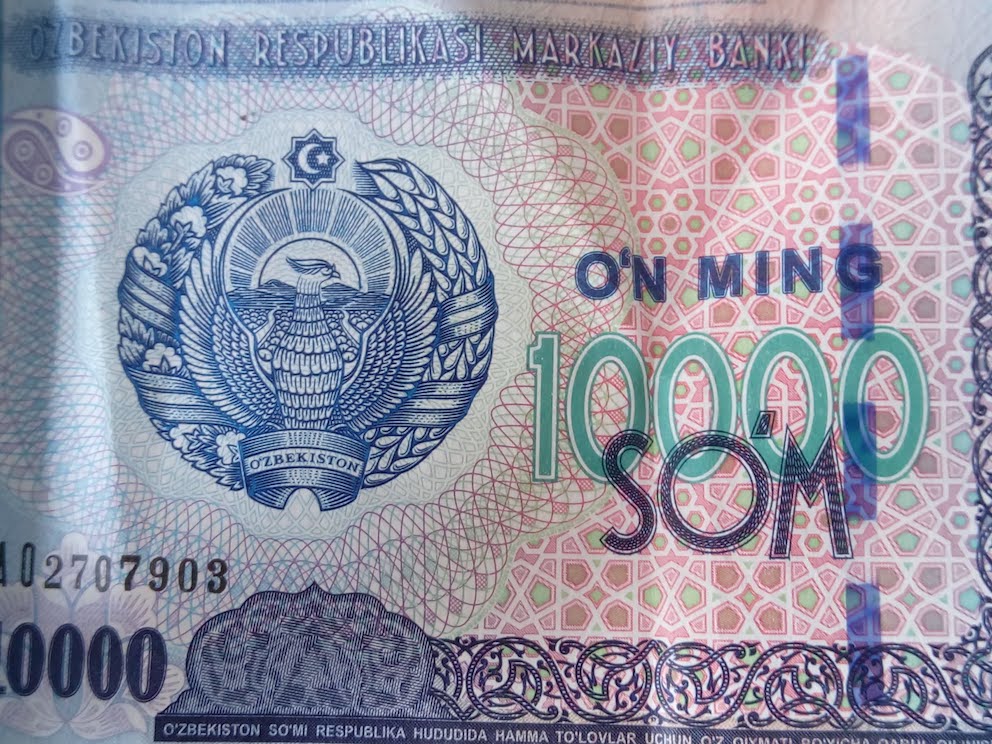
We watch, fascinated, as she puts a wodge of red 500 sum notes into a metal counting machine. They fan out in a crimson arc. The Uzbekistani government spent the 90s fighting to bring inflation under control. It peaked at over a thousand percent in 1994. By 2003 it had dropped to only 3.8%, and the exchange rate is now 1,026 sum to the dollar, nearly 2,000 to the pound.
When our turn comes, my mother fishes out a $100 bill and hands it over. After five minutes of unwrapping, counting and rewrapping of hundreds of banknotes, the cashier hands over 102,600 sum, a bundle slightly larger than a breeze block.
We move out of the way, then just stand and look at it, wondering what to do. Until now, we were concerned about how to keep our money safe, secreting our dollars and credit cards in inner pockets and moneybags. We don’t need a money belt so much as a carrier bag.
Fortunately, I’ve brought my largest handbag, which has already attracted some incredulous stares as it’s the one with the picture of a lady kissing a pet leopard in a diamante collar on the front. This can take about 70,000 sum, while my mother crams the rest into her miniature M&S rucksack. I wonder what people do when they’re having a big night out and only want to take an evening bag.
How to withdraw cash in Tashkent
The 102,600 sum takes care of our immediate needs like buying food and train tickets to Bukhara. Then comes the next challenge: withdrawing enough cash from an ATM for our days in Bukhara and Samarkand.
There appears to be one at the Hotel Metropole by Amur Timor (Tamerlane) underground station, so we head down through a dank shopping arcade into an underground station with wide, high corridors, and marble walls and floors, lit with twinkling glass lanterns.
It’s only a few metres below the ground; the Tashkent metro was started in 1968, just after the earthquake, and its three lines are very shallow to reduce damage from further quakes.
“Is the metro in London like this?” asks a young man, kindly pointing us to the right platform and showing us where we need to get off. Amur Timor is where two of the lines intersect.
“Not really,” we admit, looking up at the crystal chandelier high above our heads.
We emerge from the metro at a grassy crescent around a statue of Tamurlane. Part of President Islam Karimov’s nation-building effort is a glorification of Uzbek history and the promotion of Tamurlane as a national hero, even though he wasn’t strictly speaking Uzbek.
Tamerlane claimed – falsely – to be descended from Genghis Khan, and now Karimov in his turn is using Tamurlane’s reflected glory to unite the Uzbek people behind him.
We circle the statue, avoiding the waterlogged grass, and walk up towards the Hotel Metropole. When we get there, the cashpoint is out of order.
Next stop the Dostyk
“Try the Dostyk,” suggests a bored receptionist. “Maybe you can get a cash advance on your Visa card.” Most of the banks don’t have cashpoints, apparently, and the Dostyk is a fifteen minute walk through the pouring rain.
“We’ve run out of dollars,” says the guy at Dostyk’s small banking section. “Try the Maritime.”
It’s two metro rides and a ten minute walk to the Maritime, which may or may not have a cashpoint. Heavy drops of rain are dancing off the pavements and falling with an audible ping on my head.
I have a sudden, extravagant thought. “Maybe we should take a taxi?” I suggest daringly, walking over to the first car in the line of Daewoos outside the Dostyk, and lean into the window to talk to the driver.
“How much does he want us to pay?” asks my mother.
“About 80p.”
She blinks. “And how much are you offering?”
“Uh. About 60p.”
“It’s raining. I’m tired and hungry. You’re arguing over 20p?”
I remember when I used to feel like this, and used to go to the Europa Supermarket and buy imported pasta and biscuits for more than I now spend on a week’s groceries. Part of me wants to protest that we should hold out for a lower price, but we do need to get some money out, because if it’s this much hassle in the capital, who knows what it’s going to be like in Samarkand or Bukhara.
Tashkent from a taxi
Driving through the soaked streets in our quest for cash in Tashkent, I try to see something of the city other than the inside of a bank or upmarket hotel. This is the 2,000 year old Silk Road city wiped out by Genghis Khan in the 13th Century, revived by Tamerlane, and taken by the Russians in their conquest of Transoxiana. It began as ‘Ming-Uruk’, meaning ‘Thousand Apricot Trees’, later taking its current name ‘Toshkent’, the ‘City of Stone’. But after the 1966 earthquake this part of town is all offices, hotels and plate glass shop windows, some of them set behind a bank of shrubbery. It looks a bit like Basingstoke.
“Try the Intercontinental,” they say at the Maritime. “We can’t get a connection with your bank.”
“Visa machine broken. Only MasterCard,” they say at the Intercontinental. We fan our credit cards out on the table. All of them are Visa. “Try the Sheraton.”
At the Sheraton we finally manage to withdraw enough cash to keep us (we hope) for the next week. We celebrate with a cappuccino and a cheese sandwich in the lobby. So far, all we have seen of Tashkent is the inside of several taxis and various hotels, and we’re leaving for Bukhara tomorrow night.
 Steppe in Style
Leave a comment