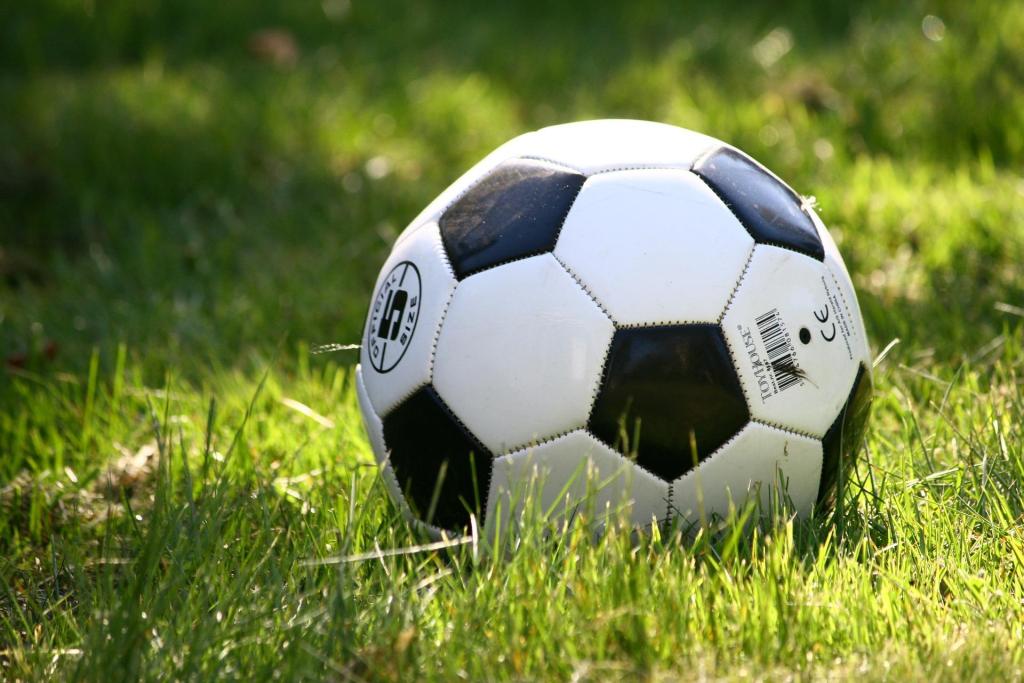
It’s a beautiful spring day. The last traces of ice have melted from the roadsides and tiny shoots of new grass are peeping through the mud in the Kyrgyz Football Federation’s garden. I’m here for a press conference ahead of Kyrgyzstan’s World Cup qualifier against Tajikistan.
“Football?” asked my editor, when I told her about the match. “Why you want go?”
“Because it will be interesting. It’s the World Cup qualifying match against Tajikistan. Do you think I need to book tickets in advance?” I press her. “Do you think I should call the Kyrgyz Football Federation or something?” I’ve looked them up on the Internet.
My editor shrugs and says that she doesn’t think it will be difficult to get a ticket because no one will go. As for the Kyrgyz Football Federation, why not speak to the newspaper’s translator who knows their press secretary.
The translator and I are standing outside this ordinary looking villa in the suburbs with two plastic models of footballs mounted on the gateposts. We follow three bulky looking sports journalists into a meeting room that’s done out in stripped pine and MFI style furniture, where we are soon joined by the press secretary and two other men.
Meeting Kyrgyzstan’s football bosses
“That is the general manager and I think the other is their head coach Nematjan Zakirov,” whispers the translator.
They’ve got a lot to say about Kyrgyzstan’s World Cup qualifier, but unfortunately I can’t understand any of it. My colleague is meant to be translating for me, but he has a major flaw as an interpreter – he’s too shy to do it in public. I jot down a few numbers that I catch in my reporter’s notebook, but they’re meaningless. Occasionally I turn to him for elucidation:
“Did that guy just say the Tajiks are all fanatics? And what was that about them running out of money?”
“Shh!” hisses the translator, horrified to be the centre of attention. Since I’m the only female in the federation’s building we’ve already come in for quite a few curious stares.
“Well you write it down!”
He makes a few half-hearted dabs at the paper with my biro. “I cannot,” he complains. I have a feeling I’ve insulted him by asking him to take notes when he’s employed as a translator. “They are speaking too fast.”
I’m so annoyed with him that after the press conference I bully him into finding someone for me to talk to. After a lot of prodding he approaches the press secretary, who calls back the general manager and head coach.
Hope over experience
“Are you optimistic about Kyrgyzstan’s World Cup qualifier against Tajikistan?” I ask them.
The general manager says something in a despondent sort of way.
“He says, yes, he is optimistic,” my colleague translates. “But he thinks it will be difficult because Tajikistan has more experience than us. They have played 15 international games.” Until 1991 there was a single international team for the Soviet Union.
“Has Kyrgyzstan played Tajikistan many times before?”
This time the head coach, a younger, tracksuited man, answers: “We lost 3:1 to them in the Asian Games, when we also lost to Oman and Iraq.”
“I think they said during the press conference that they have some problems with financing,” I say to my colleague. “Can you ask them about that?”
“It is very difficult,” admits the general manager. “We receive all the financing for these matches from FIFA. Our sponsor is the company Nasha Piva (that is ‘our beer’ in English). They have provided us with $12,000, which will be paid as a bonus to our players if they win, but if the team loses it will be spent on football development in Kyrgyzstan.”
“Is football very popular in Kyrgyzstan?”
“In Kyrgyzstan, like the whole world, football is the favourite game,” says the head coach, leaning forward and speaking earnestly. “The stadium will be full on Wednesday – there will be 20,000 people!”
Crowds gather for Kyrgyzstan’s World Cup qualifier
Neither my editor nor the Kyrgyz Football Federation’s head coach are right about the attendance. After the translator and I have pushed our way through crowds of men swarming round the Spartak Stadium with their leather jackets and brown bottles of beer, we see that just over half of the blue and yellow plastic seats are full.
All around us is the low hum of male conversation. But behind that there I can hear the birds singing and marshrutkas tooting their horns in the city centre. Outside, there are ticket touts, and men crouched on the pavement selling beer from plastic crates, and more vendors with wooden tables full of cigarettes and chewing gum and sunflower seeds that they scoop into cones made from old newspapers.
The crowds were being held back by mounted police, but there was no violence, no shouting, no drunkenness.
“Are you excited?” I ask the translator.
“No.”
“But it’s your national team!”
“No, I am Korean.”
“But you’ve always lived in Kyrgyzstan, and it’s still an international match,” I wheedle. “Tell me something about the team – who are your best players? Wouldn’t be great if Kyrgyzstan win!”
“Everyone supports Russia”
The translator is looking at me like I’m from another planet. “They will lose. They always lose,” he says. “Everyone in Kyrgyzstan supports Russia.”
“Oh.” My enthusiasm’s dampened, and we sit in silence for a while.
“There’s a lot of police outside,” I say eventually. “Are they expecting a lot of hooliganism?”
“This is not England,” the translator says crushingly.
The press enclosure is right next to the tunnel and in front of the glass-fronted VIP box. When the players run out I see that both teams, apart from the odd blond Russian player, are small and dark.
“Which ones are the Kyrgyz team?” I ask Evgene.
He doesn’t know, but I see a TV reporter who I know because she’s dating one of the British expats, and she tells me it’s the ones in red. The Tajiks are in an all white strip.
Kyrgyzstan scores!
Much to our surprise and the noisy delight of the crowd, Kyrgyzstan scores in the 10th minute. I’ve got no idea who got the goal, and nor has the translator, so I make him ask a middle aged man in the row behind us.
“Our Valery Berezovsky,” he says. “Where are you from?”
Above us, hundreds of heels are drumming down on the wooden floor of the balcony, and plastic bottles are raining down onto the pitch.
But much to our disappointment Tajikistan equalises half an hour into the game, and they get another goal just after half time. It looks like the unfortunate Kyrgyz players will miss out on their £600 bonuses. In front of us, a hawk nosed Tajik journalist unfurls a huge Tajik flag and brandishes it wildly, obscuring the pitch from us.
Mid-match analysis
“Fascists!” bellows a man in the VIP box.
My informant in the row behind asks the translator a question.
“Arsehole,” replies the translator in English.
“We have eleven arseholes on the pitch,” the man tells me in heavily accented English. The other journalists are getting annoyed that their vision’s being obscured by the flapping Tajik flag.
“They will be drinking champagne in Dushanbe tonight,” says my new friend. “Champagne, wine, beer, vodka, cognac…” and he continues to enumerate all the beverages the Tajiks might celebrate with. The early mood of euphoria after the first goal has melted away.
 Steppe in Style
Leave a comment