If the poverty in Bishkek is sometimes bad, it’s nothing compared to Kyrgyzstan outside the city. I’m not going far, just to the town of Tokmok, which three months ago I attempted to explore, and failed miserably.
This time I’m going with a group of missionaries and charity workers to a hospital in Tokmok — I’m not naming it because I want to describe what it was really like and I promised not to get the doctors into trouble.
We’re on our way to deliver mattresses manufactured by students at a charity project set up to train and employ young school leavers.
Follow the money
In the car, the missionaries and aid workers were all talking about the business or humanitarian aid and how deliveries can be monitored to stop money being siphoned off and supplies sold by the administrators. One says he’s disgusted by all the money going into bank accounts and then disappearing.
“If you want to see a well run project, you’re going to be seeing a project that’s run by a woman,” he says. “Women are what holds this country together.”
I’m trying to take notes but my biro keeps flying off the page as the jeep bounces over potholes and patches of ice. In Tokmok it’s one degree below freezing and the sky is pregnant with snow.
Tokmok in winter
The school is in a street of low whitewashed houses with a dusting of snow on their corrugated roofs. The only colour is from the gables, which are painted a cold, pale blue.
Otherwise, the street is stripped of colour: just white walls, sodden wood, rusted beige and white Ladas covered in snow, and a muddy ground spattered with puddles and patches of ice under the pale sky.
Outside, children are playing French elastic and scissor-paper-stone. A group of boys are throwing handfuls of pebbles into a circle drawn on the icy ground.
“Sheep’s bones,” says one, peering up at us through his thick black fringe.
The students have loaded striped and brightly patterned mattresses, about the size of yoga mats, onto a lorry, and we follow it to the hospital, a few blocks away.
At the hospital
This is another cluster of low buildings with blue doors and gables. Inside, it’s cold and clammy, with an unpleasantly musty smell. I’ve read that a lot of people in Central Asian hospitals catch TB and other diseases.
“The old mattresses are really disgusting,” the head missionary tells me, then turns to the chief doctor. “Hey! Show us some of the old ones.”
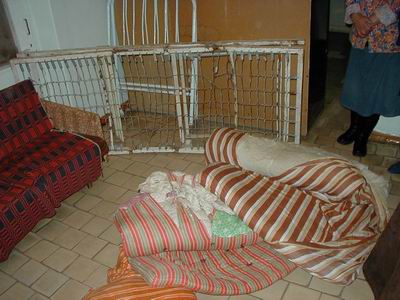
The doctor ,who is wearing a tall white chef style hat, opens a cupboard and some mattresses flop out onto the floor.
They’re torn and stained, with discoloured stuffing poking out of great rents in the fabric. Clearly every effort has been made to preserve them – they’re darned and patched in different patterned fabric – but I don’t want to touch them, let alone lie on them, and I’m not even ill.
“These aren’t bad ones,” says the missionary, poking at the top mattress, which has a thin cover in a print that’s not yet too faded for me to see the brown flower pattern. “Get some of the others.”
Ancient mattresses
The doctor calls to his orderlies to bring out some more, and they disappear down a dank corridor for a minute then return with armfuls more of the limp mattresses.
“How old are they?” I ask.
“He says they’re ten years old,” says the missionary, pointing at the doctor. “But I’ve seen ones that are thirty years old that were in better condition.”
“If you dropped a refrigerator on some of these it would fall straight through,” says one of the aid workers.
Trying to follow our conversation, the doctor becomes agitated and earnestly requests that I don’t say anything really bad about the hospital or he’ll get into trouble.
“He says it’s just the same as all the others outside the capital,” says the translator.
 Steppe in Style
Leave a comment