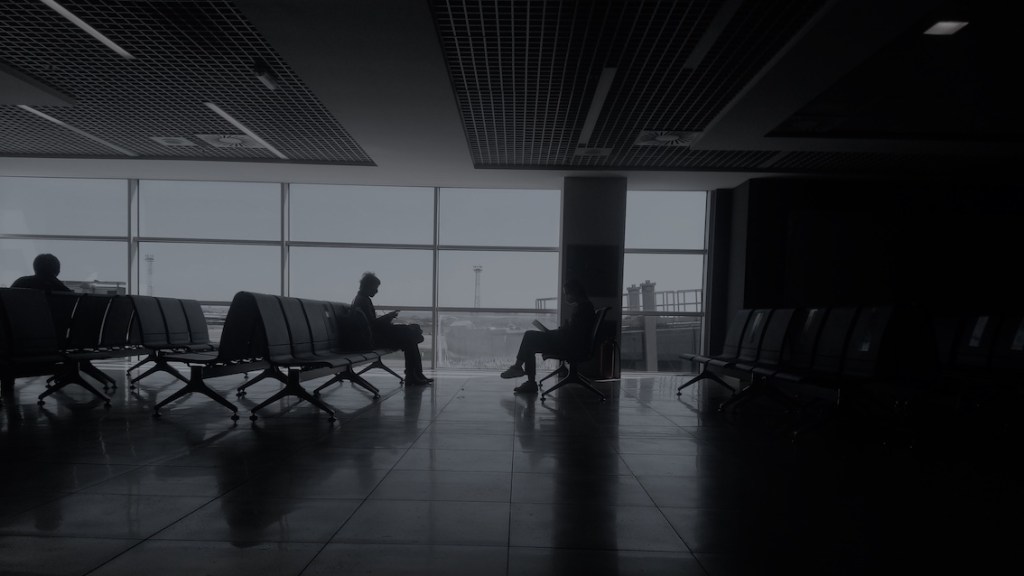
Manas airport isn’t just the Kyrgyz capital’s civilian international airport, since 2001 the US and its partners have used it as a military base for both fighting and humanitarian operations in Afghanistan.
After a brief Christmas and New Year break back home, I was flying into Istanbul at the beginning of January, where I’d meet up with my flatmate and her boyfriend, and we would all continue to Bishkek.
On the way back to Bishkek, I start to question what I was doing. I’d had a great ten days in England. Do I really want to be wading through icy slush to haggle for a tin of Hungarian peas in Osh Bazaar when I could be earning lots of money in London and eating out at nice restaurants and going to the latest films and exhibitions?
But I want to stay in Bishkek until the city wakes from its winter torpor. I want to see more of Kygyzstan, and maybe even experience the romance some of my friends have found in the city.
Friends at the airport
When I arrive at Istanbul, I find that the flight on to Bishkek’s Manas airport is delayed by five hours. I’m wheeling my trolley crossly through the airport, wondering if I could afford to buy anything nice in the duty free shops, when I hear my name being shouted and my flatmate running over to say hello.
“Come and meet my boyfriend!” she exclaims, taking one handle of my trolley and dragging it over to the bar.
He’s sitting in the airport bar, where we see another English expat friend, who is having a beer with two other guys. We all sit down, grumbling about the delayed flight, and order some more beers.
I get chatting with the young American next to me about his time with the Peace Corps in Turkmenistan. He tells me about the giant posters of the Turkmen president that adorn public buildings across the country. Golden statues of him are dotted around Ashgabat, the most spectacular of which is the 12-metre high revolving image of him atop the triumphal arch in the city’s central square. “The buildings in Ashgabat look amazing, but they’re really just like a film set. If you go round the back there’s nothing there, or just some crappy building like the ones in Bishkek,” he says. “I tried to photograph them, but you wouldn’t want to get on the wrong side of the police in Ashgabat!”
My flatmate is deep in conversation with his friend about human trafficking — a big problem in Kyrgyzstan, while at the other end of the table her boyfriend is chatting to our expat friend. By the time our flight is called the table is covered in empty beer bottles, pretzel crumbs and crumpled cigarette packets.
Mystery delay at Manas airport
In Ataturk airport we were told that the flight was being delayed because of “snow on the ground”. When we arrive in Bishkek another five hours later, a grey dawn is breaking but there is hardly any snow, just little patches of ice in the roadside ditches and in the shadows the sun doesn’t reach.
In the back of the taxi, our English friend is peering round the edge of the suitcases piled on his knees, squinting at the US warplanes lined up beside the runway.
“That wasn’t snow,” he says. “The reason we couldn’t come in was that something was going on in Afghanistan and they needed the runway for that.”
Manas airport, built for Soviet bombers, has a 13,800 foot runway and is 1,500 kilometres from Kandahar, a three hour flight. The US base here, opened in December 2001 as part of Operation Enduring Freedom, was named after Peter J. Ganci Jr., the chief of the New York City Fire Department who died in the World Trade Centre on September 11. At the moment, there’s around 2,000 troops here from the US and various other countries.
Midwinter blues
When we arrived at Manas airport, my flatmate wanted to show her boyfriend how things work here and haggled mercilessly to get us a taxi, beating them down to 250 som. The taxi drivers retaliated by walking us over to the far corner of the parking lot and giving us the tiniest most decrepit taxi they could find, with the worst driver.
Even pinned to the seat under my suitcase, every time we go over a pothole I bounce upwards coming down with a painful thud on the seat’s broken springs. The driver who looks like he’s falling asleep over the wheel which, I notice, appears to be held in place with sellotape. A gaping void festooned with loose wires marks where the radio once was. The windows are pitted with cracks, notably a head shaped patch of broken glass on the windscreen ahead of the front passenger seat where I’m sitting.
As we draw closer to the city, the forlorn wooden cottages give way to blocks of flats and then the shops and offices of Chui Prospect. “New Year” is spray painted in shop windows or spelled out in letters cut from coloured paper. Small faded banners advertising “Beta Tea” and “Merry Christmas from Mobicard” are strung between the trees’ leafless branches. They flutter sadly against the pale sky.
 Steppe in Style
Leave a comment