One morning in October I slung some clothes into my rucksack and crept down the stairs outside into the courtyard, careful not to wake my neighbours to meet my Italian colleague, our local friend and his friend outside TSUM for a trip to Lake Issyk-Kul.
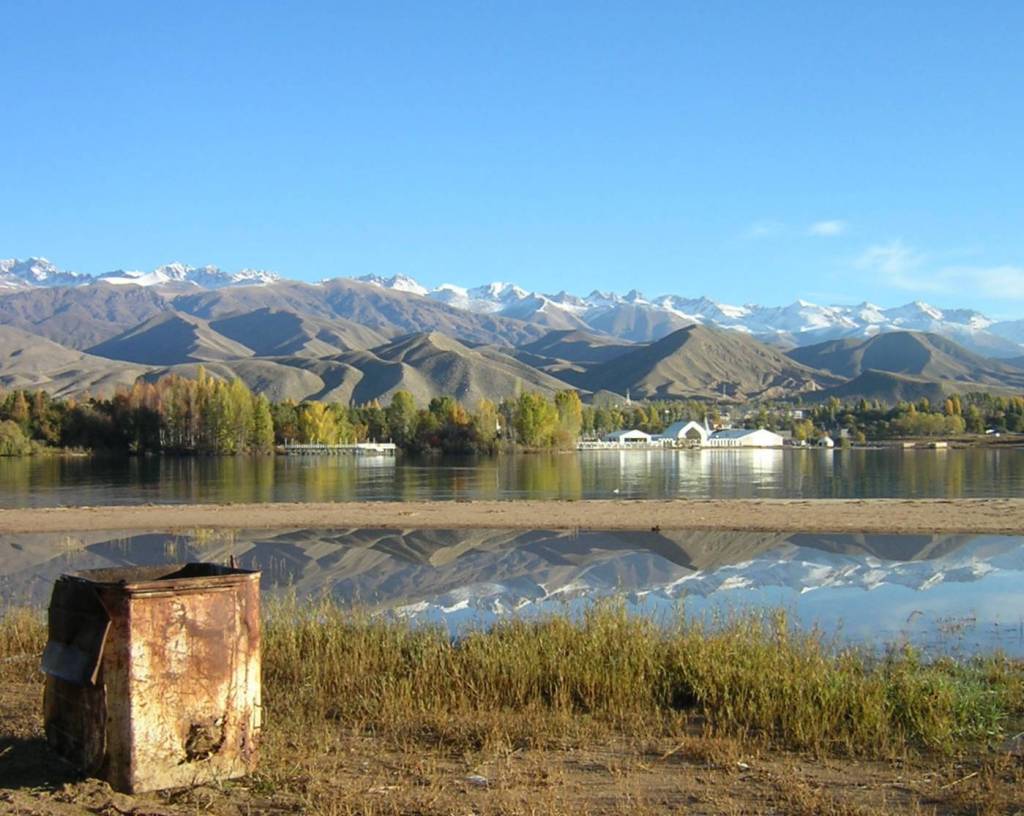
Issyk-Kul is a high mountain lake up in the Tian-Shan mountains. Known as the pearl of the Tian-Shan’s it’s a source of intense pride for most people I’ve met in Kyrgyzstan because of its beauty and cleanliness.
“Those are ex-tra-or-din-ary shoes,” is Uran’s greeting, as he stares at my red patent Ferrogamo trainers.
His friend Sharip is a Dungan, originally from Western China, one of Bishkek’s many ethnic minorities.
“Sharip would like to learn some English,” says Uran, sitting him next to me on the ripped seats of the bus to Issyk-Kul.
English lesson
We move slowly out of the bus station, heading for the road to Tokmok. Sharip, who currently speaks no English whatsoever, is pointing at things for me to name.
“Car.”
“Market”
“Donkey cart.” As I speak, Sharip notes them down in a little book, asking me to check the spelling of each one. All along the roadside are smouldering piles of dead leaves, with the residents still diligently raking.
It’s very hot with the morning sun streaming through the streaky window, and I was up late drinking with my neighbour, even the lumpy seat feels quite comfortable and the bus’s rocking gait is soothing. I’m feeling drowsy…
I feel a sharp nudge in my shoulder and jerk my head up. Sharip has poked me awake with his biro and is pointing out the window again.
“Tree.” It’s going to be a long five hours.
It’s not until we reach the foothills of the Tien-Shan that the air starts to chill, as we wind upwards between steep slopes and jagged rocks. The hillsides opposite us are dotted with shrubs, their leaves autumn amber, red and brown like multi-coloured parachutes.
We’ve been rolling along a road hacked out beside the raging grey-green Chui river. All along the roadside are statues and woodcarvings. We also pass less attractive monuments: a heap of rubble with a twisted metal pipe sprouting out of it, the shell of a bunker, with concrete crumbling off its metal supports.
Sharip is delighted to see I’m awake.
“Mountain.”
“River.”
Pit stop in Balychny
Issyk-Kul itself lies on a plateau that opens out suddenly between the mountains. We don’t see the streak of intensely blue water, many shades darker than the sky, until we’re almost in Balychny, the industrial town at its western tip.
We have a pit stop at Balychny bus station, where Kyrgyz fisherwomen immediately surround the bus, offering us bunches of herrings, some natural coloured, other cured to a bright yellow. They’re wearing silk headscarves that hold in place visors like fluorescent ducks’ bills but in spite of these their skin is weathered dark brown.
I order a cup of coffee at a kiosk, but by the time it arrives, the water full of sugar and undissolved lumps of ersatz Nescafe burning my fingers through the plastic cup, it’s time to get back on the bus.
Then we’re driving right alongside lake Issyk-Kul. The valley surrounding it is so flat it creates the optical illusion of a lake lapping at the feet of the mountains on its opposite side, though here we’re a good mile away from the foothills.
Lake among the mountains
Over the centuries lake Issyk-Kul’s volume has fluctuated, at one time covering the entire valley, while during the middle ages it was much smaller than today. Remains of Medieval houses have been found more than 20 metres underwater.
I can’t see lake Issyk-Kul very well now because more people pushed onto the bus at Balychny. From my side all I can see is scuffy brown grass stretching to the mountains, punctuated with green oases of cottages and apple orchards.
Women with round cheeks and brightly coloured headscarves, and men in tall felt hats and waistcoats are crammed into the aisle between the seats. When someone’s mobile starts bleeping out the Brigand theme tune there’s a concerted shuffle as at least ten people try to reach into their trouser pockets.
Freedom
The people here are different from in the city. I know that Issyk-Kul and the other high mountain oblasts are the poorer areas of the country, and people barely eke out a living during the winter months, but they seem freer than the office workers and traders in Bishkek. The man next to me has a shiny face burnt to a deep mahogany, and he smiles widely to reveal two gold eye teeth in an otherwise empty mouth.
After the frenzied crush on the bus, the silence of Cholpon-Ata is startling. The four of us stand in the empty street, listening to leaves rustle in the wind, and the distant thunk of a hammer on wood. In spite of the bunting strung along the high street, this is clearly a summer town, abandoned for the winter. All the kiosks – advertising samsi, kebabs, tea – are shut down for the winter.
“We’re not open yet,” says one man, who is retiling his patio.
“What time do you open?” His café looks inviting, and I’m starting to feel peckish.
“In April.”
Most of the holiday homes in Cholpon-Ata have extra rooms let out to paying guests over the summer, and we’re trying to find one that’s still open because a hotel would be too expensive for Uran and Sharip.
They’re trying to remember where they stayed last time they were here, leaping up to look over the high walls that surround every villa between the town centre and the shore.
Finally they disturb a dog whose barking brings out a rotund Kyrgyz lady to see what’s the matter. She’s in the middle of doing up the holiday cabins outside her house, but says we’re welcome to stay there. The price is 100 som each, about £1.50.
My colleague and I put our bags down on the narrow white beds in our cabin. It’s so cold we can see our breath when we exhale and there’s a strong smell of varnish. The inside toilets have been locked up for the winter, but there’s one across the yard.
Don’t steal me!
“Be careful with her!” laughs the friendly Kyrgyz lady, pointing at me. “Someone will steal her and ride away with her across their horse.”
It’s in the provinces, places like Issyk-Kul oblast, that many young Kyrgyz men abduct a girl they’ve got their eye on, take her back to their family and effectively force her to become their wife. Bride stealing is an old Kyrgyz tradition, but anyone who thinks it’s romantic and colourful should bear in mind that at least a quarter of the abducted brides are raped – and that’s just the ones who to admit to it.
The men are modern enough to hire a taxi rather than carrying a girl off over their saddles. But they rely on the old social taboos: the girls’ families often give them no choice but to go through with the marriage after they have spent the night at the man’s house. If they don’t marry they are considered ‘soiled goods’; their families don’t want them back, and they will have great difficulty finding a husband.
Our landlady is joking though. No man would make the mistake of carrying off a Russian girl or a foreigner.
Hungry in Cholpon-Ata
It’s now late afternoon so we head into town to find something to eat. The cinemas and nightclubs are all closed, the café-bars are empty, and in the post office, tiled with blue and white socialist murals in cool blues and whites, the stone bench is too cold to sit on.
At the tiny general store we examine the small white cheeses under a glass case, and buy two lipyoshka breads and some biscuits. I add a bottle of Baltica 3 to our haul. I don’t think I can face spending Saturday night in an icy wooden lean-to full of varnish fumes, walking across the yard to the lavatory, without a drink.
Dark falls quickly in Issyk-Kul, but we decide to walk down to the lake anyway, stumbling together down a tunnel-like avenue. A bluish street lamp at the far end casts an eerie light between the trees. We can’t see the lake, but we can hear it lapping delicately on the beach and smell the mix of salt and pine needles in the air.
A lake of grief
“There is a legend that once this was a kingdom and there was a beautiful princess who wanted to marry a poor man,” begins Uran. “The king was so angry he killed the suitor and locked the princess in a tower. She cried and cried with grief until she drowned the whole kingdom, and that was how Issyk-Kul was created.
“When the wind blows you can hear her weeping.”
The cold drives us indoors so we shut ourselves into the girls’ cabin and lay our goodies on the table. Uran is still garrulous, lecturing us on the education system in Kyrgyzstan.
When I go outside to check out the lavatory, there’s not a sound from anywhere. The moon has risen and is casting a faint shimmer on the black surface of the lake.
Shivering, I go back inside after a minute or two, being careful not to touch the doorjamb on my way in.
Uran is still talking. “…people admire Vladimir Putin because whatever he does, he is a Russian patriot. Our president Akayev is only a patriot for himself.”
Telling jokes
Then we start telling jokes.
“This is a Russian joke,” says Uran. “A plane crashed in the desert, and there was only one man left alive. He needed sex.”
“Sex?” say my colleague and I in unison. “Not food or water? He needed sex?”
“Yes, sex,” was the firm reply from Uran, who has probably never had sex in his life. “So when he saw a deer running through the desert he chased it all day and all night. And then finally he caught up with it, and just nearby there was another plane that had also crashed, and in it was a beautiful blonde woman. So he said to her: ‘As one human being to another, most desperate person, can I ask you a huge favour? Would you hold this deer for me?’
“This joke shows that when a Russian wants something he does not let himself become distracted.”
While we’re laughing, Sharip pulls at Uran’s sleeve, muttering urgently to him in Russian.
Lost in translation
“What? Oh yes, we know another good joke,” continues Uran. “A man went into a restaurant in Spain and the manager brought him a dish, and said, ‘Try this! It is a great local speciality.’ He ate it, and it was delicious, and at the end he said: ‘That was wonderful. How did you make those little dumplings?’ ‘Those weren’t dumplings,’ said the manager. ‘They were the testicles of the bitten ox!’ But they had been so tasty that the man came back again the next day and asked for the same dish. This time the dumplings were smaller, and the man asked: ‘Why were they so small this time?’
“And the manager said… ‘Because they were the waiter’s testicles!’”
“Ok… kay,” say my colleague and I, not really getting it.
“Testicles of the bitten waiter!” yells Uran, and Sharip rolls around on the bed howling with laughter.
At ten o’clock the boys check their watches. “Time for bed!” they say cheerily, and bid us goodnight.
My colleague and I get ready for bed, braving the icy water to do our teeth and wash our faces. I don’t think I’ll get to sleep for hours, but to my surprise I feel myself dropping off. Perhaps the varnish fumes have a narcotic effect.
 Steppe in Style
Leave a comment