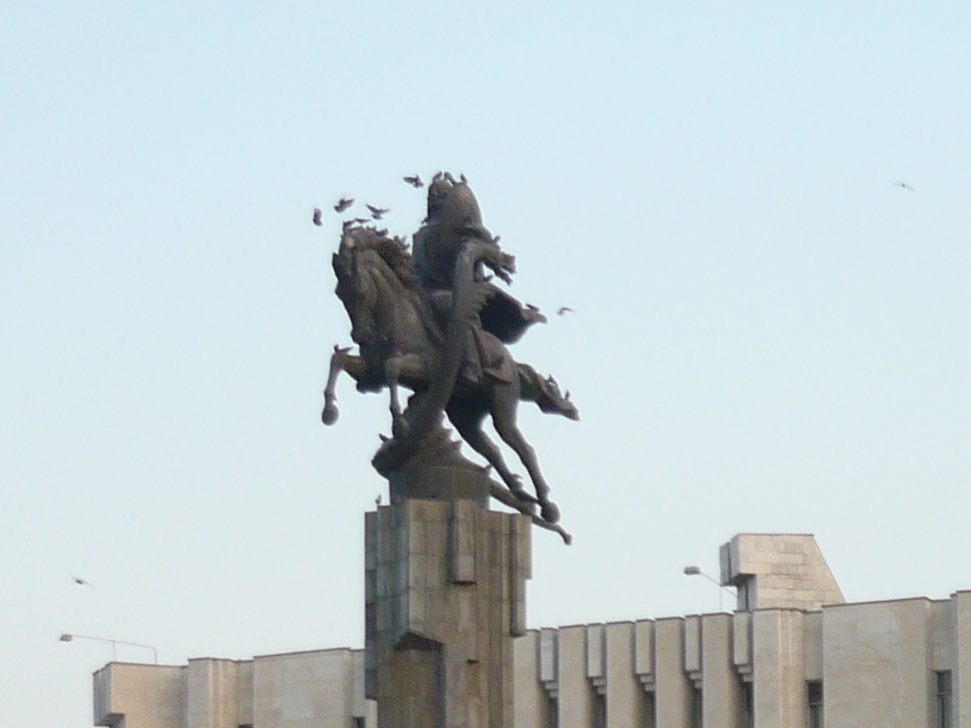
One day I got an unscheduled morning off and decided to visit Manas Village, a newly built tribute to Kyrgyzstan’s national hero, the epic warrior Manas.
That wasn’t the original plan. I was on my way to the Issyk-Kul Hotel in the outskirts of Bishkek where was expecting to attend a round table on drugs control, trying to stem the tide of heroin and marijuana being smuggled north from Afghanistan, through Central Asia and Russia to Europe.
I was a bit late, standing on the corner trying to flag down a marshrutka that might be going in my direction. The sun was low in the sky, and it was chilly standing under the looming shadow of the Philharmonic Hall, while the Manas statue in front glinted in the sun.
The glare in my eyes made it difficult for me to spot the numbers on the front of the buses as they roared past the busy crossroads, let alone the list of destinations, all abbreviated in cryptic Cyrillic, daubed on a small board behind their windscreens.
Marshrutka roulette
Eventually I took a chance on one that was going south. It was so crowded I was afraid that, standing with my head bent under the low roof and pressed into a stout man’s leather jacket, I wasn’t going to be able to see the hotel, but I knew when the bus swerved sharply round to the left that we weren’t going in the right direction.
Then we were crossing the Ala-Archa river and zooming back towards TSUM. I fought my way to the front and shout at the driver to stop. Luckily I realised the hotel couldn’t be far because we had already reached the southern end of the city where white light glints off the sparkling slopes of the mountains. Even more luckily, there was also a row of taxis nearby.
The taxi dropped me outside the hotel, and I raced through the lobby, cramming myself into the tiny lift with two suited delegates.
When I got to the door, the woman there beckoned the press secretary over. I’d had a brief conversation with her when I was arranging to come to the conference that ended with the line going dead. I hadn’t been able to decide if the connection had been broken before we said our goodbyes or if it was simply an example of post-Soviet abruptness.
It turned out to have been the former; she had been just about to tell me that the session was closed to journalists when the line dropped.
How to find Manas Village
Since I had made the effort to get there, I decided to try and find Manas Village, built to commemorate the 1,000 Years of Manas anniversary back in 1997, which I had read about and knew to be nearby.
It was quiet there, on the road to the mountains, though there were people about. Under the trees that lined the road was a carpet of golden leaves being raked up by babushkas as fast as the trees could shed them, and children were crossing the fields from the concrete micro-district in the distance on their way to school.
Manas Village wasn’t covered in my guidebook, and the websites I had searched gave conflicting information, so I wasn’t sure what to expect, but I spied an odd shaped tower off to the left and struck out along a side road.
Ahead, there was a walled compound, the cement topped with red-painted turrets and flying aluminium pennants. I pushed open some wrought iron gates and went cautiously in. A flat arena about the size of a football pitch opened out in front of me. It was strewn with rock patterns, and curling walls, and at the opposite end was a huge concrete mound.
There was no sound but the chirrup of birds and the faint crackle of Russian pop from a tinny overhead speaker. Two uniformed soldiers stepped out of a guardhouse by the gate, and I took a step back. I suddenly realised how alone I was there.
“Ten som,” said the taller soldier, stepping towards me.
Fumbling, I handed it over, and was greatly relieved when he called out and a young Kyrgyz woman in a sparkly jumper emerged from the hut.
A tour of Manas Village
She started pointing things out to me, speaking rapidly in Russian. I could make out some of it, enough to understand that everything in Manas Village (which isn’t a village at all, but a monument) symbolises some aspect of Kyrgyz geography or history. The 500,000 line Manas epic, twenty times longer than the Iliad, is not just a record of Manas’ life but until recently it served as a kind of encyclopaedia of Kyrgyz geography, history, legends and customs.
The white walls represent the Ala-Too mountains, surrounding the flat and fertile Chui Valley in the centre. The red stairs are Manas’ splendid horses. The stones with odd markings on them are the ancient carvings on the petroglyphs near Lake Issyk-Kul, represented by the blue painted concrete next to them. The only thing I could compare Manas Village to was Gaudi’s extravagant architecture in Barcelona, but it was a Kyrgyz Gaudi done in paint and concrete, that no one comes to see.
The piece de resistance is the concrete mound, Manas’ yurt where he planned the battles to conquer the territory that is now Kyrgyzstan.
“His yurt had four rooms,” said the guide, Aigul, proudly and the silver threads in her jumper glistened in the sun.
The tower too has metal curlicues and an Art Deco feel. It was chilly inside its steel and concrete stairwell, but even though every week the snow crept a little further down the flanks of the Ala-Too mountains, it was quite hot in the little observation platform at the top. The mountains were so close here it almost seemed as if we could stretch out and touch them, and they were brilliantly white against the cornflower blue sky.
The sights of Bishkek
Next to me, Aigul was pointing out the sights.
“That’s Flamingo World,” she says eagerly, indicating the small zoo. From above it’s just a long, low warehouse.
“That’s micro-district six,” she continues, pointing to concrete towers among the trees to our left. Then she gestures towards a set of huts. “That’s the Free Economic Zone.”
Bishkek’s only really elegant architecture is around the Philharmonic, where the first banks and apartments were put up in Imperial Russian times, then turned into administrative buildings and people’s theatres by the Soviets. But all we can make out in the russet haze of Bishkek is a plume of grey smoke curling out of a solitary chimney.
One third of the city’s factories have closed down now they can’t sell to guaranteed markets in the USSR they’re no longer economically viable. Most of those that are still open operate at a fraction of their former capacity.
 Steppe in Style
Leave a comment