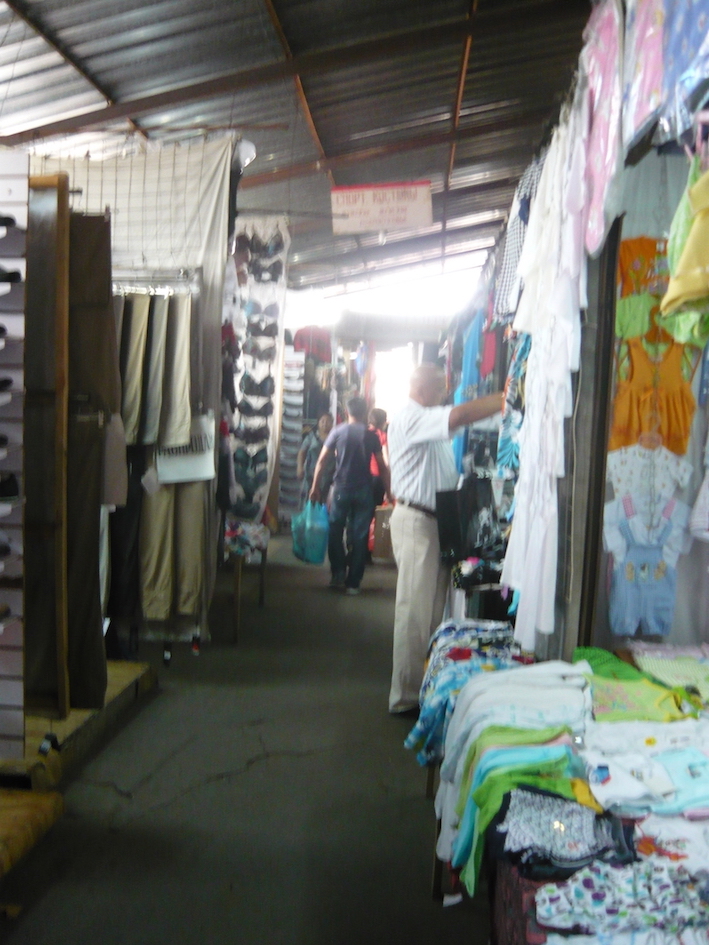
Soviet Frunze has changed back into Bishkek, a stop on the Silk Road. The huge markets – Central Asia’s largest bazaar Dordoi, Osh Bazaar, Alamedin and the others – are flourishing, and the streets and underpasses of the entire city are turning into one great web of commercial activity.
On my first day I saw the stalls all along Soviet Street and the corner around TSUM. Men and women crouch by the road selling their fruit and vegetables; piles of apricots, juicy tomatoes, aubergines and pale green peppers. Then there are kiosks selling newspapers and lottery tickets and girlie mags, little carts with pastries or ‘gamburgers’ sizzling under a grill, and pitiful old ladies selling a single clove of garlic or a bunch of wild flowers.
Bazaar mentality
Even TSUM, the Central Universal Store, is more like a bazaar than a department store. It’s divided into departments; food, cosmetics and photographic equipment on the ground floor; clothes on the second; household goods on the third and tourist souvenirs on the fourth. But each of these departments is sub-divided into many different stalls or kiosks.
Every stall is laden down with wares, a jumble of clothes bulging off over-loaded rails and pinned psychedelically to the walls behind; in the household goods section, fridges and washing machines and vacuum cleaners are piled high on top of each other to the ceiling; and downstairs twenty almost identical photographic stalls compete for custom.
One of my colleagues told me that most people don’t buy their clothes at TSUM or the Turkish boutiques in the city centre because it’s too expensive. They either have a dressmaker or they go out to Dordoi, Central Asia’s largest bazaar. I decide that Dordoi sounds rather exciting, so I take $40 out the cashpoint on Sunday morning and go to stand on the corner outside TSUM where she says the marshrutka, one of the fixed-route minibuses that career dangerously around the city, leaves from.
How to get to Central Asia’s largest bazaar
The first marshrutka to arrive, a big yellow one with ‘Дордой’ written on a board propped against the windscreen, causes a rush of people. Unprepared for this, I get shoved out the way by ten or twelve women, all with dyed hair and bulky plastic bags. Inside, there are people standing in the aisle between the seats, their heads bent over at awkward angles, and a man on a stool by the door taking money.
When the next marshrutka arrives, I’m ready and run to the door before it grinds to a halt. I manage to squeeze into a seat that seems to have been made out of metal bars bent into a bench shape, with a lumpy bit of mattress on top, and bolted to the floor of the van. My knees are hunched up in front of me, and I’m squeezed between a stout Kyrgyz man in a leather jacket and a Russian mother and daughter with buckets of apricots on their laps. I’ve heard there are a lot of accidents involving marshrutkas, and the chairs often get detached from the floor, injuring people, but we are squeezed in so tightly it doesn’t seem there would be anywhere to fall to.
Marshrutka payment etiquette
As we jolt off down the road to Central Asia’s largest bazaar, the other passengers start counting notes out and passing them forward to the driver. They all seem to know exactly how much to pass on. I pull a 20 som out of my bag, wave it hopefully, and it’s snatched away by the Russian mother. The driver has one hand on the steering wheel while the other counts som and makes change. He turns round to shout something at the passengers, and everyone stares at a Kyrgyz youth slumped on the back seat until he reluctantly pulls out some notes. A 10 som note and three ones are passed back and the Russian lady indicates they are for me.
The drama seems to be over, so I turn to look out the window, noticing that this part of Bishkek looks far more third world than anything I have seen so far. Tiny wooden cottages with corrugated iron roofs stand among overgrown gardens the size of allotment plots. All along the roadside people are selling things – heaps of melons or tomatoes, trays of pastries, oily car parts spread out on the ground, clothes draped over fences.
We’re trundling over an unpaved road in a line of cars and marshrutkas, one behind the next. The line veers off to the side, past a field full of half-built cottages and shacks made of wooden planks and tarpaulin. There’s a small mosque with an aluminium dome, its plaster walls looking brand new.
Welcome to Dordoi bazaar
On a rainbow painted arch at the entrance to Central Asia’s largest bazaar are the words ‘Welcome to Dordoi’, and everywhere there are cars and people carrying bags, pulling handcarts, buying, selling, spitting, smoking and shouting.
The driver pulls up among rows and rows of marshrutkas of all shapes and sizes. I’ve heard that a lot of the cars and minibuses here are bought (or stolen) in Germany or Lithuania, and I pass one that still has a poster in the back window advertising ‘Čili Pizza, Gedimino pr. 23, Vilnius’.
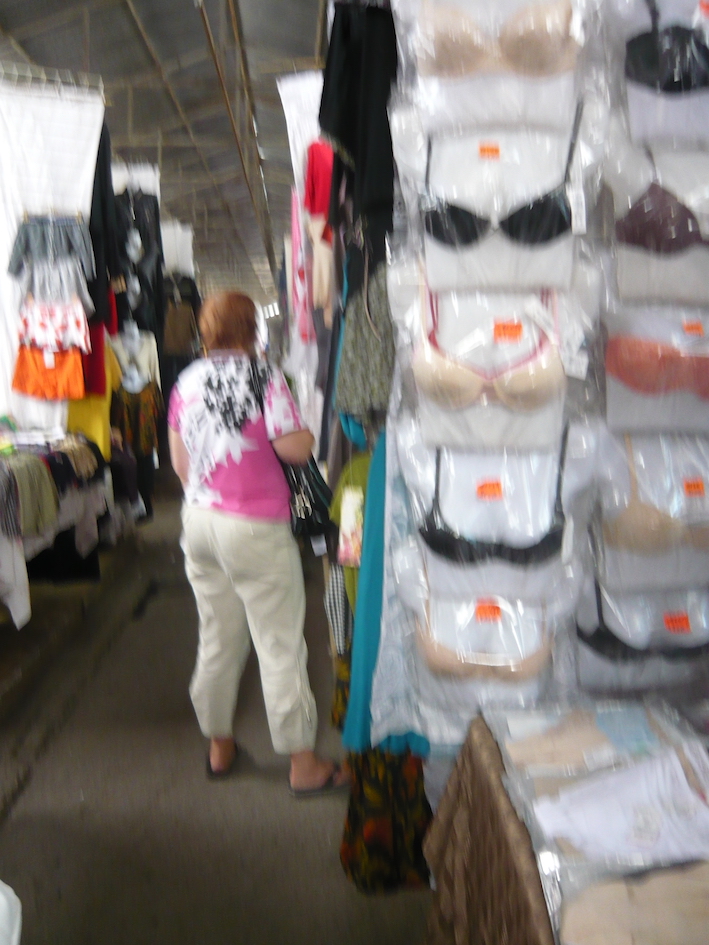
Clutching my bag to my side, I follow the press of people pushing to get into the bazaar. Inside, under the tarpaulin roof that casts a bluish shade onto every face, it’s like a Middle Eastern souk with stall after stall on either side of the alleyways, crammed with merchandise – electrical goods, nail varnish, hair things, cassettes – and then alley after alley of clothes.
Swept along by the tide of shoppers, I am pushed past bulging bales of scarves, t-shirts dangling from their hangers, and men pulling carts along the narrow lanes. When it starts to seem like the rows of clothing stalls will go on for ever, I suddenly emerge into daylight, and see ten or more stores full of black rubber galoshes pegged onto clotheslines, interspersed with people selling radios and headphones, sunglasses, embroidered velvet coats, wigs, mops, kalpaks, pills from India, DVD players from China, and an old Russian lady with four skinned pigs’ trotters.
 Steppe in Style
Leave a comment