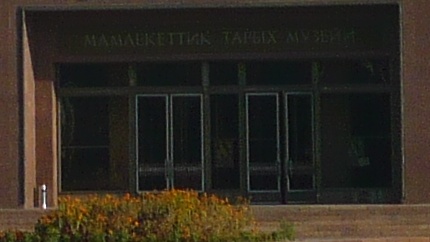
On my first weekend in Bishkek I decide to check out some museums to explore Bishkek’s Soviet past. This takes me to the History Museum behind the Lenin statue on Ala-Too Square, and the Frunze House Museum.
The History Museum is the stone cube on Ala-Too Square that I saw on my first day in Bishkek. The display starts on the first floor, which is obviously all about Bishkek’s Soviet past because it is decorated in red plush with lots of bronze busts of Lenin and various other men that I can’t identify, with red and gold banners propped among the displays. Glass cases contain documents in Russian and framed newspaper articles.
I walk up to the second floor, which by contrast is rather shabby with glass cases containing stones and tools and other bits of metal that look like they were uncovered on an archaeological dig, under peeling white walls. I can hear a steady ping, ping, ping of water dripping through the ceiling into a metal bucket.
In one corner is a yurt, a circular tent made of thick felts and animal hides draped over a wooden frame, like the Mongolian ‘ger’. Back when the Kyrgyz were nomadic people (and many still are), they would carry these around with them, setting up camp in the mountain valleys. I bend down to look through the entrance, surrounded by appliquéd felt, and see stacks of brightly coloured rugs and blankets piled on top of a carved wooden chest.
Frunze House Museum
The Frunze House Museum is, somewhat predictably, on Frunze Street, on the other side of Oak Park. I walk down a lane between the trees among Kyrgyz couples walking arm in arm and children running about. This area, behind the White House, the Kyrgyzstani parliament, is full of large neo-classical buildings, a bit grimy but nonetheless imposing. These are the government offices.
The cottages that used to be here were cleared away long ago – all except one, where Mikhail Vasilievich Frunze, for whom the city was once named, was supposedly born. This is now encased in plate glass walls, below a concrete fresco celebrating Bishkek’s Soviet past.
Frunze’s house is a tiny two-roomed cottage, very prettily preserved with the floorboards shining with polish, the copper pots around the fireplace glowing and the small beds piled high with starched linen.
Upstairs, on the top floor of the museum is an exhibition illustrating Frunze’s life history, starting with the arrival of his father in Bishkek (then known by its pre-Soviet name of ‘Pishpek’), a Russian garrison town. His father, a surgeon’s assistant with the Imperial army, settled in Pishpek and married a Russian laundry-woman.
I struggle to read Russian, but I found out before I came here that Frunze first became involved in revolutionary activity when he was studying at the military academy in Almaty. In May 1905, when he was 20, he led the strike in Ivanovo-Vorenesensk, the city where many of Russia’s textile mills were. After several years in exile, he escaped to Minsk, where he founded a secret Bolshevik organisation, and in October 1917 again led the Ivanovo-Vorenesensk workers to Moscow. He commanded the Red Guards who occupied the Kremlin in the October revolution.
In the civil war that followed the revolution, he led Red forces to defeat Admiral Kolchak in Siberia and General Wrangel in the Caucasus. He returned to Central Asia in 1922, where he again defeated Wrangel’s White forces, and drove the basmachis, Muslim guerrilla fighters, out of the Fergana Valley in the south.
After the war, he returned to Moscow where he quite soon got on the wrong side of Stalin. He survived several mysterious car accidents, but in 1925 he died — again under suspicious circumstances –— during a stomach operation that the Soviet Central Committee had ordered him to have. Bishkek was renamed Frunze the year after his death.
After the information on Bishkek’s Soviet past, the exhibition continues with an account of Bishkek in the 20th century. Again I can understand very little from the captions under the exhibits, but I get an idea of what was going on from the pictures. I seem to be the only visitor, and am pursued from room to room by a lady curator who is trying to give me a guided tour in German despite my protests that I don’t understand her.
She points to the pictures of the city being rebuilt after the civil war, the railway being laid between Bishkek and Almaty, and Kyrgyz workers on collective farms in the Chui Valley.
“Der grosse Toktogul Verdammung,” says the lady and points at a series of pictures of the giant Toktogul dam, in the far west of Kyrgyzstan. From there we move on to pictures of Kyrgyz youths in railway trucks, on their way to defend Moscow in the Second World War. The lady is gesturing and talking rapidly.
“I really don’t speak German,” I tell her in my halting Russian.
After the war, there are new buildings going up in the city centre, cars and schools and more factories. The lady gives me a little speech. I think that’s the end of the tour, so I thank her, and escape into the dazzling sunlight.
 Steppe in Style
Leave a comment