My eventful journey from Almaty ends at the newspaper’s offices in Bishkek, Kyrgyzstan, where I meet the newspaper’s glamorous editorial assistant, who puts me into yet another taxi to my new apartment.
The relief of arriving safely allows me, suddenly, to relax and for the first time in 24 hours I feel sleepy and the streets pass in a tired blur.
Bishkek, or as much as I see of it from the taxi, reminds me of those old BBC sitcoms from the seventies, where the colours of shop signs and advertisements are muted, and everything is a little old-fashioned but not wholly unfamiliar. The people are slightly thinner than they are in England today, and the ladies wear skirts and heels. But in those BBC repeats you don’t see bleached concrete tower blocks reaching towards an intensely blue sky, and dazzling sunlight piercing a thick canopy of oak leaves overhead. Nor are there the yells in Russian and Kyrgyz, or the scream of breaks and rattle of trolleybuses.
My new home in Bishkek
The one-bedroom flat is large by London standards, and overlooks a leafy courtyard where three babushkas in patterned pinafores stare us down as we pass their bench. In a corner of the courtyard where the grass is knee high, is a pale blue wreck of a Lada with weeds twined around its high curved mudshields.
I managed to find out a little bit about Bishkek before I came here, even though Kyrgyzstan, this small mountainous country south of Kazakhstan and west of China, isn’t exactly a popular tourist destination. Most people I spoke to in England had never heard of it. If they had, it was usually because in 2001 the government lent Manas airport in Bishkek to the US and its allies for bombing raids on Afghanistan, some 300 miles to the south.
The new country wasn’t even our atlas, which was printed before 1991 when Kyrgyzstan became independent from the Soviet Union. Previously, it was the Soviet Socialist Republic of Kyrgyzia, which was outlined with a red dotted line, shaped like a V turned on its side. A spur of the Tien-Shan mountain range separates the north, which had a nomadic culture more similar to that of the Kazakh steppes or Mongolia, from the traditional, Islamic south. Bishkek, marked on our map by its old Soviet name of ‘Frunze’, is on the northern edge of the Tien-Shan.
I learned from the Lonely Planet that Bishkek was built less than 130 years ago. Unfortunately the guide was six years old and only had a few pages dealing with Bishkek.
I also discovered, in the School of Oriental and African Studies (SOAS) library, a guide to Frunze, published in the late 1980s. Among the graphs and statistics, it mentioned that Frunze was the greenest city in Central Asia.
I remember sitting in the library, anxiously fingering an inset map of the city centre, with its wide open spaces, pale green trees and roadside ditches, and inhaling the musty smell of pages that hadn’t been opened for a long time.
Now I’m no longer trying to find things out from books and websites; I’m actually here. And rather than cocooning myself in the flat, I have to go out and discover this strange place that is going to be my new home.
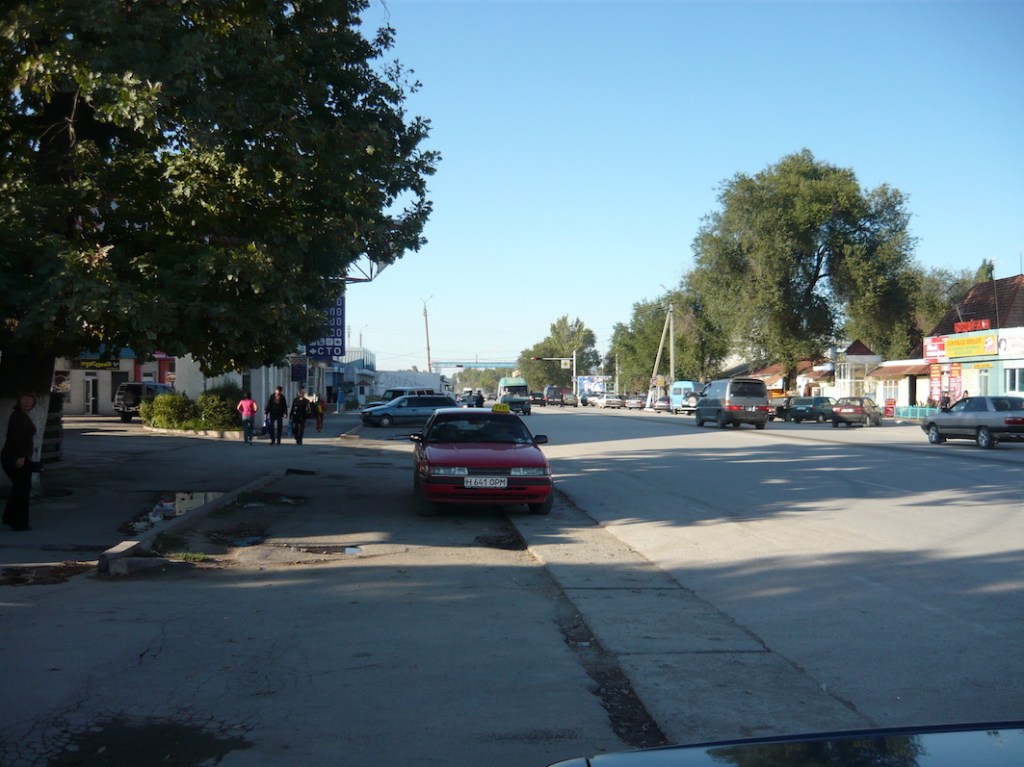
Bishkek, Central Asia’s greenest city
Just like in Almaty, the air outside is oppressively humid. Te sun is sucking up droplets lying on leaves and pavements, leaving dark stains where puddles have formed and then evaporated. There are drainage ditches beside the pavement, fast-moving streams a foot across, gushing and bubbling noisily on either side of the road.
I’ve barely walked ten metres before I feel as if I’ve had a shower with my clothes on. My skin is damp with sweat and condensation and my feet have been washed by the water that spills across the pavements from the overflowing ditches.
Having consulted the Lonely Planet map, I’m walking east and am fairly confident that in a few minutes I will hit Soviet Street, one of the city’s main arteries, that will take me down to TSUM and the central post and telegraph office. Bishkek was built on a grid plan so whatever dangers I may face I’m unlikely to get lost.
But it doesn’t feel as if I’m near the centre of a capital city. Bishkek is an overgrown town, its wide streets thickly lined with trees and grassy verges with rank grass drooping into the ditches.

There are so many trees. Where I’m walking there is one row of trees between the apartment buildings and the pavement, another between the pavement and the irrigation ditch, then another line of trees and a narrow strip of grass, then a fourth row of trees between the grass and the road. The trees aren’t regular; some lean haphazardly over the road or sprout through the pavement, surrounded by cracked concrete. A little way down the road the Kyrgyzstani President, Askar Akayev, beams from a billboard, his big round head and thick half-moon eyebrows topped by a kalpack, the tall felt hat traditionally worn by Kyrgyz men.
No cars pass, although I can hear a roar of traffic behind the tweeting birds and rustle of leaves. The only people in sight are one or two babushkas bent over bulky shopping bags, and a group of men loitering by a kiosk ahead of me. They are smoking and spitting into the ditch. Some have squatted down and curled their bodies into little balls with their feet sticking out below.
Although they have a variety of faces — European and Oriental — all have cropped hair and are wearing acrylic trousers and shirts in dark greys or black. More than 80 nationalities co-exist in Bishkek, the result of centuries of invasion by Turkic and Arabic tribes, Chinese, Mongols and Slavs. There are the Kyrgyz, the Russians and Ukrainians, the Kazakhs and Uzbeks, the Dungans and Uighurs from Western China, the Tajiks who fled their civil war, and all the people deported here under Stalin’s regime – Volga Germans, Koreans, Estonians, and the Chechens, Abkazians and Tatars from the Caucasus.
I cross the road, scrambling over the ditches and cracked curbstones. The buildings here are taller than those on Erkindik Prospect and built in grimy concrete. Some, the tallest 12 story blocks, have ornate concrete arches over their balconies, a superficially different style for each occupant.
The buildings are even higher on Soviet Street, where huge white tower blocks are poised above glass-fronted cafes and shops, interspersed with dozens of bureaux de change. On the pavements Kyrgyz women and old men with straggly beards and kalpacks sit at little wooden tables selling cigarettes, chewing gum and sunflower seeds. Others are selling drinks from plastic barrels covered in blue and white ‘Shoro’ branded cloths.
The traffic is fierce here. Cars grind their gears and toot their horns, squeezing around minibuses, trolleybuses and brand new four wheel drives with red diplomatic number plates.
Empty space
Chui Prospect, which intersects with Soviet Street by the central post office, is much quieter. I walk on, as far as Ala-Too Square, a flat treeless expanse of white stone and tarmac that brings home to me the sheer amount of empty space in Central Asia. Kyrgyzstan, slightly larger than England and Wales put together, has a population of under five million. In next door Kazakhstan 16 million people are spread over two million square kilometres of land — 6.2 people per square kilometre compared to 244 in the UK.
To one side of Ala-Too Square is the Lenin statue, arm outstretched, dwarfing the two young soldiers standing on guard beneath it. Kyrgyzstan is the only one of the post-Soviet republics that has kept a statue of Lenin in its central square. Behind Lenin is the stocky red and white marble slab of the History Museum. On the other side of Chui Prospect, which runs through the middle of the square, are high walls lined with white marble cloisters and topped with gold domes.
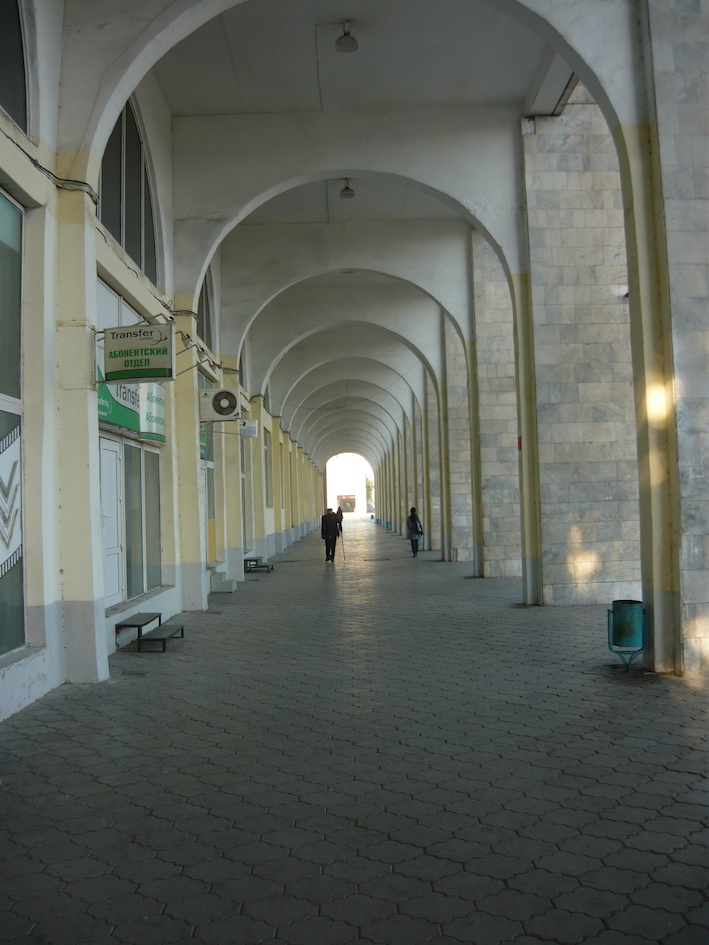
I’d read this impressive façade hides a knitting factory, now closed down. Out of the trees’ shade, the heat and light are relentless, with the sun reflecting off the white marble and glaring through the sparkling fountains where slim children dance and splash in their underwear. I look up and see that the haze has cleared and above the golden domes are snow-capped mountains silhouetted against the stark blue sky.
 Steppe in Style
Leave a comment